ACEMAGIC has quickly established a notable presence in the mini PC market with its distinctive designs. The company offers mini PCs equipped with both Intel and AMD processors, and it has also ventured into the laptop category, primarily targeting business and mainstream consumers.
At Computex 2024, ACEMAGIC unveiled a groundbreaking new laptop, continuing its tradition of innovative designs. The highlight of this release is the world’s first dual-screen laptop that does not require an additional portable keyboard. Previously, similar concepts have been showcased—Razer’s project Valerie in 2017 and ASUS’s Zenbook Duo—but ACEMAGIC’s new laptop offers a truly integrated dual-screen experience.
Other companies like GPD and Lenovo are also entering the dual-screen laptop space with upcoming releases. However, ACEMAGIC’s X1 stands out by fully integrating both screens into a single, cohesive unit.
The ACEMAGIC X1 is not tailored for extreme gaming but rather focuses on a solid, balanced configuration. It is powered by the 12th Gen Intel Core i7-1255U CPU from the Alder Lake-U family. This processor has a total of 10 cores (2 P-Cores and 8 E-Cores) and 12 threads, with a base frequency of 3.50 GHz and a boost up to 4.70 GHz. The CPU has a default TDP of 15W, which can be adjusted down to 12W, and a maximum turbo power of 55W.
Instead of a discrete GPU, the laptop utilizes the integrated Iris Xe graphics engine of the Intel Core i7-1255U, which comes with 96 Execution Units clocked at 1.25 GHz. This iGPU supports multiple display technologies and can handle up to four displays simultaneously, with a maximum resolution of 8K at 60Hz or 4K at 120Hz.
The laptop is equipped with 16GB of DDR4 dual-channel memory, which operates at 2666 MT/s and is user-upgradeable up to 64GB. Storage is provided by a single M.2 2280 SSD slot supporting PCIe 3.0 x2 speeds, and it comes with a 1TB NVMe SSD pre-installed.
In terms of connectivity, the ACEMAGIC X1 offers an array of interfaces, including two USB 3.0 ports (one with display-out functionality), an HDMI 2.0 port (4K at 60Hz), and a USB Type-C port for charging. Wireless connectivity is ensured by WiFi 6 and Bluetooth 5.2. The laptop ships with Windows 11, although the pre-installed version does not come with an activated license.
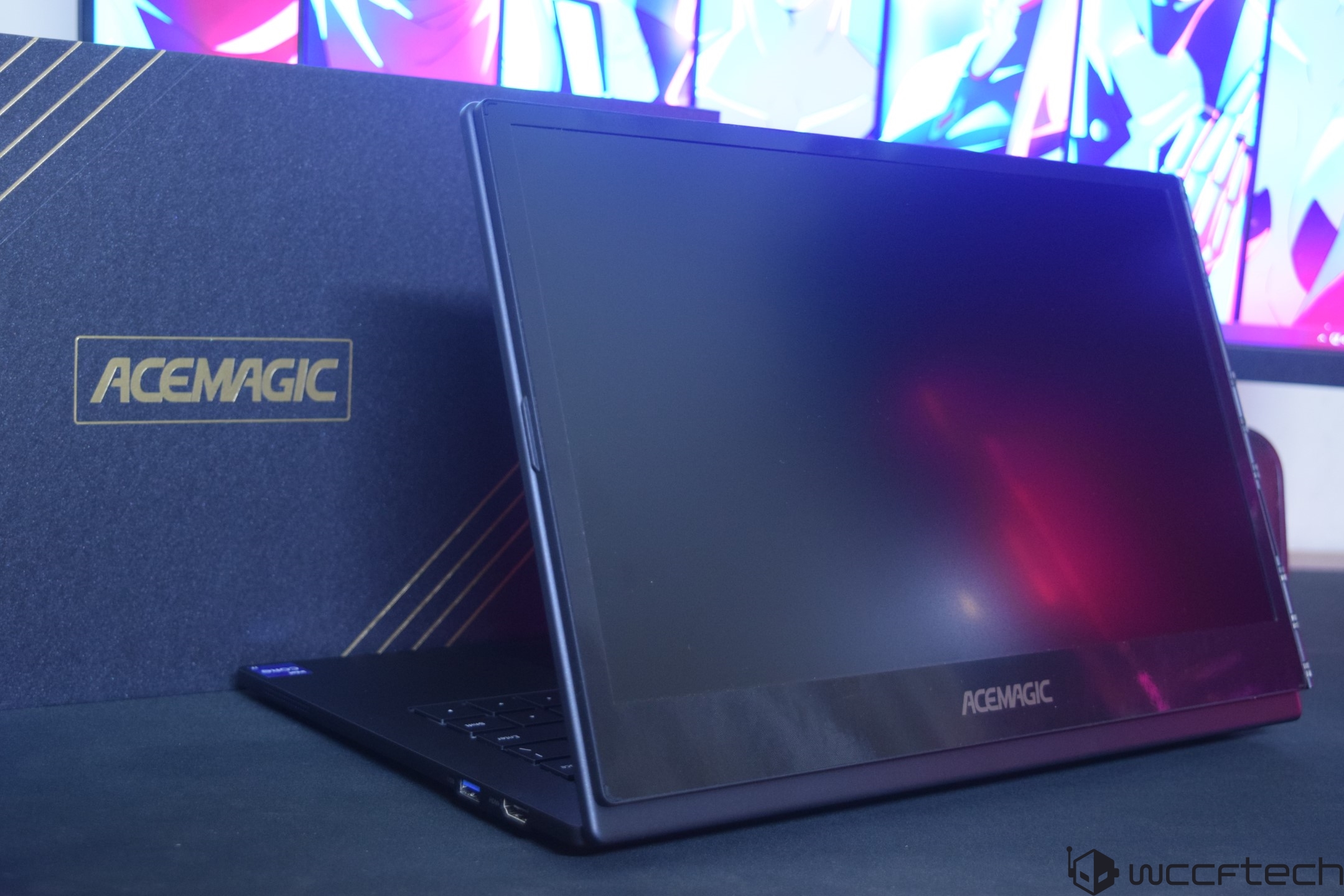
Opening the package reveals a sophisticated black and gold design. The laptop itself sports a sleek matte black finish with a reflective “ACEMAGIC” logo, and it weighs under 2kg (4.27lbs), making it highly portable for a 14-inch laptop. The laptop’s dual 14-inch IPS screens both offer a resolution of 1920 x 1080 and a refresh rate of 60Hz.
The design employs a magnetic cover to secure the secondary screen, which can be folded 360 degrees to the back. The screens are horizontally aligned, and the hinge mechanism allows for easy adjustment without a portable keyboard.
The keyboard and touchpad are standard and support all the typical Windows 11 gesture controls. The keyboard layout is compact, without a numeric keypad. Above the keyboard, five additional keys control the dual-screen functions, allowing users to switch between screens and modes, accompanied by a power button with an integrated fingerprint sensor.
The left side of the laptop houses two USB ports, completing the connectivity options. This dual-screen design represents a significant innovation in the laptop market, offering flexibility and functionality for a variety of user needs.One of the ports on this laptop is a USB 3 type, rated at 5 Gbps, and can function as a DisplayPort (ALT). The second port is dedicated to charging and includes a small LED indicator to show the charging status.
On the other side, there is a standard HDMI 2.0 connector and another USB 3 port with a maximum transfer bandwidth of 5 Gbps.
The keyboard boasts a chiclet design, which makes typing easy. However, the keyboard lacks a backlit feature. The trackpad is large and wide, facilitating smooth use. While it doesn’t have any additional features, it performs well as a basic trackpad without unnecessary frills.
When the second screen is rotated to the back, the laptop transforms into an oversized tablet, offering a unique appearance.
Inside the chassis, there are two blower fans with large vents at the bottom and back for expelling hot air. The laptop doesn’t overheat much due to its less demanding hardware but it’s still good to see a decent cooling solution being implemented.
The matte black exterior of the chassis feels premium and adds to the overall aesthetic appeal of the laptop.
Now, regarding the secondary screen, it turns off as soon as the primary screen is closed. The only way to use the secondary screen when it’s rotated to the back is by tilting the screen like a regular laptop. This allows you to present documents, videos, or files to someone sitting in front of you or use the dual-screen mode for additional workspace.
The two screens can function as one large horizontal display running a single instance of Windows, or in dual-window mode with each screen displaying its own instances.
The design leverages a hinge mechanism commonly seen in foldable smartphones and tablets. However, there are some issues with this implementation. The second screen seems a bit heavy, making it difficult to lock in place. Even a slight breeze can cause the screen to move, which can be inconvenient.
The primary screen has a magnetic cover that includes an infrared sensor and a Full HD webcam. There’s no option to disable the camera, but a piece of paper can be taped over it if privacy is a concern. The plastic cover also provides extra protection to prevent scratches when the second screen is closed, a thoughtful touch by the manufacturer.
A significant missed opportunity is the absence of a touchscreen. The dual-screen design would benefit greatly from touchscreen functionality, but it looks like this feature will have to wait for a future version or revision.
For performance testing, the ACEMAGIC X1 laptop was evaluated using the standard 25W power profile for its Intel Core i7-1255U CPU. The performance was compared to several other devices featuring different Intel and AMD processors at varying power levels.
For gaming, a variety of esports titles and AAA games were tested at 1080p resolution. Performance comparisons included integrated graphics from AMD’s Radeon and Vega series, as well as Intel’s UHD and Iris Xe-LP graphics.The ACEMAGIC X1 is noteworthy for its thermal efficiency and power consumption. Using a 25W power profile, the laptop peaked at around 71 degrees Celsius during synthetic benchmark tests, but generally maintained an average of 55 degrees Celsius, indicating good thermal performance.
In terms of the dual-screen design, ACEMAGIC is venturing beyond its established mini PC territory with the X1. This first attempt at a dual-screen laptop design reflects the company’s ambition to innovate. Performance-wise, the X1 offers standard 12th generation specifications which are decent but not extraordinary. The battery life ranges between 6 to 8 hours during web browsing and standard applications, thanks to its design favoring larger batteries. While capable of lightweight gaming, the settings would need to be on the lower end and resolution down to 720p even for older games. Despite the hardware not being its strongest feature, the laptop’s 1 TB storage and 16 GB of memory are suitable for most office and business applications, and it runs relatively cool.
The dual-screen design aims to enhance the workstation experience. When positioned correctly, the two screens provide a significant visual and functional upgrade. However, the secondary screen’s stability is a concern; it tends to shake, making the user experience somewhat less reliable. Additionally, when using the primary screen, the secondary screen needs to be rotated to the back, leaving it vulnerable to potential damage. Another drawback is the lack of a touchscreen, which could enhance usability significantly.
Despite these issues, the dual-screen functionality offers a notable advantage, allowing users to multitask more efficiently by separating work and entertainment across two displays. The X1 is priced at $899, reasonable considering the dual-screen feature, yet it doesn’t offer the best value in terms of hardware and overall experience.
For future iterations, improving the hinge mechanism’s stability, adding touchscreen functionality, and providing some form of protection for the secondary screen could significantly enhance the product. The ACEMAGIC X1, as a first-generation dual-screen laptop, presents an interesting concept, but it is evident that refinement is needed, much like the initial journey of foldable smartphones.


