Loongson has unveiled its latest 3C6000 series CPUs, marking a significant step in China’s server technology with processors sporting up to 64 cores. Tailored for the domestic market, these chips promise enhanced performance for local consumers and businesses.
Loongson introduced three new processor lines: the 2K3000, 3B6000M, and 3C6000. The first two models, featuring up to 8 cores and clock speeds reaching 2.5 GHz, are built on the LA364E CPU architecture. These chips come with an upgraded integrated GPU, offering increased computing capabilities and INT8 performance, making them ideal for industrial use and mobile applications.
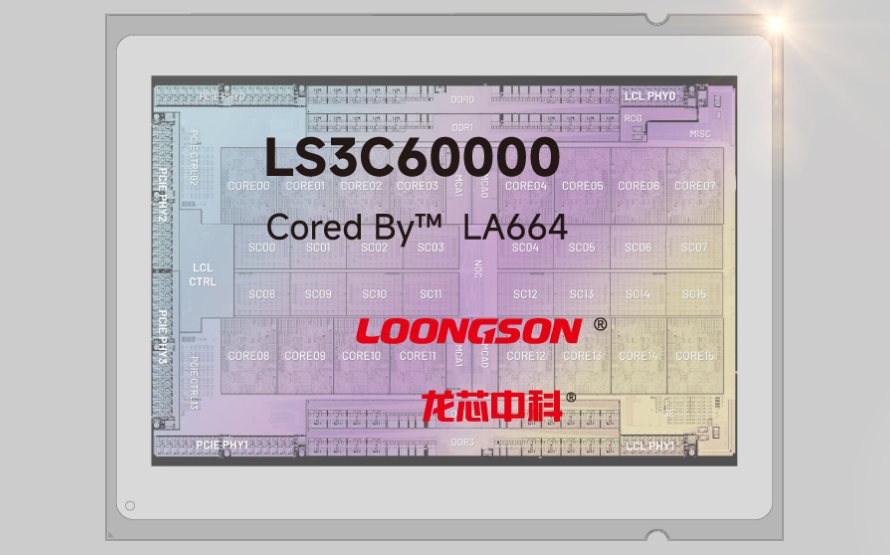
However, the star of the launch is undoubtedly the 3C6000 series. Based on Loongson’s 4th Gen CPU architecture and incorporating LA664 cores, these processors come in three configurations. The “S” series includes a single chiplet, the “D” series contains two, and the “Q” series boasts four chiplets. With 16 cores per chiplet, these configurations provide options of 16, 32, and 64 cores respectively, and clock speeds varying from 2.0 GHz to 2.2 GHz. The company employs its innovative Dragonchain interconnect to link the chiplets efficiently.
These CPUs come equipped with substantial cache memories and are designed to support advanced memory controllers and PCIe lanes. The “S” series offers a quad-channel DDR4-3200 controller, while the “D” and “Q” series provide an 8-channel configuration. Additionally, the processors can be integrated into multi-socket setups, amplifying their versatility.
Loongson has also shared initial performance comparisons against Intel’s 3rd Gen Xeon “Ice Lake-SP” series. The LS3C6000/S outperforms in SPEC CPU 2017 integer benchmarks while slightly trailing in floating point tests. The differences diminish as core counts increase, with the 64-core variants showing competitive results against Intel’s offerings.
The key advantage of Loongson’s 3C6000 series lies in its affordability and availability within China. As these CPUs enter the market, we can anticipate new benchmark data that will further highlight their capabilities and potential impact on the server landscape.