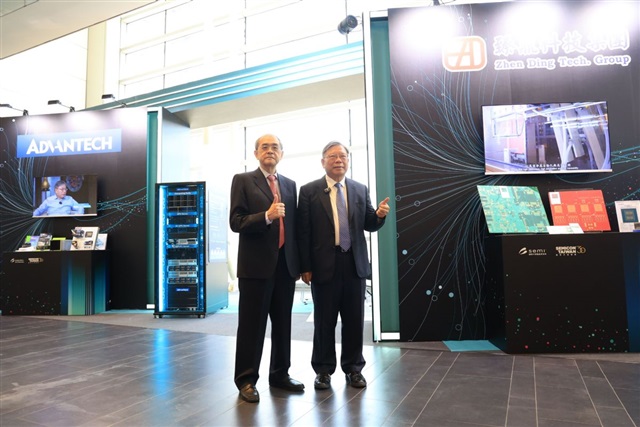
Zhen Ding Technology Group returned to SEMICON Taiwan 2025 with a clear message: in the age of AI, printed circuit boards are no longer passive carriers. They are becoming the backbone of computing, evolving into what the company calls semiconductor engines that unlock higher performance, efficiency, and reliability across data centers, edge devices, and industrial systems.
As the world’s largest PCB manufacturer, Zhen Ding is leaning into the rapid shift created by AI workloads. These applications demand ultra-fast signal transmission, robust power delivery, and advanced thermal solutions. That means the board itself has to do more: route high-speed interfaces cleanly, reduce loss and crosstalk at ever-higher frequencies, and dissipate heat without sacrificing density. In other words, the PCB must be designed as a performance component, not just a platform to mount parts on.
At the event, chairman Charles Shen emphasized how this transformation reshapes the design-to-manufacturing pipeline. Co-design between chip, package, and board is now critical to hit targets for bandwidth, latency, and power. Materials selection is moving toward ultra-low-loss dielectrics. Stackups are getting more complex with higher layer counts, finer lines and spaces, and tighter impedance control. Power delivery networks are being engineered with a semiconductor mindset to minimize noise while handling the surging currents of AI accelerators. Thermal strategies are being built into the board from the start, integrating heat spreaders, vias, and advanced laminates to keep hotspots under control.
The broader ecosystem is aligning around this shift. Zhen Ding’s engagement with industrial computing leaders such as Advantech underscores the rise of the AI factory, where production lines are instrumented with sensors, vision systems, and inference at the edge to improve quality and yield in real time. For manufacturers, that means PCBs not only power AI servers and networking gear but also enable AI-native equipment on the factory floor—inspection, robotics, motion control, and predictive maintenance systems that depend on deterministic connectivity and rugged design.
Several markets are driving this momentum simultaneously:
– AI servers and accelerators: Boards must support extreme bandwidth, from PCIe Gen5/Gen6 and CXL to 800G-class networking, while delivering clean power to GPUs and custom silicon.
– High-speed networking: The transition to 400G/800G and beyond requires materials and stackups optimized for signal integrity and low insertion loss over longer runs.
– Edge AI and industrial systems: Compact, thermally constrained designs need high-density interconnects, robust power integrity, and reliability for harsh environments.
– Automotive and mobility: ADAS and centralized compute push for advanced substrates and multilayer PCBs tuned for safety, longevity, and electromagnetic performance.
To meet these needs, Zhen Ding is focusing on technologies that bridge the gap between packaging and PCB. That includes fine-line HDI, next-generation build-up processes, substrate-like PCBs, and close collaboration with partners on assembly and testing. The aim is to deliver boards that can keep pace with chiplet architectures, HBM memory stacks, and advanced packaging approaches without bottlenecking the system.
Sustainability and manufacturability remain part of the equation. As AI hardware scales, so do energy use and material consumption. Designing boards that improve power efficiency and heat management, while optimizing yields and reducing rework, contributes directly to greener data centers and smarter factories. The company’s emphasis on process innovation and quality control ties performance gains to lower total cost of ownership—an increasingly important metric as enterprises expand AI deployments.
The takeaway from SEMICON Taiwan 2025 is straightforward: AI is redefining what a PCB must do, and Zhen Ding intends to lead that redefinition. By treating the board as an active performance enabler—one that co-evolves with chips, packages, and system architecture—the company is positioning itself at the center of the AI hardware stack. From hyperscale data centers to edge computing and AI-powered manufacturing, the next generation of breakthroughs will depend on boards engineered for speed, power integrity, and thermal resilience. That’s where the new competitive frontier lies, and it’s where Zhen Ding is placing its bets.