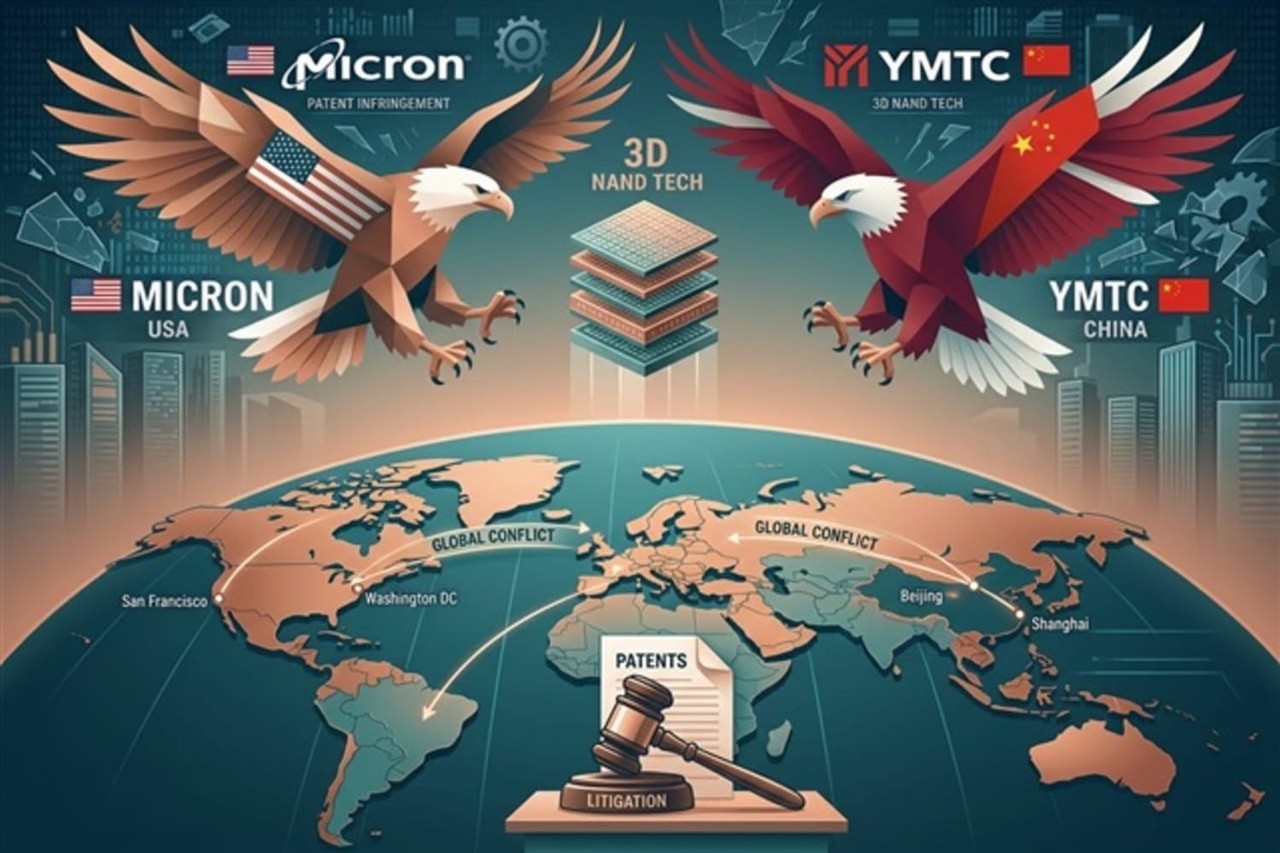
Micron Faces New Challenge in Germany as YMTC Wins Two NAND Patent Injunctions
Micron is under renewed pressure in Europe after Germany’s Munich I Regional Court ruled in favor of Chinese memory manufacturer YMTC and issued two injunctions tied to alleged patent infringement. The decision marks another significant development in the global competition surrounding NAND flash memory technology, a market that remains crucial for smartphones, data centers, connected vehicles, industrial systems, and consumer electronics.
According to industry sources, the injunctions could have a direct impact on Micron’s ability to supply certain products in Germany. While the full commercial effect will depend on how enforcement proceeds, the ruling has already drawn attention across the semiconductor sector because Germany is one of Europe’s most important markets for automotive electronics and industrial-control equipment.
The dispute centers on NAND memory, a core storage technology used in a wide range of modern devices. NAND flash is essential for fast, compact, and energy-efficient storage, making it a key component in solid-state drives, embedded storage modules, vehicle infotainment systems, factory automation hardware, and advanced driver-assistance platforms.
If enforced, the injunctions may limit the availability of some Micron NAND products in Germany. That could create opportunities for rival memory suppliers, including YMTC, particularly in sectors where long-term supply stability is critical. Automotive and industrial customers often require reliable component sourcing for extended product cycles, so any disruption involving a major supplier can influence purchasing decisions.
The European automotive market is especially important in this context. Modern vehicles increasingly rely on high-capacity memory for navigation, software updates, safety systems, in-car entertainment, and autonomous driving functions. As cars become more software-defined, memory chips are becoming just as important as processors and sensors. A restriction on NAND supply in Germany could therefore ripple through parts of the local electronics supply chain.
The ruling also highlights the growing role of intellectual property disputes in the semiconductor industry. As competition intensifies between global chipmakers, patents have become a powerful tool for protecting technology, defending market share, and gaining leverage in negotiations. NAND flash memory is a highly specialized field, and companies invest heavily in research, manufacturing processes, and product design to improve density, speed, endurance, and cost efficiency.
For YMTC, the German court decision represents a notable legal win in Europe. The company has been working to strengthen its position in the global memory market, and success in a major European jurisdiction may support its broader ambitions. For Micron, the ruling adds another challenge at a time when memory makers are navigating changing demand, pricing cycles, and geopolitical tensions affecting semiconductor trade.
It remains unclear how quickly the injunctions may be enforced or whether Micron will pursue legal remedies to reduce or delay their impact. Patent disputes often involve appeals, settlement discussions, licensing negotiations, or technical workarounds. Even so, the Munich court’s decision could influence supply contracts and strategic planning for companies that depend on NAND memory in Germany and across Europe.
The case is a reminder that the battle for dominance in memory technology is not only being fought through product performance and manufacturing scale, but also in courtrooms. As demand for NAND flash continues to grow across vehicles, smart factories, cloud infrastructure, and everyday electronics, legal victories involving key patents can have consequences far beyond a single market.
For now, the European NAND flash market will be watching closely to see how Micron responds and whether YMTC’s injunctions lead to real changes in product availability, supplier relationships, and competitive positioning in Germany’s high-value automotive and industrial technology sectors.