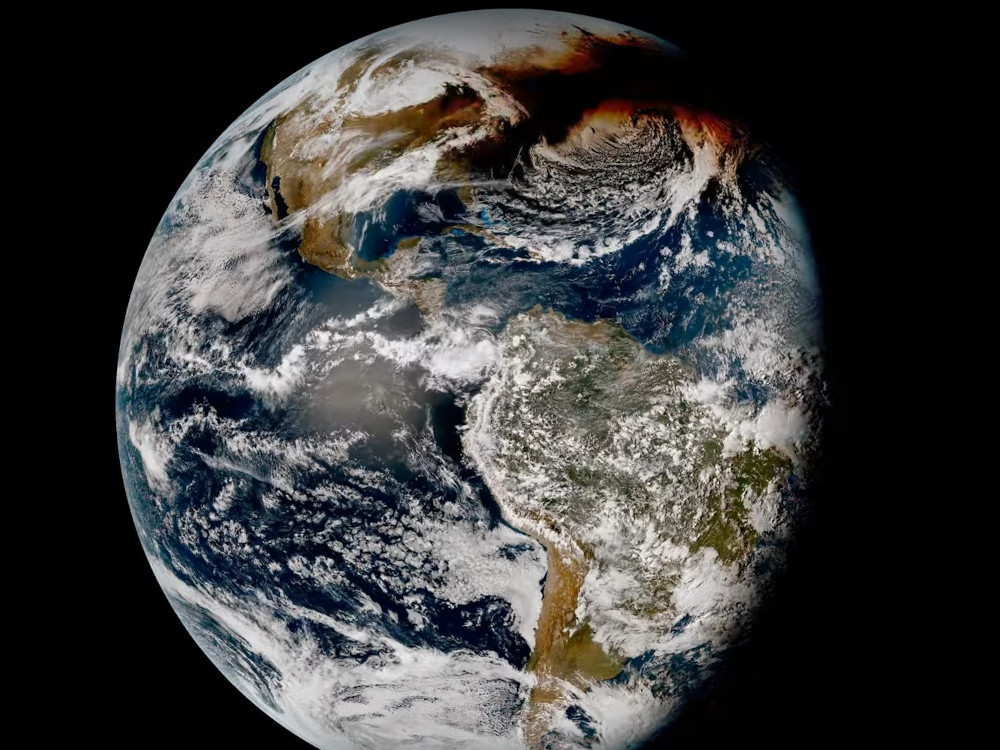
Capturing the grandeur of cosmic events has always piqued human curiosity, and nothing quite compares to the spectacle of a solar eclipse. However, a unique perspective has been provided that showcases this celestial event from a viewpoint quite literally out of this world. Through a time-lapse video, the progression of a solar eclipse shadow has been recorded from space, and the footage is both profound and enlightening.
The video in question is a brief but stunning six-second clip presented in crystal clear 4K resolution. It effectively compresses the movement of the moon’s shadow across the Earth, tracking its journey from the Pacific Ocean all the way to eastern Canada. The phenomenon of a solar eclipse observed from space is particularly mesmerizing because, unlike ground-based observation which is often thwarted by the fickleness of weather, the view from orbit is unobstructed by cloud cover. Instead, the varying heights and densities of clouds add a layer of depth and dynamism to the shadow’s trail.
This remarkable footage was made possible thanks to the GOES-16 satellite. Operating from a geostationary orbit, GOES-16 hangs approximately 36,000 kilometers (or nearly 22,000 miles) above the Earth’s equator, matching the planet’s rotational velocity and thus keeping a constant vigil over the same patch of the globe. The satellite is noted for its capacity to monitor atmospheric conditions with high-resolution imaging.
Over a span of seven hours, the European Space Agency consolidated the high-resolution images into the time-lapse video now available for public viewing. Interestingly, the satellite didn’t just capture images in the visible spectrum but also recorded numerous other spectra that remain invisible to the human eye.
The collection of this data serves a greater purpose than mere observation. By studying the images across various spectra, researchers can delve deep into the effects of solar eclipses on cloud formation and atmospheric conditions. Notably, the transient obscuration of sunlight isn’t the only transformation that occurs; there is a marked drop in temperature during the eclipse, especially within the umbra—the area where the sun is fully blocked—and to some extent in the penumbra as well. These temperature fluctuations can alter air currents and impact cloud formation, offering a natural laboratory for atmospheric science.
While such a breathtaking display won’t occur again until August 12, 2026, when a total solar eclipse will traverse a path from Greenland to Spain, the footage provides an opportunity to relive the latest occurrence. The vivid six-second glimpse into the wonders of space and our celestial neighbors serves as a reminder of the magnificent scale on which nature operates. Moreover, it underscores the value of satellite technology in enhancing our understanding of Earth’s intricate systems and the broader universe.