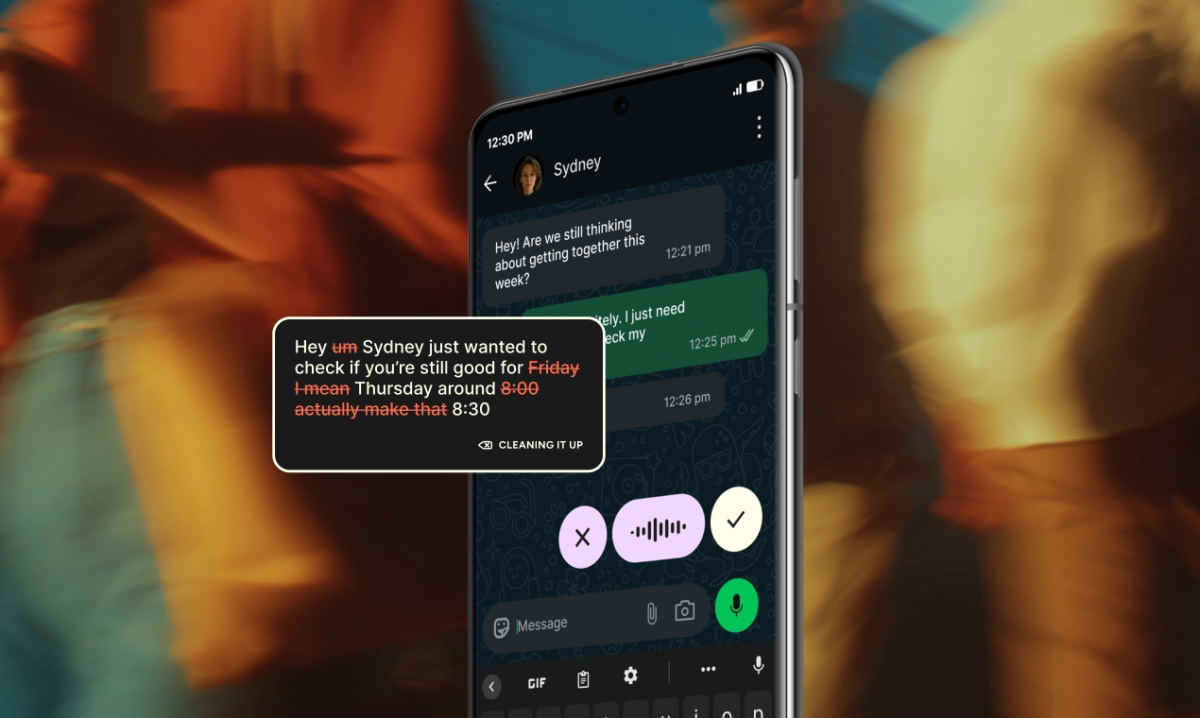
AI-powered dictation startup Wispr Flow is officially expanding to Android, launching its long-awaited app today after first rolling out on Mac and Windows, followed by iOS in June 2025. The move brings the company’s fast-growing voice-to-text experience to a much wider mobile audience—and it’s arriving with major performance upgrades and new language support designed for real-world speech.
On iOS, Wispr Flow works through a dedicated keyboard. On Android, the experience is built around a floating bubble that stays available across apps. Users can press and hold the bubble to dictate, or tap once to start speaking and hit the close button when they’re done. The goal is to make dictation feel lightweight and immediate, without forcing people to switch apps or change how they already write messages, emails, notes, and documents.
The Android release keeps the features that helped Wispr Flow stand out on other platforms. Beyond basic speech-to-text, the app automatically removes filler words and cleans up messy phrasing, then formats your text based on what you said and where you’re writing. In practice, that means it can produce more polished messages and context-appropriate formatting instead of raw transcripts that still need heavy editing.
Wispr Flow’s co-founder and CEO Tanay Kothari says Android made it possible to build the voice-first experience the team originally envisioned—one that’s fast, fluid, and capable of competing with typing as the default way people create text on mobile.
The company also says it completed an infrastructure rewrite alongside the Android launch, delivering dictation that’s about 30% faster than before. That speed boost matters in everyday use, where even small delays can make voice input feel less natural than typing.
Language support is another major focus. Wispr Flow can translate in more than 100 languages and is designed to work across different apps, which is key for users who jump between chats, productivity tools, and email throughout the day.
In addition, the company introduced a new Hinglish model aimed at speakers in India who naturally mix Hindi and English in the same sentence. Instead of forcing users into formal Hindi transcription that doesn’t match how they actually talk, the Hinglish model is designed for mixed, code-switched conversations—the way many people communicate with friends, family, and coworkers.
Even during an early rollout to a limited group of users, Wispr Flow says people have already dictated more than 1.3 million words in English over just the past few days, an early signal of strong engagement and frequent daily use.
The Android launch also arrives as interest in AI dictation continues to grow. While desktop and iOS already have plenty of voice-to-text tools, fewer polished options have been available on Android—making Wispr Flow’s arrival notable, especially as more users look for faster ways to write without relying on their thumbs.
Wispr Flow’s growth is also reflected in investor attention. The company raised $30 million in funding in June, followed by another $25 million round in November. In total, Wispr Flow has raised $81 million, and its most recent funding valued the company at about $700 million, according to sources.