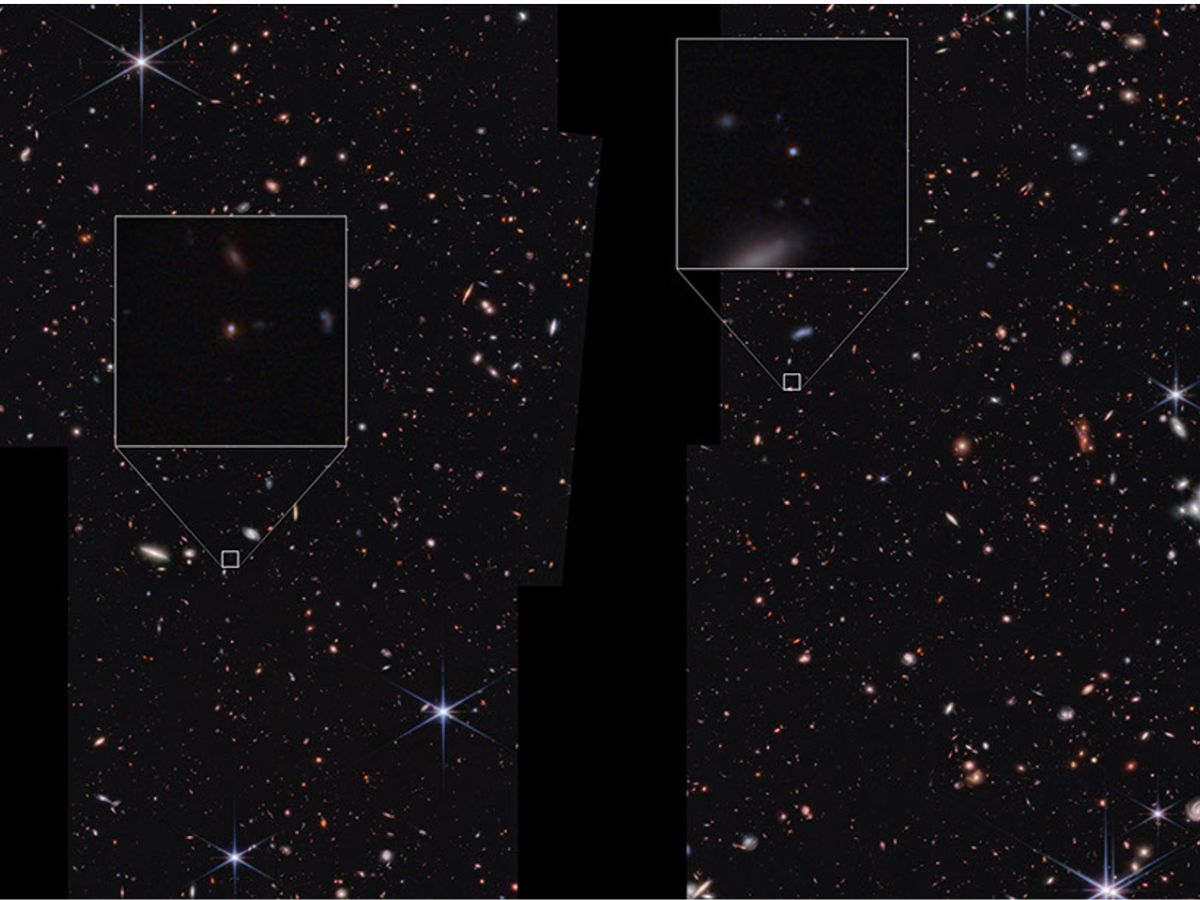
Astronomers digging through the James Webb Space Telescope’s public archive have come across a cosmic mystery: nine distant objects that look like tiny, point-like dots, yet behave like no known class of galaxy.
At first glance, these sources resemble quasars, the brilliant beacons powered by supermassive black holes. Quasars often appear as sharp points of light because their intense cores outshine their host galaxies. But there’s a problem: these nine objects are far too faint to be quasars. Their spectral “fingerprints” also don’t match. Instead of the broader spectral features commonly associated with quasars, the data shows narrow spectral lines, which suggests a very different kind of energy source and environment.
Could they be narrow-line galaxies? Astronomers do know of galaxies with narrow lines, but those typically don’t show up as point sources. They look extended, like small smudges or shapes, not pinpricks. And they can’t simply be stars within the Milky Way either, because they’re much too far away based on the observations.
Because the nine objects combine traits that don’t normally appear together, researchers have compared them to platypuses—creatures that famously confused early scientists by mixing features that “shouldn’t” coexist in a single animal. In the same way, these Webb discoveries don’t fit into the standard astronomical filing cabinet.
So what are they? One leading idea is that Webb may be catching galaxies at an extremely early stage of formation—possibly earlier than astronomers have been able to observe before. If that’s true, these unusual point-like galaxies could offer a rare glimpse into the opening moments of galaxy building, when structures are still compact and evolving rapidly.
The discovery raises bigger questions that astronomers are eager to pursue, including how galaxy formation truly starts and what the earliest building blocks look like before they develop into the familiar spirals and ellipticals seen across the universe today. For now, the next step is clear: researchers need to find more of these odd objects, confirm how common they are, and gather deeper data to pin down what’s powering them.
Thanks to Webb’s sensitivity and the growing treasure trove of archived observations, strange finds like this are becoming more likely—and each one has the potential to reshape what we think we know about the early universe.