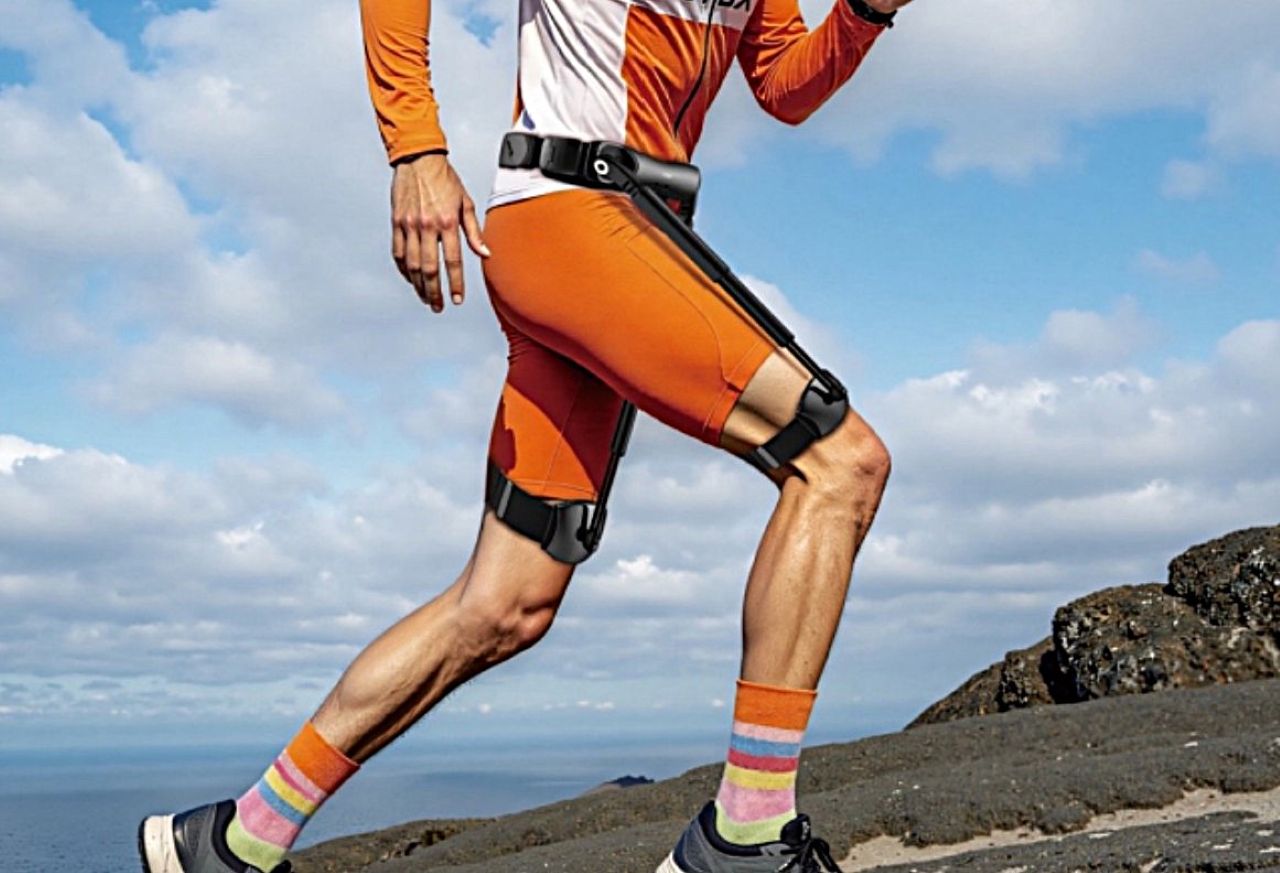
Vigx is stepping into the wearable mobility market with a clever idea: a powered exoskeleton that can fold down to roughly the size of an umbrella, making it far easier to carry and store than most assistive gear. The new π6 lineup is built for people who walk, run, or hike outdoors and want extra leg support without hauling around bulky equipment.
The company says the Vigx π6 exoskeleton is designed to reduce the effort needed to move, with benefits that can matter over long distances. According to Vigx, powered assistance may lower heart rate by up to 30% and reduce knee joint pressure by up to 15%, potentially helping users stay fresher and go farther with less strain. The system provides lifting assistance at the thighs, aiming to make each step feel lighter during walking, running, and hiking.
Three versions are planned: π6 Base, π6 Pro, and π6 Ultra. The Base model weighs 1.9 kg (4.2 lbs.) and uses a 300 W motor capable of delivering up to 10 Nm of torque. Vigx claims its battery can support up to 10 km (6.2 miles) at 8 Nm of assistance, or up to 25 km (15.5 miles) at 4 Nm, depending on how much support the user selects.
The π6 Pro increases power and adds intelligence. It upgrades to a 500 W motor delivering up to 14 Nm of torque and includes a terrain-sensing camera designed to read surface conditions and help the exoskeleton adjust its assistance automatically.
At the top of the range, the π6 Ultra pushes performance further with an 800 W motor that delivers up to 16 Nm of torque. It also includes an extended battery, with Vigx projecting up to 16 km (9.9 miles) at 8 Nm or up to 40 km (24.9 miles) at 4 Nm. Like the Pro, it features a terrain-sensing camera, and it adds a time-of-flight sensor for more detailed depth and distance awareness.
Vigx says the sensor suite is driven by a quad-core 1.5 GHz AI CPU, enabling automatic assistance changes with a stated 30 ms response time. In practical terms, the promise here is smoother, more natural-feeling support as the ground changes from flat pavement to uneven trails, slopes, or mixed terrain—without the user needing to constantly tweak settings.
Beyond raw power, the π6 is also engineered to deliver assistance closer to the wearer’s center of gravity. That design choice is meant to reduce unwanted sway and twisting, which can be a problem with wearable devices that apply force too far from the body’s natural balance point.
Vigx is targeting a launch window of June 2026. Pricing hasn’t been announced, but expectations place it around the $1,000 range. If Vigx delivers on the combination of compact folding design, terrain-aware assistance, and meaningful reduction in exertion, the π6 could be an appealing option for hikers, runners, and everyday walkers who want to extend their range while putting less stress on their knees and legs.