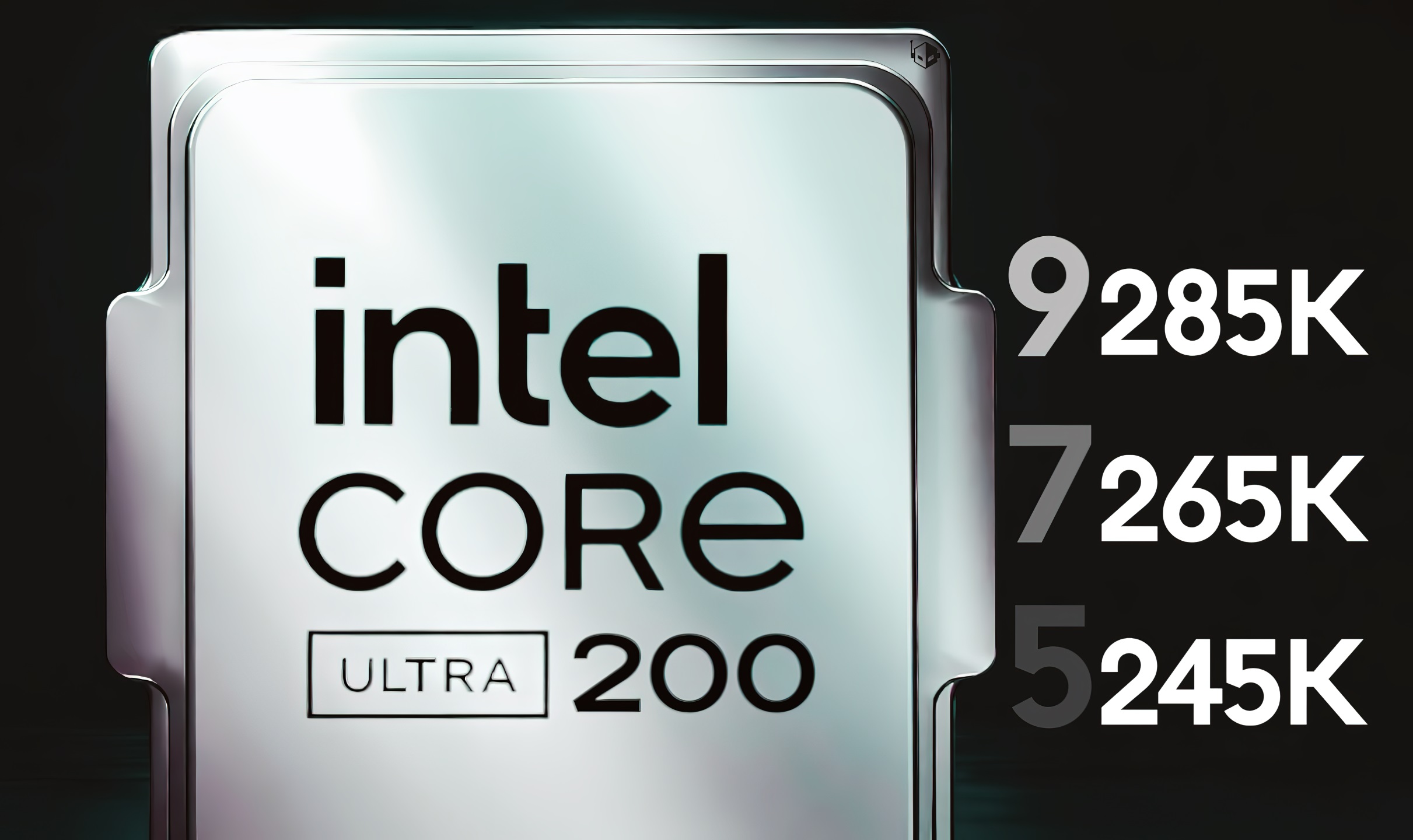
Intel’s Core Ultra 200 “Arrow Lake” Desktop CPU specifications have reached their final stages, with the official launch now just a month away. As anticipation builds, more details have surfaced, offering a glimpse into the impressive capabilities of these upcoming processors.
Coming up soon, Intel’s initial launch will feature five specialized SKUs under the “K” series banner, comprising the Core Ultra 9 285K, Core Ultra 7 265K, Core Ultra 7 265KF, Core Ultra 5 245K, and Core Ultra 5 245KF. Interestingly, the previously speculated Core Ultra 9 285KF variant won’t be making an appearance.
The flagship of the lineup, the Intel Core Ultra 9 285K, boasts 24 cores and 24 threads. It employs 8 P-cores from the Lion Cove architecture and 16 E-cores based on the Skymont architecture. This powerhouse offers a significant 76 MB cache pool, consisting of 36 MB L3 and 40 MB L2 cache. With base clocks of 3.7 GHz on P-cores and 3.2 GHz on E-cores, the CPU can boost up to 5.7 GHz and 4.6 GHz, respectively. This model features a PL1 TDP of 125W, scaling up to 250W under maximum conditions.
The Intel Core Ultra 7 265K follows as the premium alternative, integrating 20 cores and 20 threads with a mix of 8 P-cores and 12 E-cores. The CPU carries a 66 MB cache split between 30 MB L3 and 36 MB L2. With base frequencies of 3.9 GHz on P-cores and 3.3 GHz on E-cores, the boost clocks reach up to 5.5 GHz and 4.6 GHz. Similar to the flagship, it also maintains a 125W PL1 and extends up to 250W in PL2.
Rounding out the lineup is the Intel Core Ultra 5 245K, featuring 14 cores and 14 threads, arranged with 6 P-cores and 8 E-cores. This model offers a total of 50 MB cache (24 MB L3 and 26 MB L2). The base clocks are set at 4.2 GHz for P-cores and 3.6 GHz for E-cores, capable of boosting up to 5.2 GHz and 4.6 GHz, respectively. This CPU stands apart with its lower PL2 TDP of 159W.
Excitingly, the KF variants, which exclude integrated graphics, will be available for the Core Ultra 7 265 and Core Ultra 5 245 models. However, users opting for these variants will require discrete GPUs for display output.
Intel’s Arrow Lake CPUs are introducing Xe-LPG-based integrated graphics in the K variants. Meanwhile, for those eyeing more budget-friendly options, non-K models are expected to arrive in early 2025, accompanied by the Intel 800-chipset motherboards. This new architecture promises not just higher efficiency but also better stability, resolving issues present in prior generations.
Mark your calendars for October 24th, as Intel drops the Core Ultra 200 “Arrow Lake” CPUs alongside their robust Z890 chipset motherboards, which are set to revolutionize memory configurations as evidenced by the upcoming ASRock Z890 Taichi motherboard.
Which of these cutting-edge Intel Arrow Lake “Core Ultra 200K” CPUs are you most excited for?


