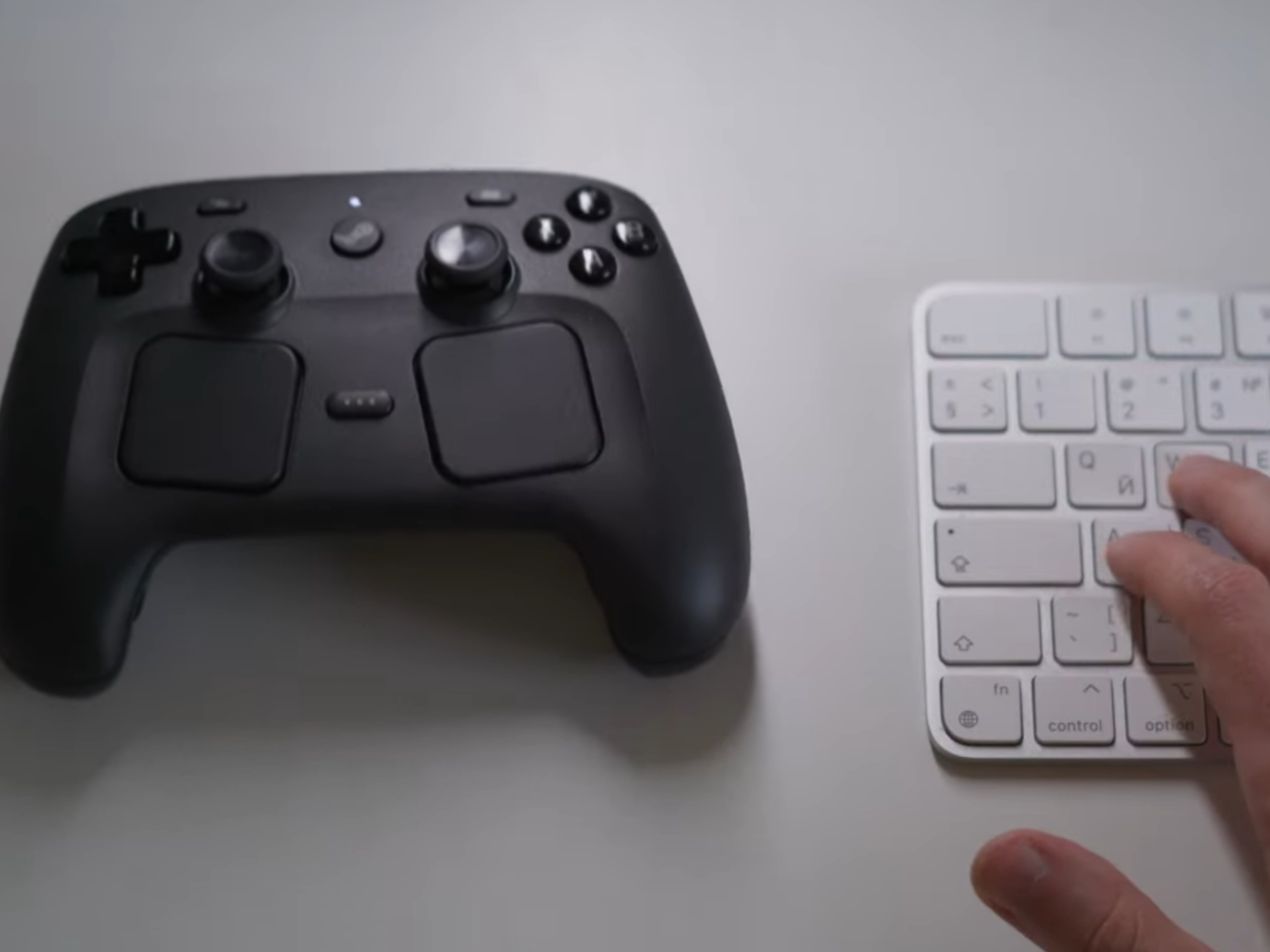
Steam Controller Turns Into a Tiny “RC Car” Thanks to a Clever Haptic Motor Experiment
The Steam Controller may no longer be a mainstream gaming accessory, but one inventive developer has found a surprisingly fun new use for it: making it move across a table like a remote-controlled car.
A hobbyist developer known as VeryLazyPixels has created a web app that uses the Steam Controller’s built-in haptic motors to make the gamepad slide across smooth surfaces. It does not have wheels, tracks, or any hidden mechanical parts. Instead, the controller “drives” by vibrating in carefully timed patterns, creating enough movement to push itself forward and steer from side to side.
The unusual project was first shared online in mid-June after the developer was inspired by another experiment where someone used the Steam Controller’s haptic motors to play music. That demonstration showed just how powerful the controller’s vibration system could be. From there, VeryLazyPixels wondered whether those vibrations could be controlled precisely enough to move the controller intentionally.
As it turns out, they can.
The result is a quirky web-based tool that lets Steam Controller owners control their gamepad from a keyboard. Once connected, pressing W or the Up Arrow makes the controller move forward, while A and D steer it left and right. The Spacebar stops the motion. There is currently no reverse function, so this is more of a sliding gadget trick than a fully functional remote-control vehicle.
Setting it up is intentionally simple. Users only need a Steam Controller and a Chromium-based browser such as Chrome or Edge. The app relies on WebHID, a browser technology that allows websites to communicate directly with compatible hardware. After opening the web app, users can select the option to link the controller, choose the Steam Controller from the device window, and start driving it across a flat surface.
The experiment is not especially practical, but that is part of its charm. The Steam Controller is not designed to crawl across desks, and repeated sliding may scuff the controller or leave wear marks over time. A smooth surface is also important, since rough materials could increase friction and make movement harder or potentially damage the device.
Still, as a creative gaming hardware hack, it is undeniably entertaining. The project highlights the flexibility of the Steam Controller’s haptic motors and shows how even older gaming accessories can surprise users when developers experiment with them in unexpected ways.
For Steam Controller fans, this is less about usefulness and more about curiosity. It is a fun reminder that gaming hardware can do much more than it was originally built for, especially when a clever idea meets a bit of browser-based technology.