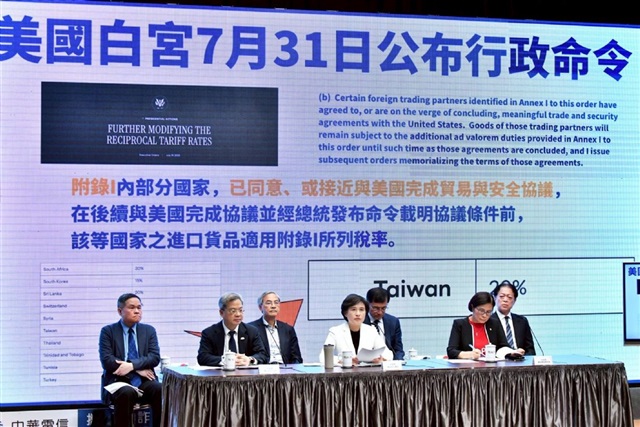
Rising tariffs and hardline “Make America Great Again” policies have redrawn the global trade map, straining even long-standing alliances and eroding confidence in the reliability of the United States. As reciprocal duties proliferate and economic nationalism gains ground, partners who once counted on stable rules and predictable leadership are reassessing how to protect their interests. In this unsettled environment, Taiwan faces a pivotal choice: how to recalibrate its industrial strategy to thrive amid sharper geopolitical competition and a more fragmented global economy.
The immediate effect of tariff brinkmanship is uncertainty. Companies hesitate to invest when market access can shift with each policy announcement, and governments reconsider the risks of concentrating supply chains in any single country or bloc. For export-driven economies, this turbulence is more than a headline; it influences capital flows, production footprints, and long-term competitiveness.
At the same time, the rise of regional groupings, including the Shanghai Cooperation Organization, highlights a steadily multipolar landscape. Trade, technology standards, and energy cooperation are increasingly shaped by clusters of countries rather than a single global center of gravity. The practical takeaway for economies like Taiwan is clear: resilience now depends on flexibility, diversification, and strategic autonomy.
What Taiwan should focus on now
– Diversify demand and suppliers: Expand export markets to reduce dependence on any one destination, and build multi-source supply chains to cushion against sudden shocks.
– Prioritize de-risking over decoupling: Maintain access to major markets while limiting overexposure. Dual-track strategies, alternative logistics routes, and modular production can keep options open.
– Invest in strategic industries: Strengthen high-value manufacturing, advanced materials, and next-generation technologies to preserve an edge as costs and tariffs rise.
– Deepen regional ties: Broaden trade, standards cooperation, and industrial collaboration with a wider network of partners to stabilize market access amid shifting alliances.
– Build supply chain buffers: Increase inventories of critical inputs and develop rapid reconfiguration plans so production can pivot when policies or prices change.
– Enhance economic security tools: Improve export compliance, risk monitoring, and scenario planning to anticipate tariff moves and regulatory shifts before they bite.
– Accelerate innovation and talent: Support R&D, workforce upskilling, and automation to offset rising frictions and sustain productivity-driven growth.
These priorities share a common theme: control what you can control. Taiwan cannot dictate global politics, but it can shape its exposure to risk, invest in the next wave of industrial capability, and cultivate a broader set of economic relationships. That approach turns volatility into impetus—an opportunity to modernize, move up the value chain, and ensure that growth is not hostage to external shocks.
Allies around the world are grappling with the same dilemma. With trust in traditional anchors under pressure, successful economies will be those that combine openness with preparedness. For Taiwan, the path forward is a pragmatic blend of resilience and reach: protect critical capacities at home, connect widely abroad, and stay agile as the balance of global power continues to shift.