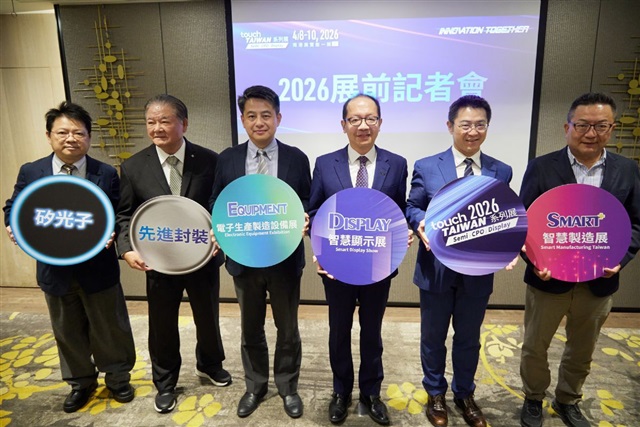
Touch Taiwan is set to return April 8–10, 2026, and this year’s exhibition is shaping up to be one of the most globally connected editions yet. The annual event will bring together more than 300 companies from 12 countries, filling 820 booths with the latest breakthroughs in display technology, semiconductor innovation, and next-generation manufacturing.
Organizers say the timing couldn’t be more important. According to Jim Hung, chairman of the Taiwan Display Union Association (TDUA), the panel industry is in the middle of a complete transformation. As traditional display markets mature and competition intensifies, the focus is shifting toward higher-value technologies and fresh growth engines—especially areas tied closely to the semiconductor supply chain and advanced manufacturing.
A major theme expected to stand out at Touch Taiwan 2026 is SiPh (silicon photonics), a fast-rising technology that uses light to move data more efficiently. As AI computing, data centers, and high-speed networking continue to expand, silicon photonics is gaining attention for its potential to boost bandwidth while reducing power consumption and heat—two of the biggest challenges in modern computing infrastructure. With the industry racing to support ever-larger AI workloads, SiPh is increasingly viewed as a key building block for the future.
Advanced packaging is also positioned to take center stage. As chipmakers push beyond traditional scaling limits, packaging has become a critical way to improve performance, cut latency, and integrate more capability into smaller footprints. From heterogeneous integration to more sophisticated chip-to-chip connectivity, advanced packaging is now one of the strongest drivers of progress in both computing and electronics—and Touch Taiwan is expected to spotlight how these advances connect to display tech, smart devices, industrial applications, and emerging AI hardware.
By gathering hundreds of exhibitors under one roof, Touch Taiwan 2026 aims to serve as a real-world snapshot of where the industry is heading next: a tighter fusion of displays, semiconductors, photonics, and manufacturing innovation. For companies navigating a rapidly evolving market, the event offers a concentrated look at the technologies most likely to define the next phase of growth—both in Taiwan’s tech ecosystem and across the global supply chain.
If you’d like, paste the rest of the post text (the snippet cuts off after “half of…”) and I can rewrite the full article more accurately while keeping it search-optimized and faithful to the original intent.