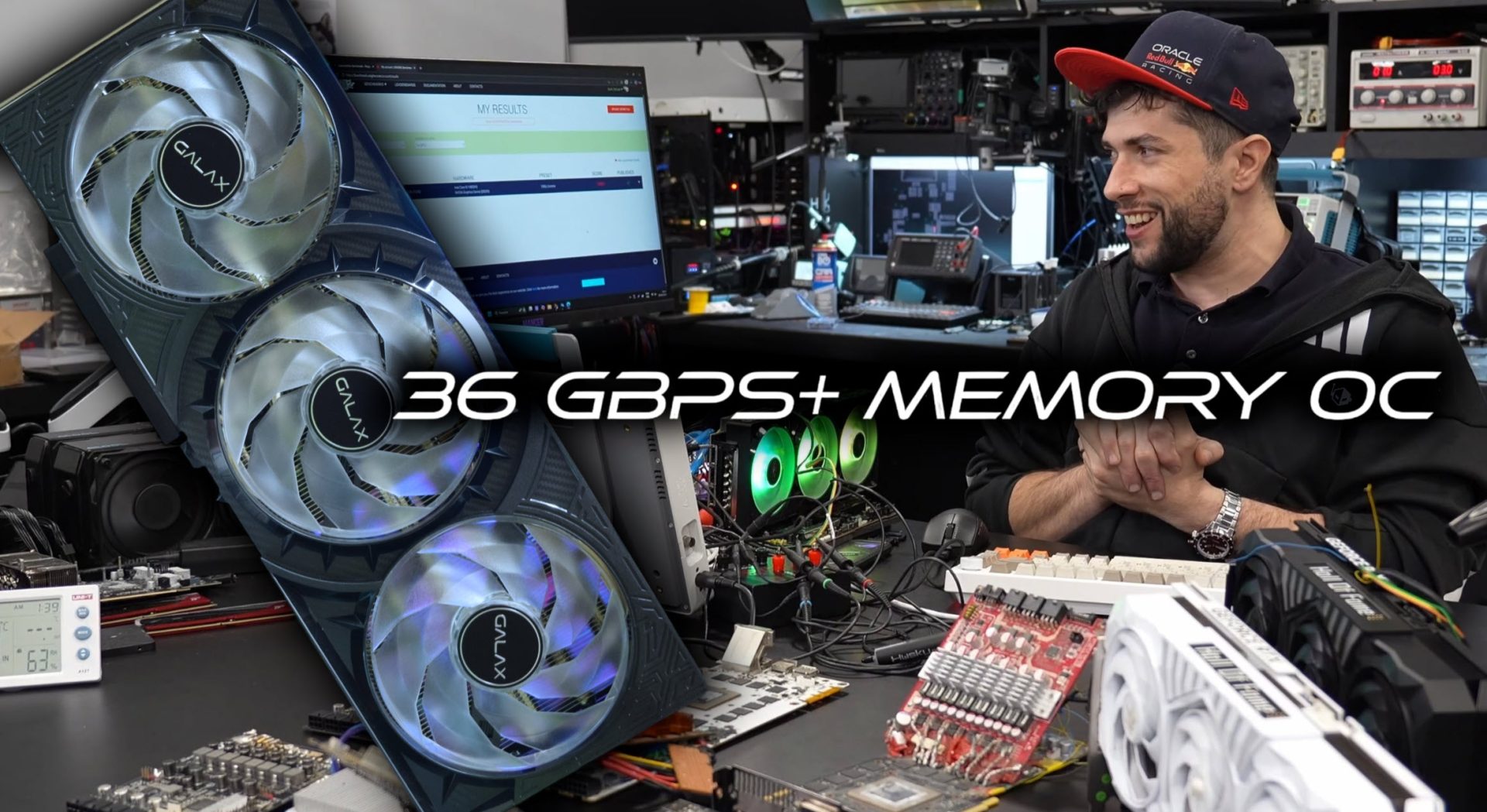
NVIDIA’s GeForce RTX 50 series comes with speedy new GDDR7 memory, but it also ships with a hard stop that frustrates overclockers: a memory clock limit most tools can’t push past. Now that wall has been cracked wide open. Brazilian overclocking team Teclab has demonstrated a way to bypass the RTX 50 memory clock restriction, pushing an RTX 5070 Ti to an eye-watering 36 Gbps+ memory speed.
Teclab is no stranger to headline-grabbing GPU mods and record-setting tinkering. They’ve previously pulled off ambitious hardware changes like higher-VRAM modifications on older GeForce cards, and they’ve also used custom approaches to unlock performance ceilings that typical settings and utilities won’t touch. This latest RTX 50 series project continues that tradition, focusing specifically on the limits NVIDIA enforces at the software/firmware level.
Out of the box, RTX 50 graphics cards with GDDR7 generally run at 28–30 Gbps memory speeds, with reported effective clock figures like 15,000 MHz for the RTX 5080 and around 14,000 MHz for other models in the lineup. While standard overclocking software may allow memory offsets up to +3000 MHz, it won’t exceed that cap because the limit is locked down. In the past, some enthusiasts tried to gain more speed by swapping memory chips for higher-binned modules, while others experimented with deeper modding methods. Teclab’s newest technique takes a different route.
According to Teclab’s Burti, the test card was a GALAX RTX 5070 Ti 1-Click OC, notably an entry-level model. It wasn’t shunt-modded, but its power limit was fully unlocked. Interestingly, software monitoring couldn’t properly read the GPU’s power draw because the current-sensing multiplexer was disabled—meaning typical telemetry wasn’t telling the full story of what the card was actually doing.
They ran a series of benchmarks to show the performance impact step by step. The first run used no manual overclocking, though the power limit was already opened up. The second run applied a traditional manual overclock, with the card boosting beyond 3.3 GHz. The third run is where the breakthrough appears: Teclab’s bypass essentially “tricks” the GPU’s clock management at a logic or early programming level, making the graphics card believe it’s operating at a lower frequency than it truly is. This behavior applies not only to the GPU core clock but also to the GDDR7 memory clock.
The result was a strange but telling mismatch: monitoring tools displayed lower GPU clocks around the 3.1–3.2 GHz range and showed the memory sitting at the stock 28 Gbps, yet the benchmark score climbed higher than the straightforward manual overclock run. That strongly suggests the card was actually sustaining much higher real-world clocks than software was reporting. Teclab stated the RTX 5070 Ti was running beyond 36 Gbps (18,000 MHz+).
Here’s how the Unigine Superposition scores reportedly broke down:
RTX 5070 Ti (No OC / Power Limit Unlocked): 9922 points
RTX 5070 Ti (+500 GPU / +3000 Memory / Power Limit Unlocked): 11722 points
RTX 5070 Ti (+330 GPU / 36 Gbps+ Memory / Power Limit Unlocked): 11993 points
What makes this especially impressive is that 36 Gbps is an extreme target for memory rated at 28 Gbps. While next-generation 36 Gbps memory from major manufacturers has been rumored and discussed—along with higher VRAM densities—availability is expected later rather than sooner, with some speculation that ongoing memory supply issues could delay broader rollout significantly.
For overclocking enthusiasts, the bigger takeaway is that these 28 Gbps GDDR7 modules may have far more headroom than many expected, provided the artificial limits can be bypassed. Teclab also isn’t stopping here. The team plans to show more results in an upcoming video, including testing with the GALAX RTX 5070 Ti HOF, which could reveal even higher overclocking potential and possibly new records.