SK Hynix Turns to Nvidia AI to Accelerate Next-Generation Memory Chip Development
SK Hynix is bringing more artificial intelligence into its memory research and development process by using Nvidia technologies to speed up complex chip simulations. The move highlights how AI and GPU acceleration are becoming increasingly important in the race to build faster, more efficient, and more advanced memory semiconductors.
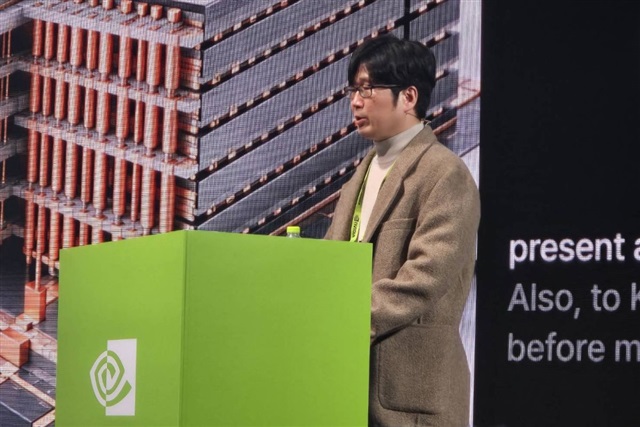
During a presentation focused on memory R&D applications, Junghan Kim showcased how Nvidia’s computing technologies are being applied to improve key parts of SK Hynix’s development workflow. The company is using AI-powered tools and GPU-based acceleration to reduce the time required for simulations that are essential in designing and refining memory chips.
One major area of improvement is etching-process development. Etching is a critical step in semiconductor manufacturing, where precise patterns are carved into materials to create the microscopic structures used in chips. Because modern memory chips are becoming more complex, engineers must run detailed simulations to understand how materials behave during production. By using Nvidia’s AI and GPU technologies, SK Hynix can perform these simulations more quickly, helping engineers identify potential issues earlier and optimize manufacturing processes with greater accuracy.
The company is also testing Nvidia-powered systems for thermal and elastic deformation analysis. These simulations help researchers understand how memory chips respond to heat, stress, and structural changes. As chips become smaller and more densely packed, managing heat and material deformation becomes increasingly important for performance, durability, and reliability. Faster analysis allows development teams to evaluate more design options in less time, which can help shorten the path from research to production.
This collaboration reflects a broader shift across the semiconductor industry. Traditional chip simulation methods can be time-consuming and resource-intensive, especially as advanced memory technologies require more detailed modeling. GPU acceleration can dramatically improve processing speed, while AI can help analyze complex data patterns and support smarter decision-making during development.
For SK Hynix, these tools could play an important role in improving productivity and strengthening its competitiveness in the global memory market. Faster simulations may allow the company to refine chip designs more efficiently, improve manufacturing yield, and accelerate innovation in DRAM, NAND, and future memory technologies.
As demand grows for high-performance memory used in artificial intelligence servers, data centers, consumer electronics, and advanced computing systems, chipmakers are under pressure to innovate faster than ever. By adopting Nvidia’s AI and GPU acceleration, SK Hynix is positioning itself to meet that demand with more efficient research methods and more advanced semiconductor development capabilities.
The use of AI in memory chip simulation is no longer just a future concept. It is becoming a practical tool for speeding up research, improving accuracy, and helping semiconductor companies push the limits of what modern memory technology can achieve.


