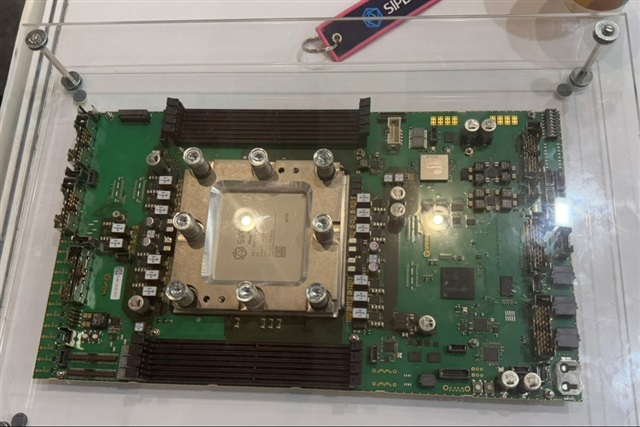
SiPearl Delivers First Rhea1 CPU Samples for Europe’s JUPITER Exascale Supercomputer
SiPearl has reached a major milestone in Europe’s push to build its own high-performance computing technology. The EU- and France-backed fabless chip company has delivered the first samples of its Rhea1 processor to Bull, where the chips will begin integration work for the JUPITER supercomputer.
This marks an important step for the Rhea1 CPU, shifting it from internal bring-up and validation into real customer system integration. In simple terms, the processor is now moving beyond the lab and into the kind of large-scale computing environment it was designed to power.
JUPITER is one of Europe’s most ambitious supercomputing projects and is expected to play a key role in advancing exascale computing on the continent. Exascale systems are capable of performing massive numbers of calculations at extraordinary speed, supporting demanding workloads in fields such as climate modeling, artificial intelligence, scientific research, medicine, energy, and advanced engineering.
The arrival of Rhea1 samples is also significant because the processor is part of a broader European effort to reduce reliance on non-European chip technologies in critical computing infrastructure. By developing a homegrown server-class CPU, SiPearl is helping strengthen Europe’s technological independence in the high-performance computing market.
As a fabless semiconductor company, SiPearl designs its processors while relying on external manufacturing partners for production. This model allows the company to focus on architecture, performance, and system readiness while contributing to Europe’s long-term goal of building a competitive processor ecosystem.
For Bull, receiving the first Rhea1 samples means integration and testing can now begin within the JUPITER supercomputer platform. This phase is crucial because it allows engineers to evaluate how the processor performs inside a complete system, including its interaction with memory, accelerators, software stacks, cooling, and overall workload management.
The move from validation to customer integration is often one of the most important stages in a chip’s journey. It helps identify final tuning needs and confirms whether the processor can meet the demanding requirements of large-scale supercomputing environments.
Rhea1’s progress comes at a time when demand for high-performance computing is rising rapidly. Governments, research centers, and industries are increasingly depending on powerful computing systems to solve complex problems, train AI models, simulate real-world scenarios, and process enormous datasets.
With the first Rhea1 CPU samples now delivered for JUPITER, SiPearl is taking a visible step toward turning Europe’s exascale ambitions into reality. If integration proceeds successfully, the processor could become a key component in one of the continent’s most important supercomputing deployments.
This development is more than a chip delivery. It represents momentum for European semiconductor innovation, a boost for regional computing sovereignty, and a promising advance for the future of exascale supercomputing in Europe.