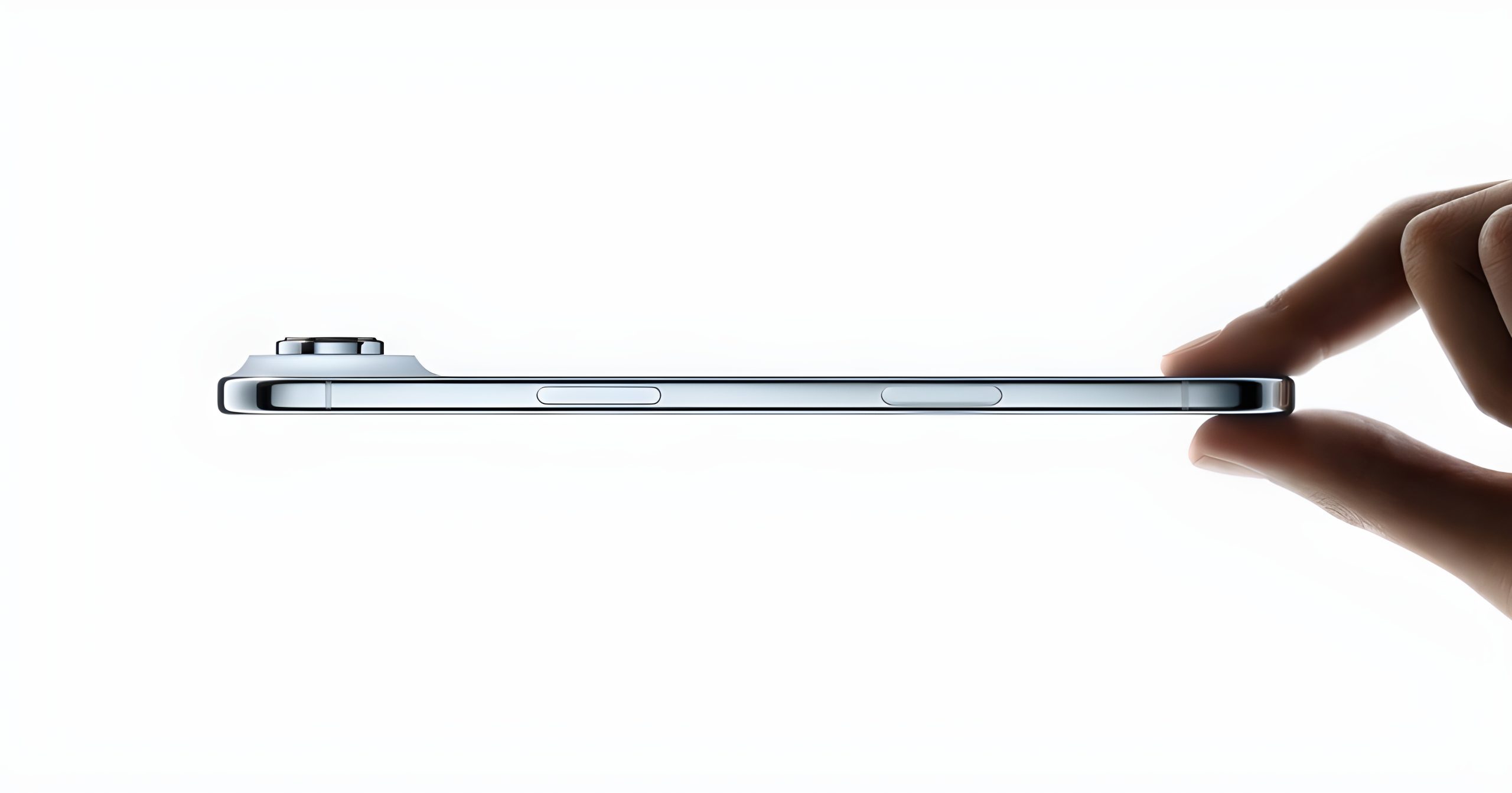
Nobody ever asked for an iPhone that’s razor-thin at the expense of staying power, yet that’s exactly where the iPhone Air landed. Now, according to industry chatter, Apple has reportedly told suppliers to slash component orders for the ultra-slim model by as much as 80 percent, reflecting a softer-than-expected response.
The outcome isn’t shocking. The iPhone Air ships with the smallest battery in the iPhone 17 lineup, and that trade-off is front and center in daily use. The frustrating part? Apple had a viable path to keep the phone thin without compromising as much on battery life: silicon-carbon batteries.
Why silicon-carbon matters
Conventional lithium-ion batteries use a graphite anode and a lithium oxide cathode. Silicon-carbon (Si-C) designs swap the graphite for a silicon-based anode, often built as a nanostructured silicon-carbon composite. Silicon can host up to 10 times more lithium ions than graphite, which translates into dramatically higher potential capacity in the same volume.
The catch is swelling. Early silicon anodes expanded so much when charged that they damaged cells. Modern Si-C solutions reinforce the silicon with fracture-resistant carbon structures, which mitigates but doesn’t eliminate expansion. Even today, full-charge expansion can be around 20 percent, and that continual expansion and contraction accelerates wear, typically shortening optimal capacity after two to three years.
Other brands are already doing it
Several smartphone makers have proven that Si-C batteries can deliver impressive capacity in remarkably thin devices:
– HONOR Magic V3: about 9.2 mm folded and just 4.35 mm unfolded
– HONOR Magic V5: around 8.8 mm folded and an incredibly slim 4.1 mm unfolded
– OPPO Find N5: approximately 4.21 mm when unfolded
– Tecno Pova Slim 5G: 5.95 mm thick with a 5,160 mAh silicon-carbon battery
Now look at Apple’s choice. The iPhone Air measures roughly 5.6 mm, edging out the Tecno in slimness, but its battery capacity is just 3,149 mAh. That means it’s only about 6 percent thinner than the Tecno Pova Slim 5G, yet carries a battery that’s roughly 39 percent smaller. It’s hard to ignore the gap.
What might have been
Imagine the iPhone Air with a ~5,000 mAh silicon-carbon pack. For reference, the iPhone 17 Pro Max sits at about 5,088 mAh. Pairing the Air’s sleek profile with that level of capacity could have rewritten the narrative around the device overnight.
Why Apple likely held back
There are valid reasons to be cautious with Si-C:
– Expansion and longevity: The roughly 20 percent volumetric expansion under full charge stresses cells, typically leading to more noticeable degradation in 2–3 years versus some graphite-based designs.
– Thermal and reliability considerations: Managing heat, cycle life, and warranty expectations in an ultra-thin chassis is harder with higher-energy, higher-expansion chemistries.
– Cost and manufacturing maturity: Yields, consistency, and long-term durability targets can be tougher to achieve at massive scale.
Still, the strategic decision looms large. Apple could have prioritized a higher-capacity, ultra-slim device that might show faster long-term battery wear, or stuck with a slimmer battery that undercuts everyday endurance. The sales picture for iPhone Air suggests the market’s verdict: thinness alone isn’t a winning feature when it compromises battery life.
Where Apple can go from here
A middle path is possible. Hybrid silicon-graphite anodes, stacked cell packaging, denser cathodes, smarter thermal design, and refined charging algorithms can boost capacity and longevity without pushing expansion to the limit. Slightly relaxing the obsession with thinness to reclaim a few tenths of a millimeter could also deliver a noticeable jump in runtime—exactly what shoppers care about.
The iPhone Air shows that design elegance matters, but not more than battery life. In a world where competitors are squeezing big batteries into svelte frames using silicon-carbon tech, Apple’s next move will need to balance style, stamina, and long-term reliability far more carefully.


