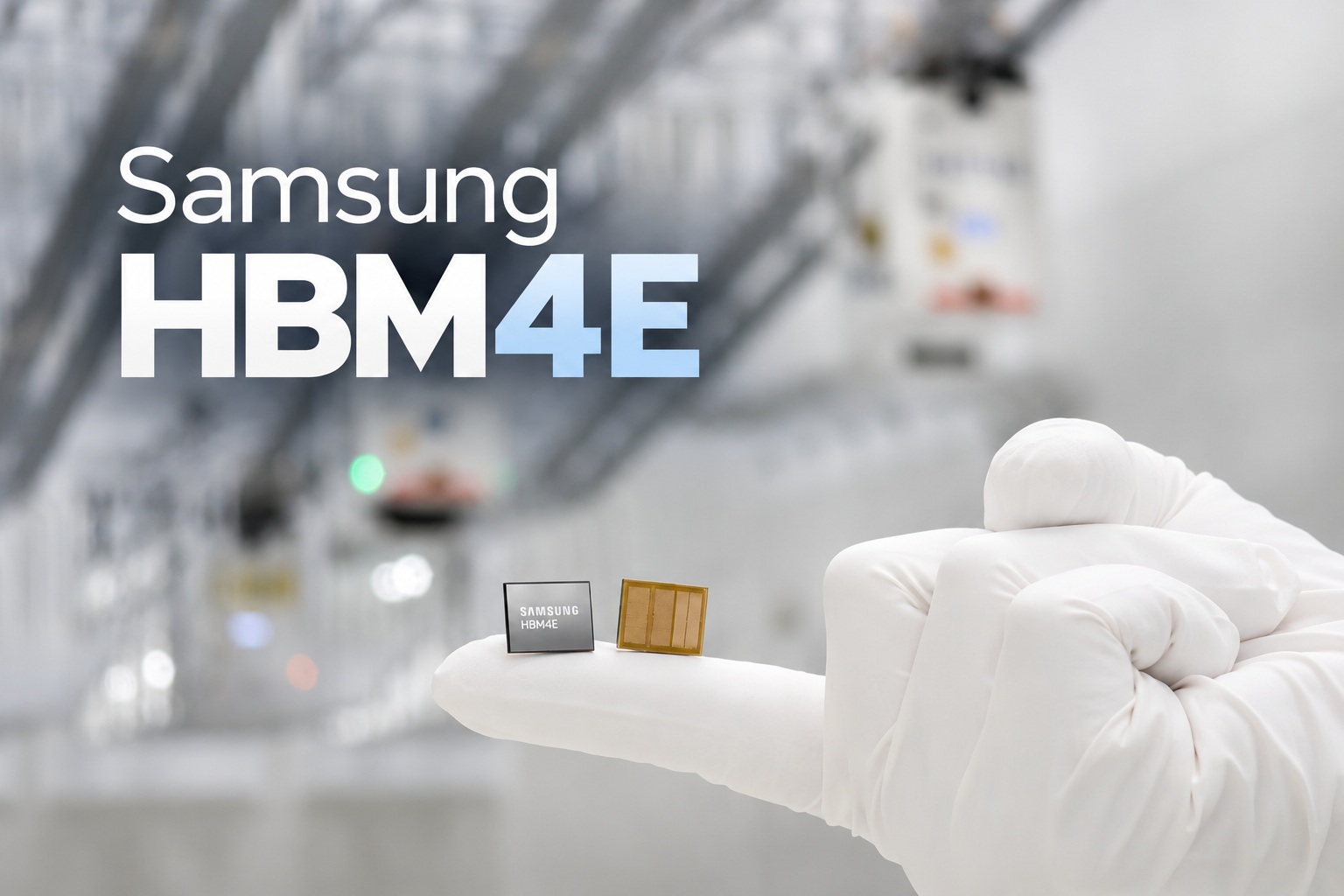
Samsung’s 12-Layer HBM4E Memory Reportedly Passes NVIDIA Qualification as AI Chip Race Intensifies
Samsung Electronics may have taken a major step forward in the fast-growing high-bandwidth memory market, with its next-generation 12-layer HBM4E memory reportedly passing qualification testing with NVIDIA and several major cloud and data center customers.
A report from South Korea claims Samsung completed customer qualification for its 12-Hi HBM4E memory near the end of September. This is a key stage before advanced memory can be used in commercial AI hardware, as customers test whether the product meets strict requirements for performance, stability, power efficiency, heat management, and long-term reliability.
The development could be significant for Samsung as it works to strengthen its position in the HBM market, where demand has surged due to the rapid expansion of artificial intelligence, AI accelerators, and high-performance data centers. HBM has become one of the most important components in modern AI computing because it provides the massive bandwidth needed to feed powerful GPUs and accelerator chips.
However, there is still an important detail to keep in mind. The report only says Samsung’s HBM4E has passed customer qualification. It does not confirm final supply agreements, shipment volumes, pricing, contract size, or mass-production delivery schedules. Samsung has also not officially confirmed the report, stating that it could not verify whether the qualification process had been completed.
Samsung began providing samples of its 12-layer HBM4E memory to major global customers in May. The new memory stack offers 48 GB of capacity and is designed to run at a stable 14 Gbps per pin, with the ability to scale up to 16 Gbps. At 14 Gbps, Samsung says the memory can deliver up to 3.6 TB/s of bandwidth, representing a performance gain of more than 20% compared with its HBM4 generation.
That level of bandwidth is especially important for next-generation AI systems, where memory speed and capacity can directly affect training performance, inference efficiency, and overall accelerator utilization. As AI models continue to grow larger and more complex, memory bandwidth has become just as critical as raw compute power.
Samsung’s HBM4E combines the company’s sixth-generation 10nm-class 1c DRAM with a 4nm logic base die produced by Samsung Foundry. This design builds on technologies already used in Samsung’s HBM4 products while pushing bandwidth and efficiency further. The company has also highlighted improvements in power efficiency and thermal performance, two areas that matter increasingly as AI servers consume more energy and generate more heat.
The evolution of HBM technology shows just how quickly the market has advanced. Early HBM products delivered a few hundred GB/s of bandwidth, while today’s high-end HBM3E and HBM4 solutions have moved into the terabytes-per-second range. Samsung’s HBM4E is expected to push that even further, with up to around 4.0 TB/s of bandwidth possible at 16 Gbps.
Capacity is also rising quickly. Samsung’s 12-layer HBM4E offers 48 GB per stack, while future 16-layer versions are expected to reach up to 64 GB. Higher-capacity HBM stacks allow AI processors to keep more data close to the compute engine, reducing bottlenecks and improving efficiency in large-scale workloads.
Samsung has been moving aggressively to compete in the HBM segment as demand from AI chipmakers and cloud infrastructure companies continues to accelerate. The company began mass production of HBM4 earlier this year, targeting next-generation AI platforms, and quickly followed with HBM4E samples for key customers.
If the reported NVIDIA qualification is accurate, it would mark an important technical win for Samsung. NVIDIA is one of the most influential customers in the AI hardware ecosystem, and qualification by the company can play a major role in determining which memory suppliers are selected for future GPU and accelerator platforms.
Still, passing qualification is only one part of the process. The next major question is whether Samsung can secure large-scale HBM4E orders and deliver them at the volume and quality required by major AI customers. In the HBM business, production yield, packaging capability, power efficiency, and consistent supply are all crucial.
For now, the report suggests Samsung is gaining momentum in the next phase of the AI memory race. With HBM4E offering higher bandwidth, larger capacity, and improved efficiency, the technology is expected to play a central role in upcoming AI accelerators and high-performance computing systems.
As AI infrastructure continues to expand worldwide, the competition among memory makers is becoming more intense. Samsung’s reported progress with 12-layer HBM4E could help the company close the gap with rivals and position itself more strongly for the next generation of AI data center hardware.