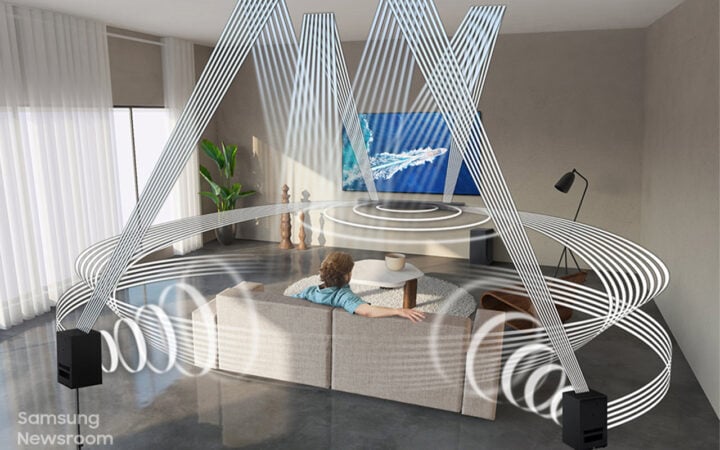
Samsung is gearing up to launch its latest 3D spatial audio technology, aptly named IAMF (Immersive Audio Model and Formats), which has been developed in collaboration with Google. This innovative technology is set to make its debut in Samsung’s own TVs and audio products within the current year.
IAMF is positioned to compete with established proprietary technologies like Dolby Atmos. Dolby Atmos has revolutionized the audio landscape by extending sound vertically, allowing it to bound off ceilings and enrich the listening experience with lifelike depth. This technology has rapidly gained traction in movie theaters and is also supported by a wide range of Samsung Galaxy smartphones released since 2018. However, since Dolby Atmos is a proprietary solution, devices that bear its certification often come with additional costs.
Samsung’s IAMF seeks to offer an open-source alternative that encompasses all the capabilities of Dolby Atmos, such as directional audio distribution both horizontally and vertically. Moreover, IAMF steps up the game by incorporating artificial intelligence to enhance the precision of source audio positioning within a scene. This technology also grants added emphasis to specific audio elements, like highlighting dialogue within movies, games, and other forms of media, thus offering heightened clarity and flexibility to the soundscape.
While IAMF may not be the name set in stone, this technology is slated to be incorporated into Samsung’s TV lineup and audio devices – including soundbars – by 2024. Samsung has yet to disclose which specific models will come equipped with IAMF; however, any TV or audio system capable of firmware updates and furnished with the necessary hardware for 3D audio could theoretically benefit from this technology. Yet, Samsung may opt to keep IAMF exclusive to a select range of products.
In addition to Samsung’s hardware, IAMF technology will also make its way to YouTube later in the year. The integration may initially be limited to the YouTube mobile and TV apps, as web browsers like Google Chrome predominantly support only stereo sound. It is presently unclear if multi-channel audio support will be extended to YouTube on TV applications, including those using Google’s Android TV platform or Samsung’s own Tizen OS, but the adoption of IAMF could potentially lead to broader multi-channel audio support in these applications.
Samsung, through its investment in IAMF, is paving the way for broader accessibility and improved quality in the realm of 3D audio technology.