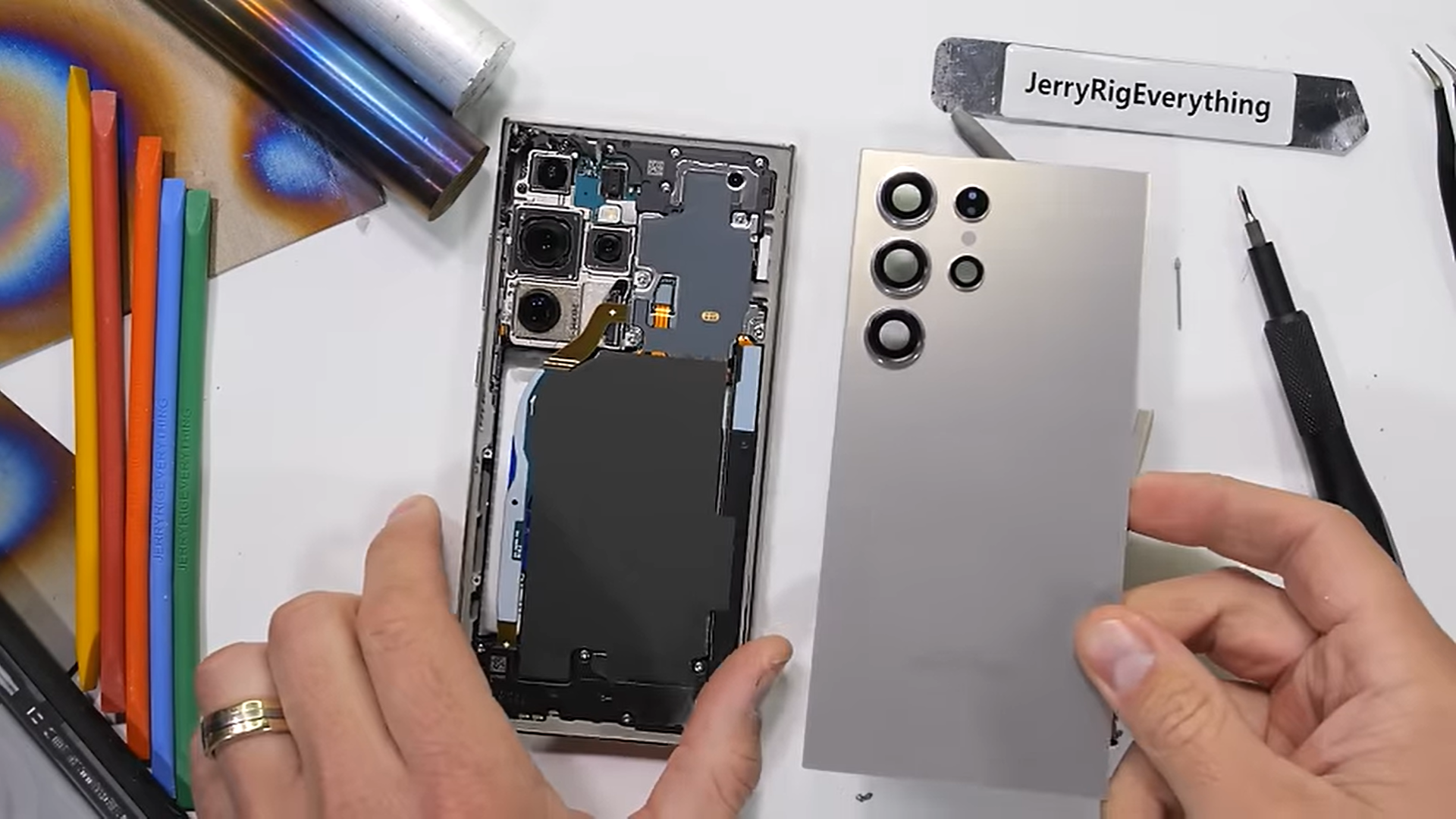
Recent technological teardowns have revealed intriguing insights about the construction and materials used in the latest smartphone models. The Samsung Galaxy S24 Ultra, for instance, has been discovered to feature a simpler disassembly process, largely attributed to its adoption of a flat display. However, it’s not just the design that has captured the attention of tech enthusiasts; the composition of its frame has become a point of discussion as well.
Upon deconstructing the Galaxy S24 Ultra, investigators found that its frame, which was marketed for its titanium build, primarily consisted of aluminum. Under intense heat – specifically in a forge reaching temperatures around 2,000°F (1,100°C) – the aluminum components melted away with ease, leaving behind the titanium segments. Unlike the method used by Apple, which employs solid-state diffusion to blend the titanium into the iPhone 15 Pro series’ frame, Samsung’s titanium was integrated into the aluminum using a simpler over-molding technique with a plastic intermediary layer.
To delve deeper into the quality of titanium used, an X-ray fluorescence (XRF) analysis was conducted – a technique similar to the one used to assess the iPhone 15 Pro Max’s frame. The XRF scanner exposed that the titanium in the Galaxy S24 Ultra likely ranked at a grade 2 or 3, whereas the iPhone 15 Pro Max’s titanium reached a grade 5, indicating a higher quality of material.
Despite the variations in material quality and manufacturing processes, the Samsung Galaxy S24 Ultra’s frame was observed to be slightly thicker than the iPhone equivalent. Nonetheless, the exact weight of the remnants from the teardown was not recorded. From a cost perspective, it was estimated that Samsung spent approximately $3 to $5 on titanium for each Galaxy S24 Ultra, while Apple invested around $10 to $15 worth of titanium for each iPhone 15 Pro Max device.
Regardless of these discoveries, the Galaxy S24 Ultra has established itself as one of the most robust high-end smartphones on the market in 2024, marking a significant evolution in its design and construction.
The interest in these technological advancements stretches beyond mere gadgetry. The use of materials such as titanium in consumer electronics reflects a push towards more durable, premium devices capable of withstanding the rigors of daily use. As smartphones continue to play a pivotal role in our lives, the attention to their build quality remains an integral aspect of their overall value and consumer appeal.