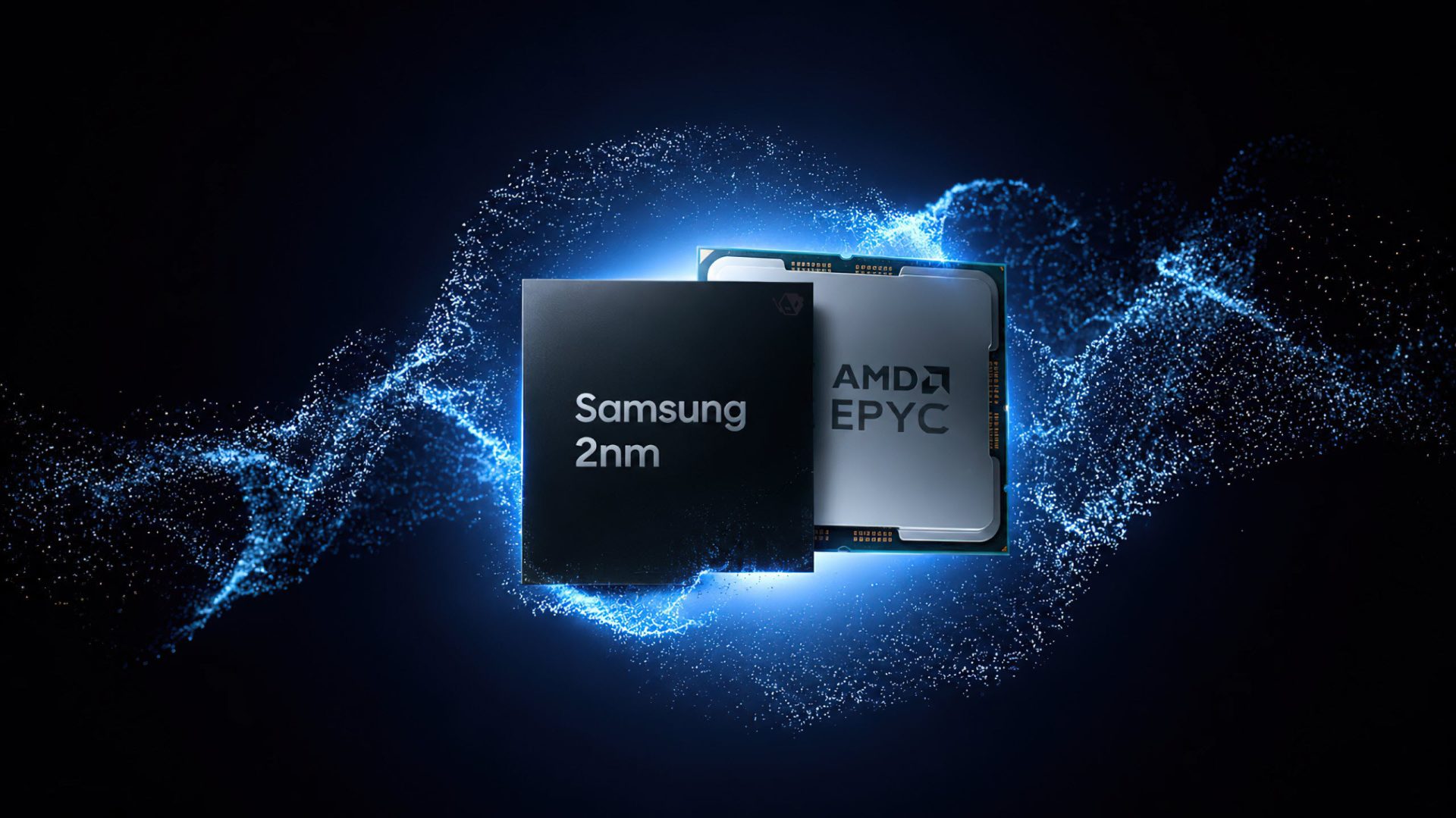
Fresh chatter from Korea’s Daishin Securities suggests Samsung Foundry may have landed a significant new 2nm notebook CPU order from a “North American fabless customer.” While the original note doesn’t name names, the latest speculation increasingly points to AMD—especially given how neatly the claim matches the rumors that have been building for weeks.
If AMD really is lining up Samsung to manufacture its next-generation 2nm CPUs, the move would be both strategic and timely. Advanced manufacturing capacity at the very top end of the industry has been under intense pressure, and leading-edge node availability is widely expected to remain tight for years. In that environment, securing a second high-end foundry partner could help AMD protect launch timelines, stabilize supply, and scale volumes more confidently.
The idea isn’t coming out of nowhere, either. Reports have indicated AMD has been in active discussions with Samsung about a potential manufacturing arrangement, and AMD CEO Lisa Su was even said to have visited Samsung’s Pyeongtaek foundry campus to evaluate capabilities firsthand. When executive-level visits happen around cutting-edge process nodes, they tend to signal more than casual interest.
Why Samsung, and why now?
The most straightforward explanation is capacity. With the most advanced production lines across the industry heavily booked, AMD may see Samsung’s 2nm gate-all-around (GAA) process as the best available path to get next-gen chips produced in meaningful quantities on schedule. There’s also an additional angle that could make Samsung even more attractive: memory. Samsung is one of the world’s biggest DRAM suppliers, and tighter coordination around CPUs and memory procurement could be a valuable sweetener in any broader partnership—particularly as data center and AI demand keeps pushing component supply chains to their limits.
What these “Venice” and “Verano” CPUs are expected to be
According to the current information circulating, AMD’s Venice is a major 2026-era CPU platform that could scale up to 256 Zen 6C cores. The rumored layout calls for eight CCDs (Core Complex Dies), each carrying 32 cores, which would position Venice as a serious high-density option for servers and other compute-heavy deployments.
Verano, meanwhile, is described as a Venice-family variant tuned specifically for agentic AI workloads such as inference. It’s expected to arrive later, potentially in 2027, and is rumored to pair as the host CPU platform for AMD’s Instinct MI500-series GPUs. Verano is also associated with AMD’s next architectural step, with expectations pointing toward Zen 7.
Backstop plan or dual-sourcing strategy?
One of the biggest unanswered questions is whether Samsung would be a fallback option or a true co-equal manufacturing partner. If Samsung is mainly serving as a backstop—insurance in case primary capacity is constrained—then production volumes could be relatively limited. But if AMD decides to split production between multiple foundries, Samsung could end up building a meaningful portion of Venice and Verano output.
That decision will likely hinge on a few core realities of advanced node manufacturing, especially yields. Even if a process is promising on paper, the real-world success of high-volume production depends on whether defect rates and performance targets can be met consistently at scale. In other words: Samsung’s 2nm GAA yields could be the determining factor in how big this relationship becomes.
AMD’s manufacturing momentum continues
The timing of this rumor also fits a broader picture: AMD has been aggressively positioning itself to secure wafer supply wherever opportunities open up. The company has reportedly been able to strengthen recent earnings by ramping production of older 5nm CPUs using newly available 4nm and 5nm capacity that other chip designers recently vacated. It’s a reminder that in today’s market, manufacturing access can be just as decisive as chip design.
For now, the Samsung-AMD 2nm story remains unconfirmed, but the pieces line up: persistent rumors, credible market commentary, executive-level engagement, and a clear business reason for AMD to diversify leading-edge supply. If the partnership is real, it could shape how AMD brings its next wave of high-core-count CPUs and AI-focused platforms to market over the next two years.