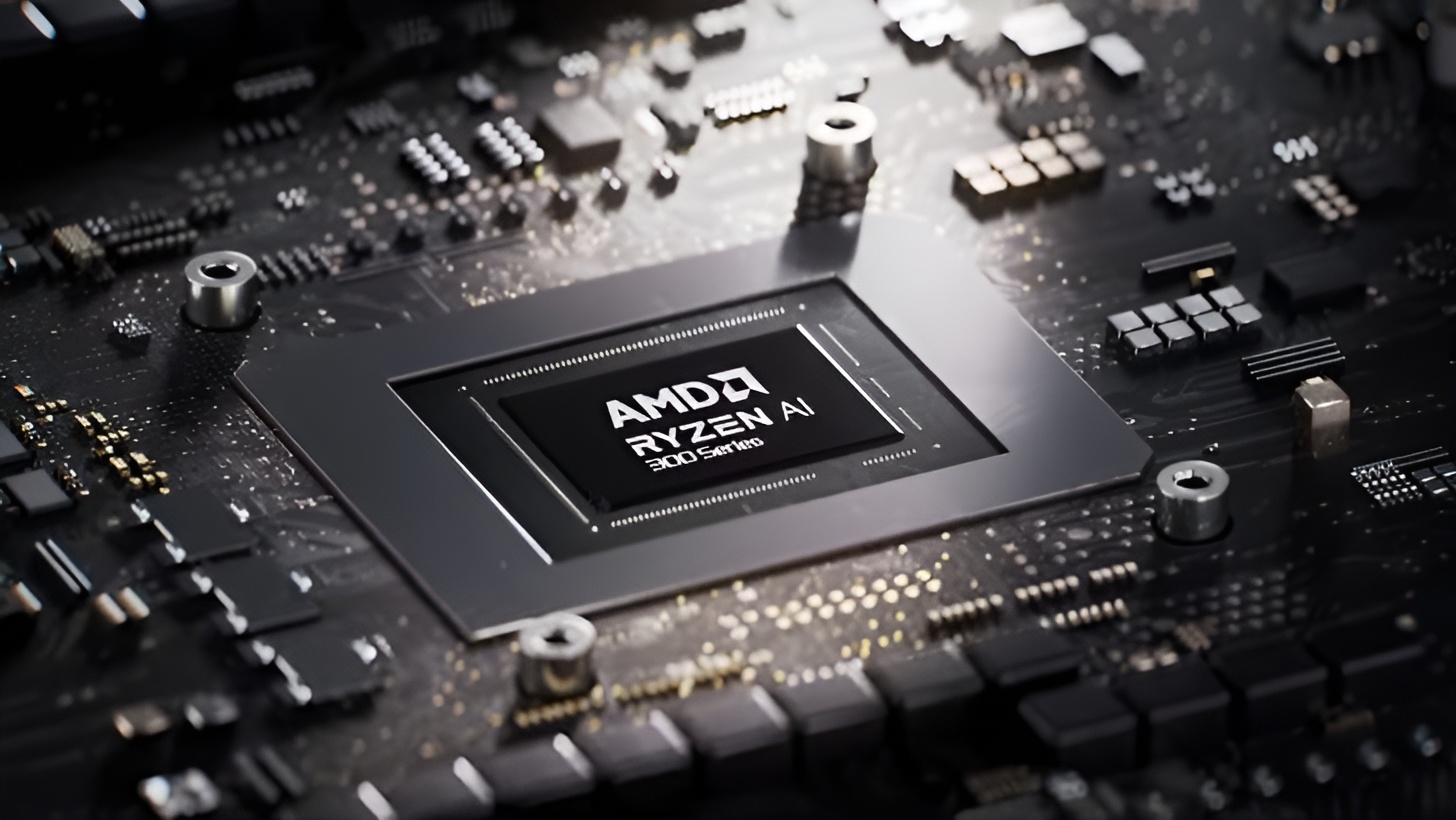
AMD’s latest Strix Point APUs are making waves in the tech world by offering remarkable performance enhancements in AI large language model (LLM) workloads, surpassing Intel’s Lunar Lake chips. The ever-growing demand for improved AI processing power has spurred fierce competition among tech giants, leading companies to roll out specialized hardware to stay ahead.
AMD’s Strix Point processors, designed for mobile platforms, have positioned themselves as frontrunners in AI tasks. According to the company’s latest insights, these processors not only lead in performance but also show significant reductions in latency, ensuring faster results. Dubbed the Ryzen AI 300 series, these processors can churn out more tokens per second compared to Intel’s equivalent offerings.
Specifically, the Ryzen AI 9 HX 375 demonstrates a staggering 27% performance advantage in consumer LLM applications within the LM Studio environment when pitted against Intel’s Core Ultra 7 258V. While the Core Ultra 7 isn’t Intel’s top-tier chip, it still holds its ground in terms of core/thread count, marking a fair comparison.
AMD’s LM Studio, built on the llama.cpp framework, is an accessible tool for users eager to leverage LLM technologies without diving into the technical complexities. Although it operates efficiently on CPUs, GPU acceleration is an option for even greater performance, thanks to its compatibility with AVX2 instructions.
In terms of latency, the Ryzen AI 9 HX 375 stands out, offering up to 3.5 times lower latency, achieving 50.7 tokens per second versus Intel’s 39.9 tokens per second in specific tests. Strix Point APUs notably enhance LLM tasks with robust integrated graphics based on the RDNA 3.5 architecture. Through Vulkan API support, these graphics can significantly bolster performance, offering as much as a 31% boost for certain tasks.
Adding another layer of efficiency, AMD’s Variable Graphics Memory (VGM) allows for optimized memory allocation for tasks aimed at the integrated GPU. This leads to enhanced power efficiency and a commendable overall performance increase, boosting outputs by up to 60% when combined with GPU acceleration.
In a bid to ensure a balanced comparison, AMD ran both their processors and Intel’s counterparts through the Intel AI Playground under identical conditions. The Ryzen AI 9 HX 375 managed to outperform the Core Ultra 7 258V, clocking in 8.7% faster on certain AI benchmarks and providing up to 13% speed improvements on specific models.
As AMD continues its push to democratize access to AI technologies, the company aims to make LLMs approachable for users regardless of their technical background. Their investment in tools like the LM Studio reflects a commitment to ensuring that cutting-edge AI capabilities are within everyone’s reach.