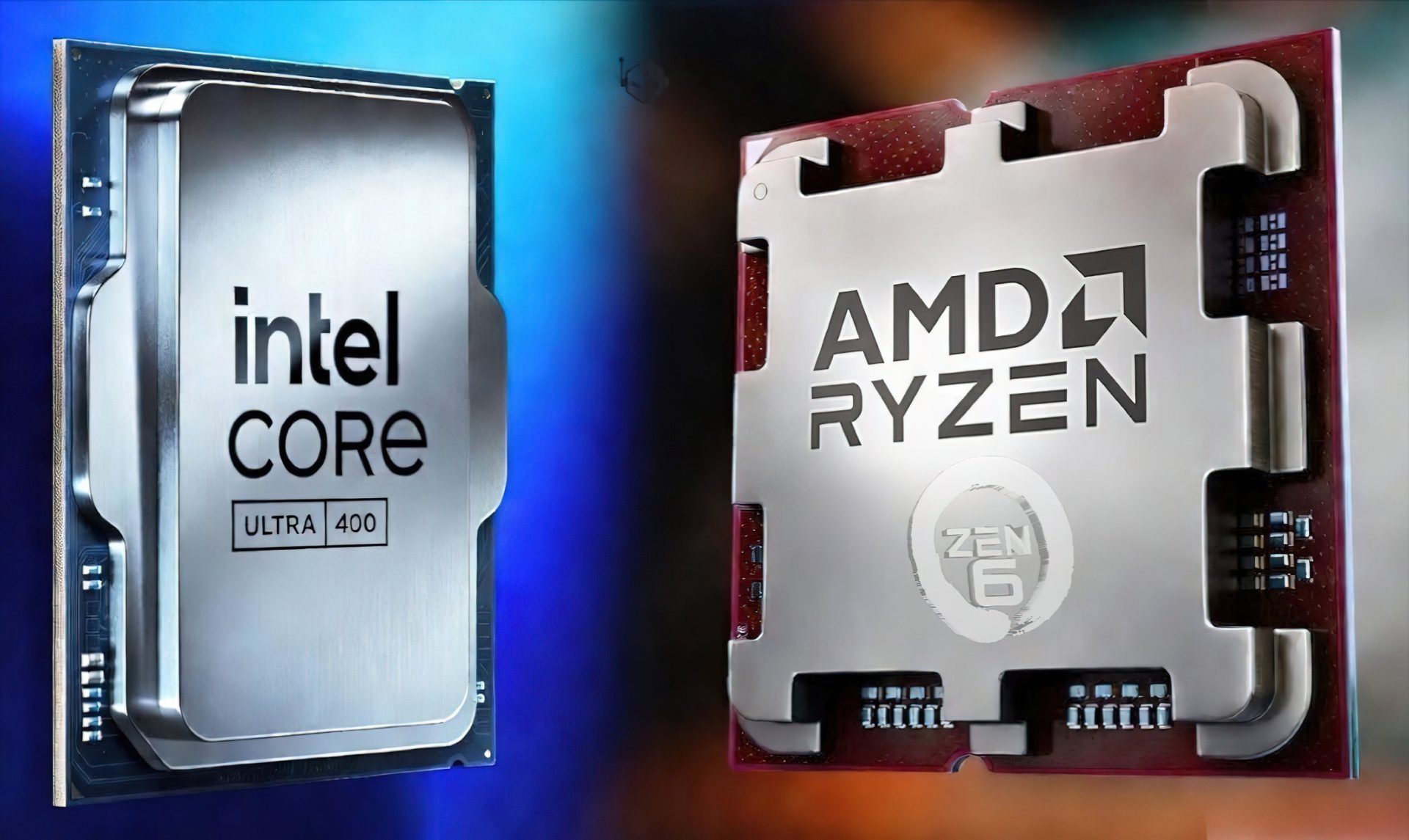
Fresh rumors about Intel’s next-generation Nova Lake CPUs are starting to pick up steam, and the early chatter suggests the upcoming Intel vs AMD showdown could come down to a familiar formula: Intel pushing instructions-per-clock (IPC) leadership, while AMD aims to win on raw clock speeds.
According to a new leak shared by well-known hardware leaker HXL (@9550pro), Intel’s Coyote Cove performance cores (P-cores) may deliver higher IPC than AMD’s Zen 6. Coyote Cove is expected to power Nova Lake’s P-core side, paired with Arctic Wolf efficiency cores (E-cores). On AMD’s side, Zen 6 is lined up for next-gen Ryzen CPUs, with more efficient Zen 6C variants also expected to appear in future APUs.
It’s important to note that Intel and AMD haven’t officially detailed Coyote Cove or Zen 6 yet, so all performance expectations should be treated as speculation for now. Still, the claim isn’t coming out of nowhere. Recent testing referenced in the rumor points to Intel’s current Cougar Cove P-core design (used in Panther Lake) showing stronger IPC than AMD’s Zen 5 in SPEC CPU 2017 results. Additional claims suggest Intel’s other recent core designs, including Darkmont E-cores and Lion Cove P-cores, also rate ahead of Zen 5 in IPC-focused measurements.
That said, AMD’s Zen architecture family is known for delivering major generational improvements, and Zen 6 is expected to be a significant update. If AMD lands a substantial uplift, the gap implied by early rumors could narrow quickly—or even flip—once real benchmarks arrive.
Where AMD may take the lead, however, is frequency. Right now, Intel and AMD are essentially tied at the top end of boost clocks, with both flagship desktop parts reaching up to around 5.7 GHz. Intel previously had the clear advantage during its 14th Gen era, where boost clocks pushed past 6 GHz, but subsequent designs reportedly stepped back somewhat in peak frequency.
Looking ahead to Zen 6, the rumor mill suggests AMD could reclaim the clock-speed crown, potentially hitting 6.0 GHz or higher—especially if its next chips take advantage of TSMC’s N2P process. Intel is expected to push Nova Lake clocks as far as possible too, but the bigger headline for Intel may be another area entirely: core counts.
If the leaked platform expectations hold, Nova Lake could scale aggressively, with talk of up to 28 cores in laptop configurations and as many as 52 cores on desktop. There’s also mention of extremely large cache figures, potentially reaching up to 288 MB in some configurations, depending on how final designs and SKUs are structured.
A rumored comparison of the upcoming desktop platforms paints an interesting picture for late 2026, with Nova Lake-S (Core Ultra 400-series branding has been floated in leaks) going up against AMD’s Zen 6-based “Olympic Ridge” Ryzen lineup (often referred to informally as Ryzen 10000-series in speculation). The leak suggests both could use TSMC N2P, with Intel offering a hybrid design (P-cores, E-cores, and low-power E-cores) while AMD sticks to an all-Zen approach. Memory support rumors also point to high-speed DDR5 and CUDIMM support being part of the conversation for both sides.
Timing-wise, the current expectation is that Intel Nova Lake and AMD’s Zen 6 desktop Ryzen launch windows could land in the same general timeframe, with most speculation pointing toward the second half of 2026. If that happens, PC builders and upgraders may be looking at one of the most competitive CPU battles in years—one where IPC, clock speed, cache, and core counts all collide in a true flagship slugfest.
For now, treat everything as early leaks rather than confirmed specs. But if these rumors are even close to accurate, Intel vs AMD in 2026 could be less about a single “winner” and more about which performance style you value most: higher per-core efficiency, higher peak clocks, or sheer multi-core muscle.