RTX 5090 GPUs Are Reportedly Being Converted Into AI Server Cards in Chinese Workshops
Rumors about the GeForce RTX 5090 being discontinued may have sounded surprising, but new footage from China suggests the story around NVIDIA’s flagship GPU is far more complicated. Instead of disappearing from the market entirely, large numbers of RTX 5090 graphics cards are reportedly showing up inside Chinese modification workshops, where they are being stripped down and rebuilt for AI server use.
According to the circulating footage, shelves inside one Chinese lab appear to be packed with high-end GeForce RTX 5090 cards from multiple board partners. Some of the models shown include premium versions aimed at gaming enthusiasts, including extremely expensive custom designs that normally target the top end of the consumer GPU market.
But these cards are not being prepared for gaming PCs. Instead, technicians are reportedly removing the GPU core and GDDR7 memory chips from the original graphics card boards. Those components are then transferred onto custom PCBs designed specifically for server environments.
The reason is simple: AI workloads are driving huge demand for powerful GPUs with large amounts of fast memory. The RTX 5090 offers 32 GB of high-speed GDDR7 memory and strong AI performance, making it attractive for companies and labs looking to build AI systems. Even though it is sold as a consumer gaming graphics card, its raw compute capability makes it valuable beyond gaming.
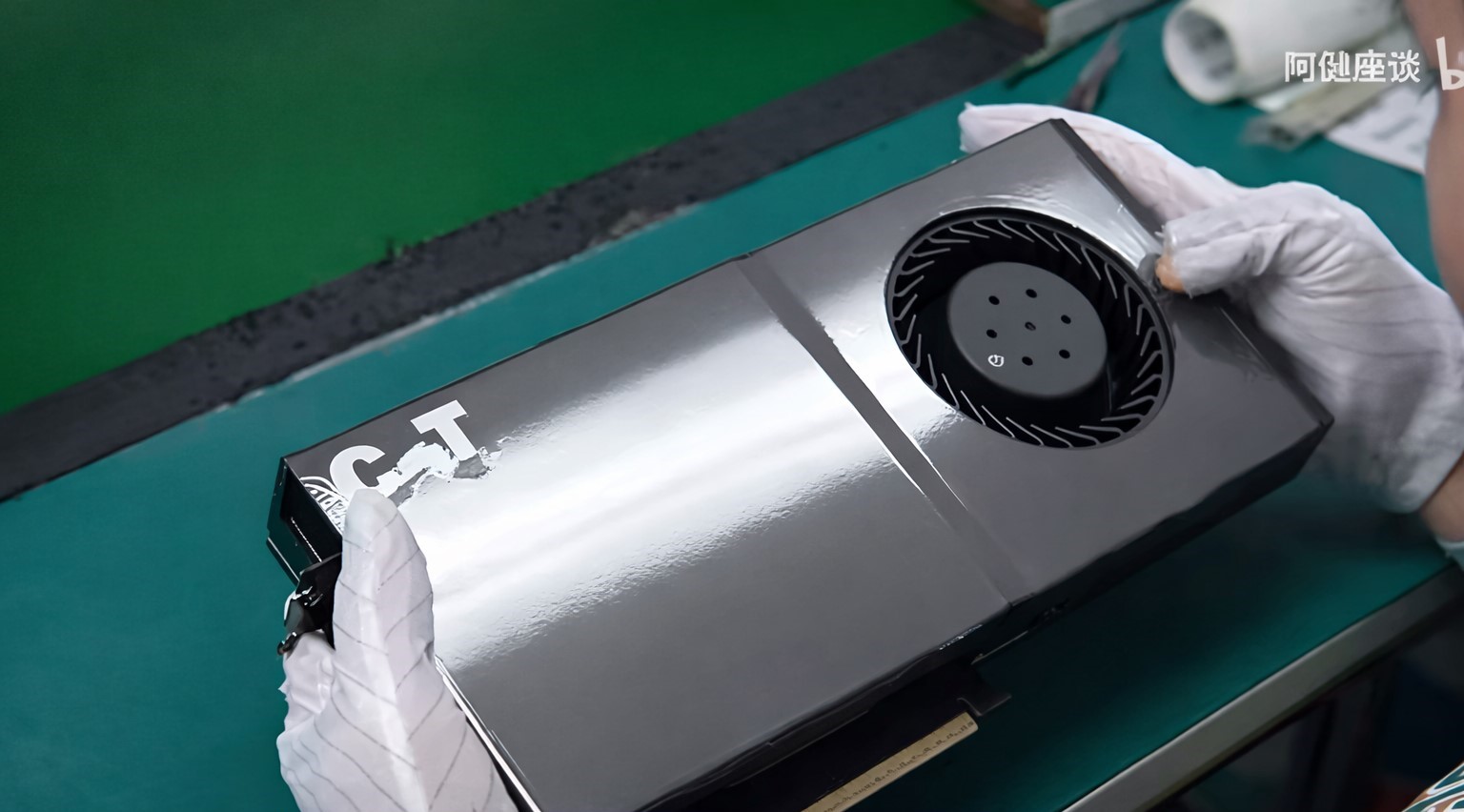
The modified cards reportedly use a dual-slot blower-style cooler rather than the large triple-fan coolers found on most retail RTX 5090 models. This change allows the cards to fit more easily into dense AI server systems, where space and airflow management are major concerns. Traditional gaming coolers are often too large for rack-mounted servers, while blower-style designs can push hot air out more efficiently in compact multi-GPU setups.
This is not the first time high-end consumer GPUs have been repurposed for AI in China. Similar activity was reported with previous flagship GPUs, as demand for AI acceleration continued to rise. The RTX 5090 appears to be following the same pattern, with gaming-focused graphics cards being redirected into the AI hardware supply chain.
The situation also raises questions about availability for regular buyers. If large quantities of RTX 5090 cards are being purchased in bulk and converted into AI accelerators, that could reduce the number of units reaching gamers, PC builders, and workstation users through normal retail channels. This may also contribute to inflated pricing, especially for premium variants that are already expensive.
NVIDIA has reportedly pushed back against claims that the RTX 5090 has been discontinued. However, the appearance of large inventories inside conversion facilities suggests that at least some supply may be flowing toward AI server demand rather than traditional consumer sales.
For gamers, the news may be frustrating. The RTX 5090 is expected to represent the peak of consumer graphics performance, but if the card is more profitable in AI deployments, availability in retail markets could remain limited. AI companies are often willing to pay much higher prices for high-performance GPUs, especially when supply is tight.
The bigger picture is clear: top-tier GPUs are no longer just gaming products. Modern flagship graphics cards now sit at the center of multiple industries, from gaming and content creation to machine learning and data-center workloads. The RTX 5090’s powerful architecture and large memory capacity make it especially appealing for AI, even if that was not the only market it was designed for.
If these reports are accurate, many RTX 5090 cards that gamers hoped to see on store shelves may instead end up inside AI servers after being dismantled and rebuilt. For now, the flagship GPU remains one of the most sought-after graphics cards in the world, but its final destination may not be a gaming PC.