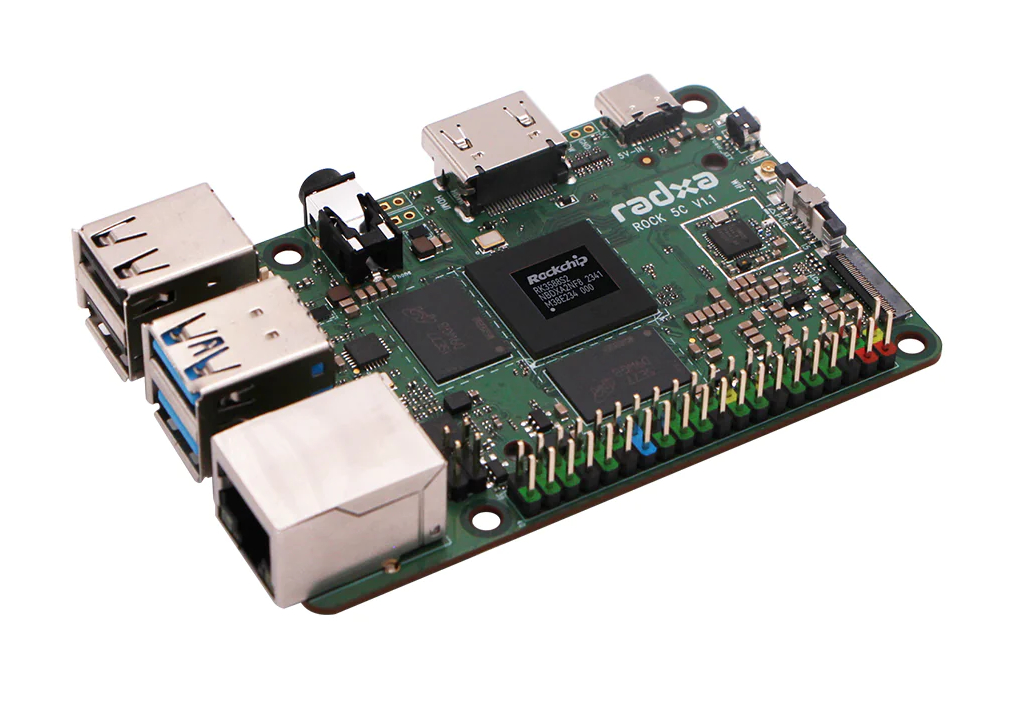
Radxa has once again updated its Rock series of single-board computers (SBCs) with the introduction of two new models, the Rock 5C and Rock 5C Lite, shortly after the release of the Rock 5A Pink Edition. Designed to be a competitor to the anticipated Raspberry Pi 5, the Rock 5C stands out with its compact dimensions, measuring just 85 x 56 mm, which will appeal to hobbyists and professionals alike.
The core of the Rock 5C is the powerful Rockchip RK3588S2 chipset, ensuring the SBC is a powerhouse for a variety of tasks. Users have the flexibility to choose from a range of LPDDR4x RAM options, from 2 GB to an impressive 32 GB, depending on their project requirements. This versatility in memory capacity makes the Rock 5C appealing to different use cases, from simple educational projects to more robust computing applications.
One of the Rock 5C’s defining features is its CPU configuration which is comprised of a mix of cores: four ARM Cortex-A76 cores and four Cortex-A55 cores. This octa-core setup strikes a balance between performance and efficiency, catering to both demanding applications and energy-conscious projects.
Adding to its multimedia prowess is the Mali-G610 MP4 GPU, which is capable of handling intense graphical tasks. Notably, the Rock 5C boasts video capabilities that support encoding and decoding of up to 8K resolution videos. However, while 8K video decoding can reach an impressive 60 frames per second (FPS), it’s worth highlighting that encoding at the same resolution is capped at 30 FPS. This limitation is something users planning to work with high-resolution video content should consider.
For those interested in AI and machine learning applications, the Rockchip RK3588S2 chipset includes a Neural Processing Unit (NPU) delivering up to 6 TOPS of theoretical AI performance. This feature opens the door for developers to incorporate advanced AI capabilities into their projects, which could range from data analysis to real-time object recognition.
In terms of connectivity, the Rock 5C does not disappoint. It offers a generous array of input/output options, reflecting Radxa’s commitment to versatility and expandability in its SBCs. This makes the board suitable for a range of scenarios, whether you’re designing a smart home setup, creating an embedded system, or constructing a personal server.
As the small computing space continues to grow, the Radxa Rock 5C and Rock 5C Lite present themselves as strong contenders against popular names like the Raspberry Pi, thanks to their robust performance capabilities, ample I/O options, and consideration for future-forward features like AI and 8K video support. With these attributes, Radxa’s latest offerings are poised to capture the attention of both enthusiasts and professional users seeking a reliable and versatile SBC solution.