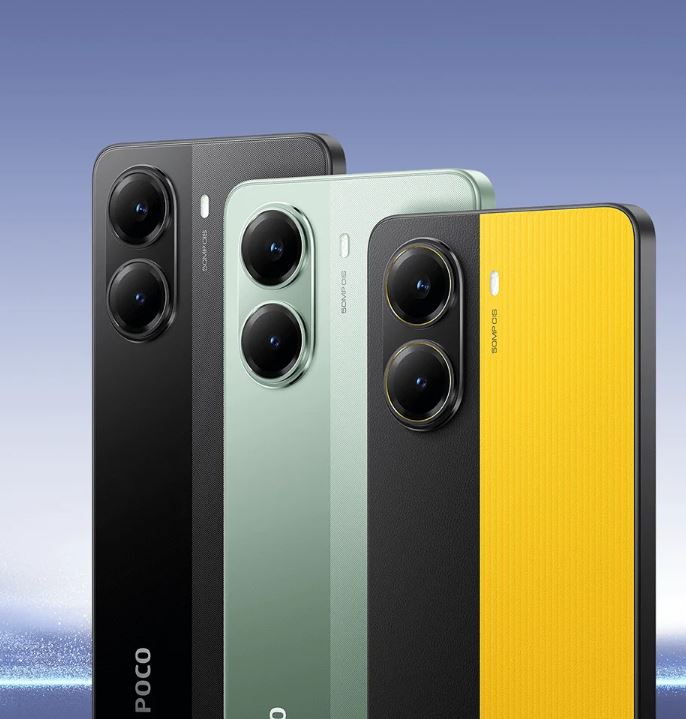
Xiaomi has recently unveiled its latest players in the smartphone arena with the launch of the Poco X7 series. These new entrants, the Poco X7 and Poco X7 Pro, are crafted to appeal to budget-conscious tech enthusiasts who prioritize performance. At the heart of the Poco X7 Pro is the Dimensity 8400 Ultra chipset, providing a power-packed punch. But how does this new chipset fare against last year’s contender, the Dimensity 8300 Ultra found in the Poco X6 Pro?
Let’s dive into the numbers. When put to the test with Geekbench 6, the Poco X7 Pro scored 1,579 in single-core performance and 6,100 in multi-core performance. Its predecessor, the Poco X6 Pro, while still impressive, garnered scores of 1,424 for single-core and 4,527 for multi-core testing.
On the AnTuTu benchmark, the advancements continue to shine. The Poco X7 Pro scored a commendable 359,485 for CPU performance, overshadowing the Poco X6 Pro, which clocked in at 290,365. For GPU enthusiasts, the Poco X7 Pro achieved a score of 574,754 on AnTuTu’s GPU test, surpassing the Poco X6 Pro’s score of 514,295.
While we don’t have specific 3DMark scores for the Poco X7 Pro, insights can be gleaned from its close sibling, the Redmi Turbo 4, which managed an impressive 4,086 on the Wild Life Extreme test. This contrasts with the Poco X6 Pro’s score of 3,068 from last year’s assessments.
Interestingly, the Redmi Turbo 4 consistently outperforms the Poco X7 Pro on numerous benchmarks, despite sharing the same powerhouse chipset.
In summary, the performance improvements in the Poco X7 Pro, powered by the Dimensity 8400 Ultra, illustrate a clear 20% advancement over its predecessor, both in CPU and GPU capabilities. These enhancements mark a noteworthy leap, offering users upgraded performance without breaking the bank. While the improvements are solid, they are more evolutionary than revolutionary, solidifying Xiaomi’s position in the competitive smartphone market.