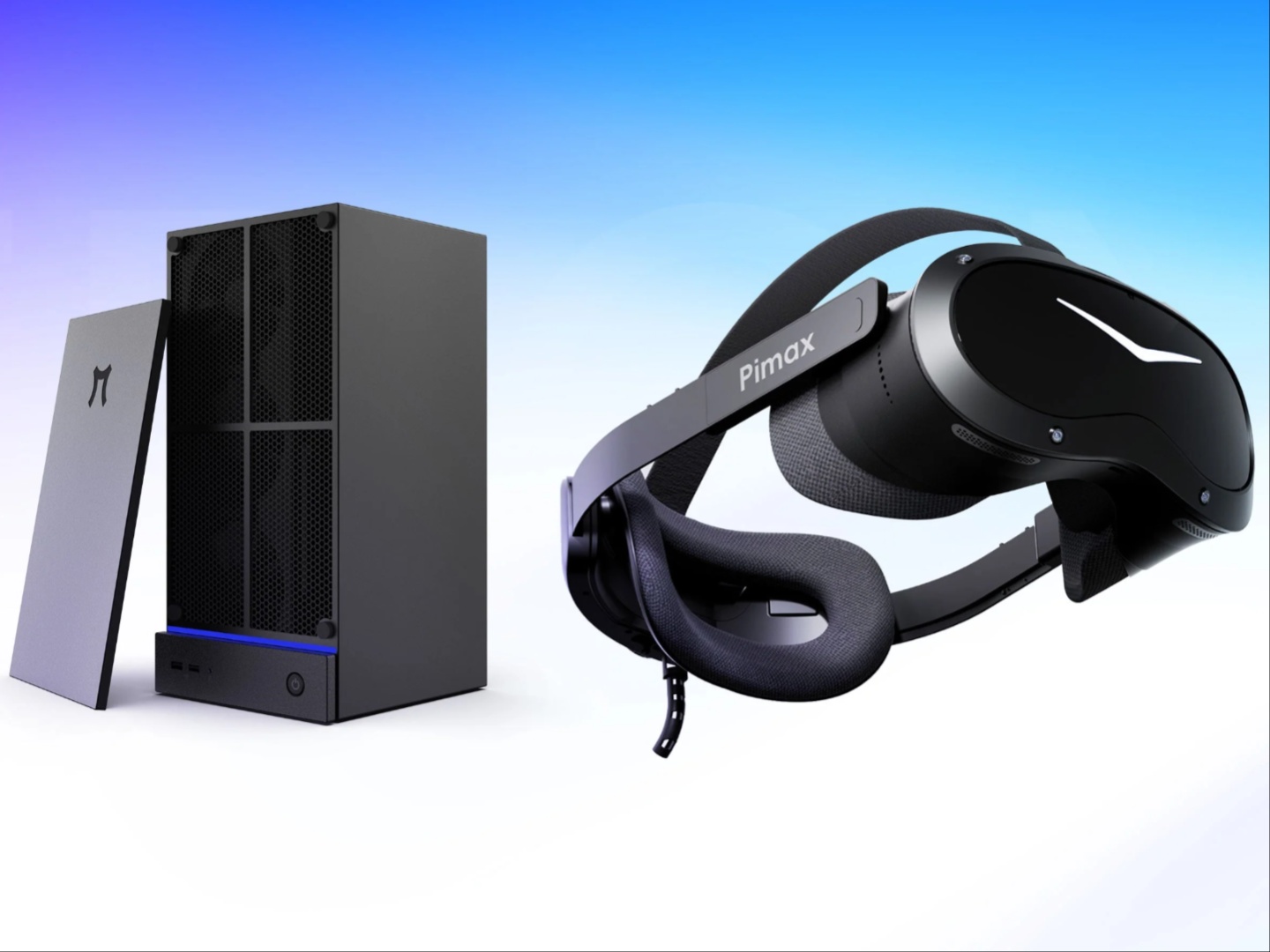
Pimax Unveils Crystal Pro VR Headset and Spation Mini-PC to Challenge Valve’s Steam Hardware
Pimax is making a bold move in the high-end virtual reality and compact gaming PC space with two new products: the Pimax Crystal Pro VR headset and the Pimax Spation mini-PC. The Crystal Pro expands the company’s premium VR headset lineup, while the Spation aims to deliver desktop-class gaming performance in a smaller, console-style form factor.
Together, these devices appear designed to compete directly with Valve’s Steam Frame and Steam Machine, offering serious hardware for users who want powerful VR gaming, wireless freedom, and a compact PC setup without sacrificing performance.
The Pimax Crystal Pro is a standalone VR headset that can also connect to a gaming PC, giving users flexibility depending on how they want to play. It supports both wired and wireless PC VR connections, making it suitable for users who want a portable VR experience as well as those who prefer maximum visual quality through a direct connection.
For wireless use, Pimax includes a dedicated Wi-Fi adapter in the box. However, users who want uncompressed Native Foveated Streaming will need the optional third-generation 60G AirLink kit. This kit uses two room antennas and a 2×2 MIMO 60GHz setup, designed to deliver a stronger, lower-latency wireless VR experience with improved image quality.
For wired PC VR, the Crystal Pro includes a DisplayPort 1.4a connection. This should appeal to VR enthusiasts who want a more stable, high-bandwidth connection for demanding games and simulation titles.
One interesting design decision is the lack of an internal battery. Instead, Pimax has moved the battery outside the headset to reduce weight on the user’s head. The included external battery pack offers a 16,000 mAh capacity, which should help extend play sessions while keeping the headset more comfortable to wear.
Inside, the Crystal Pro runs on the Snapdragon XR2 Gen 1 chipset. The headset uses TFT QD-LCD displays, also referred to as QLED panels, with a resolution of 2,880 x 2,880 pixels per eye. That high pixel count positions the headset as a strong option for users who value sharp visuals, clearer text, and more detailed virtual environments.
The headset also supports a field of view of up to 110 degrees and a refresh rate of up to 120Hz. These specifications should help create smoother motion and a more immersive VR experience, especially in fast-paced games, racing simulators, flight simulators, and interactive 3D environments.
Pimax is also offering swappable faceplates for different tracking systems. Users can choose between SLAM 2.0 inside-out tracking or Lighthouse tracking, giving the Crystal Pro more flexibility depending on the user’s current VR setup.
Alongside the Crystal Pro, Pimax introduced the Spation, a compact mini-PC built with desktop-class components. While it has a smaller chassis than a traditional tower, it is designed to deliver the kind of performance usually associated with full-size gaming desktops.
The standard configuration of the Pimax Spation includes an AMD Ryzen 7 9800X3D processor, making it a particularly interesting option for gamers. The system can be configured with either a Radeon RX 9070 XT or an Nvidia GeForce RTX 5070 Ti graphics card. It also includes 32GB of DDR5 memory, a 1TB M.2 NVMe SSD, and a 1,000W SFX power supply.
Because the Spation uses desktop hardware, some components should be upgradeable. This gives it a major advantage for users who want a compact gaming PC but do not want to be locked into fixed hardware forever. Pimax also plans to offer a DIY kit version, allowing buyers to add their own storage and graphics card.
Connectivity is another major focus for the Spation. The mini-PC includes Wi-Fi 7, Bluetooth 5.4, and 2.5G Ethernet for fast networking. For display output and accessories, it comes with two DisplayPort 2.1 ports, one HDMI 2.1 port, one USB-C port with DisplayPort 1.4a support, one USB4 Type-C port, and six USB 3.2 Gen 2 Type-A ports.
The design of the Spation has a gaming-console feel, with a front LED bar, two front USB ports, and a power button. It appears taller than Valve’s Steam Machine, but Pimax has not yet confirmed its exact dimensions.
Pricing for the Pimax Crystal Pro starts at $1,399 for the headset and external battery. Buyers who want the Crystal Pro bundle with the 60G AirLink kit will need to pay $1,899. Reservations are already open, with hands-on demos expected to begin in the fourth quarter. Shipping is currently planned for 2027.
Pimax has not yet announced pricing for the Spation mini-PC. However, its specifications suggest it will target users who want significantly more performance than a typical compact gaming box.
For comparison, Valve’s Steam Frame starts at $1,059 for the 256GB model and rises to $1,299 for the 1TB version. The Steam Machine starts at $1,049 for the 512GB model and goes up to $1,349 for the 2TB configuration.
With the Crystal Pro and Spation, Pimax is clearly targeting serious VR users and PC gamers who want premium hardware. The Crystal Pro focuses on high-resolution visuals, flexible tracking, and advanced wireless streaming, while the Spation brings powerful desktop components into a smaller chassis.
If Pimax delivers on its promises, the Crystal Pro and Spation could become compelling options for gamers looking for a high-end VR headset and a compact gaming PC built for demanding virtual reality experiences.