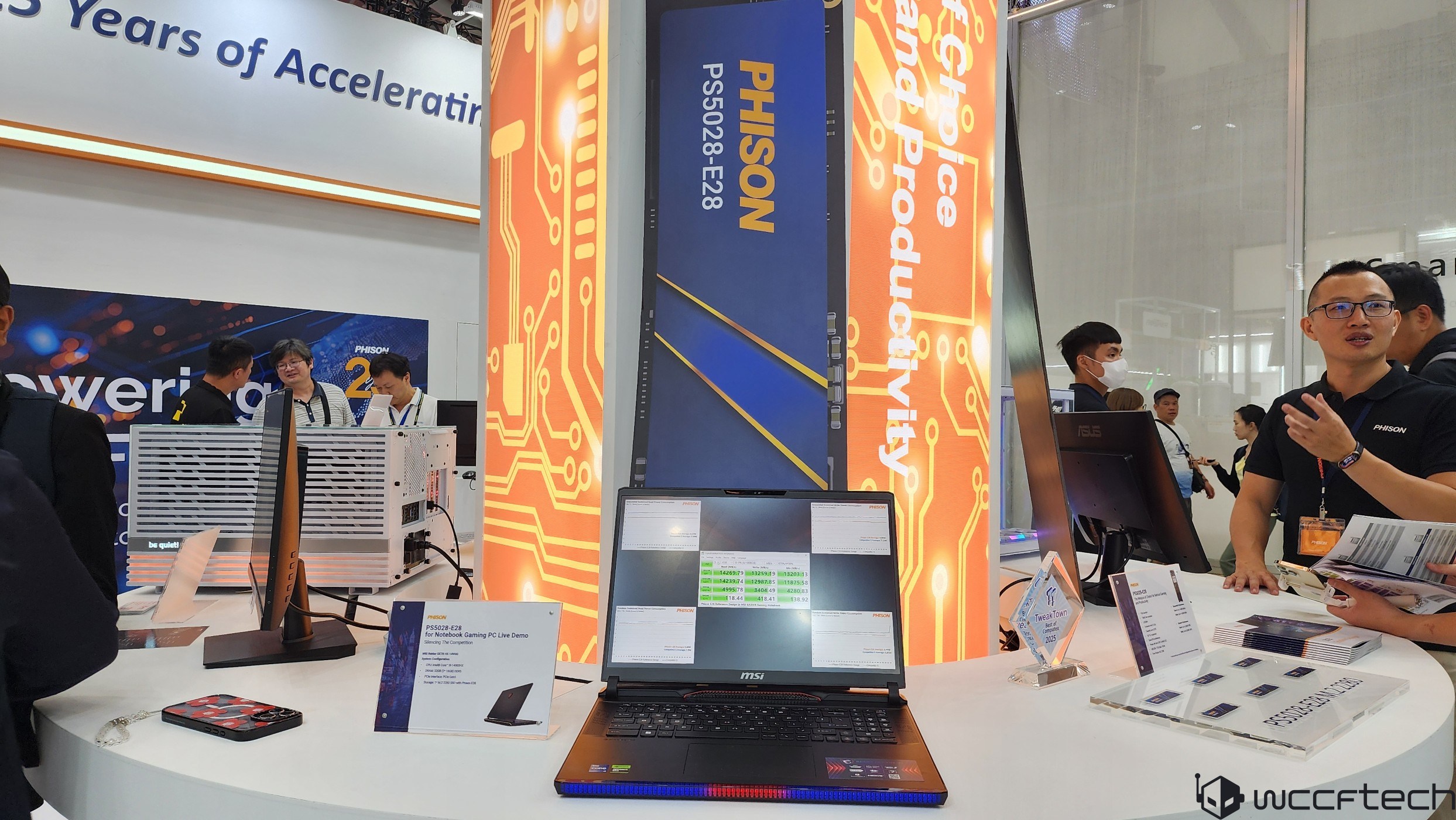
Phison has released benchmarks for its E28 Gen5 SSD controller, demonstrating impressive power efficiency compared to its competitor, Silicon Motion’s SM2508. Once thought to consume more power, the E28 now shows it’s a leader in low power consumption.
The E28 Gen5 has been powering some of the market’s fastest storage devices. In benchmarks, it surpasses the SMI2508, showcasing how it excels in various tests. During Sequential Sustained Read tests, the Phison SSD runs at 6.17W, compared to the competitor’s 7.39W. In Write tests, it uses 6.06W versus 7.12W. This 1W reduction seems minor but is crucial in SSD design.
Furthermore, in Random Sustained Read/Write power tests, the E28 consumes 7.46W compared to the 7.9W of the competition. For write operations, it uses 5.44W while SMI uses 5.91W. Notably, the SMI controller experiences spikes due to early garbage collection, reaching nearly 8W.
The speed prowess of the E28 is equally impressive, achieving up to 14,942.85 MB/s in Read and 14,149.47 MB/s in Write speeds. In Random 4K benchmarks, it maintains strong performance.
Phison tested these on an AMD Gen5 platform, which delivers exceptional storage performance. Interestingly, Phison attributes some performance issues with Intel’s Core Ultra 200S platform to Gen5 lane latency. Intel’s recent CPUs offer better performance, making them preferable for Gen5 SSDs.
Moving forward, the Phison E31T “PS5031-E31T” M.2 SSD controller, a DRAM-less design, fits into 2230 and 2240 form factors, suitable for handhelds and laptops. The compact 2230 Gen5 SSD, expected in a next-gen handheld, promises enhanced performance and battery life.
For laptops, particularly those with OLED screens, the E31T SSDs increase battery efficiency while delivering high performance, overcoming the power demands of OLED displays.
An APEX storage benchmark demonstrated the potential of Phison’s Gen5 controllers by running 16 SSDs per APEX AIC. Despite Windows kernel limitations, the setup reached Read speeds of 113,601 MB/s and Write speeds of 104,628 MB/s, showcasing the remarkable speed capabilities of these SSD controllers.