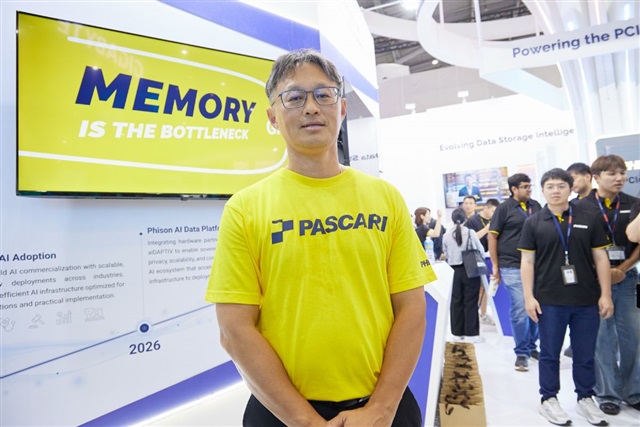
Phison CEO Predicts Years of NAND Flash Shortage as AI Demand Accelerates
Phison Electronics CEO Pua Khein-Seng believes the NAND Flash market is entering a major turning point, driven by the rapid rise of artificial intelligence and the growing role of AI agents. According to him, the surge in AI-related storage demand is creating a rare opportunity for Phison to evolve into a faster-growing and more influential technology company.
The key factor behind this outlook is the increasing need for high-capacity storage. As AI agents become more widely used across businesses, cloud platforms, consumer devices, and enterprise systems, the amount of data being generated, processed, and stored is expanding quickly. This is placing heavy pressure on NAND Flash supply, a critical component used in SSDs, smartphones, servers, data centers, and a wide range of electronic devices.
Pua said the current supply tightness is not a short-term issue. Instead, he expects NAND Flash shortages to continue for several years as demand from AI applications keeps rising. He also warned that capacity constraints in 2027 could be even more severe than those expected in 2026, suggesting that the industry may face a prolonged period of limited supply.
This outlook could have major implications for NAND Flash pricing. With demand outpacing available production capacity, prices may continue to climb. However, Pua noted that while there is still room for further price increases, the rate of growth is likely to slow over time. In other words, prices may keep moving upward, but the sharpest jumps could gradually ease as the market adjusts.
For Phison, this environment presents what Pua described as a once-in-a-lifetime opportunity. The company, known for its NAND controllers and storage solutions, stands to benefit from stronger demand across AI infrastructure, enterprise SSDs, and high-performance storage products. As artificial intelligence becomes more deeply integrated into everyday technology, storage suppliers with advanced solutions may play an increasingly important role in the broader AI ecosystem.
The comments also highlight a larger trend in the semiconductor industry. While much of the AI boom has focused on processors and accelerators, storage is becoming just as important. AI systems require enormous amounts of data to train models, run applications, manage inference workloads, and support autonomous software agents. That means NAND Flash is no longer just a background component; it is becoming a key part of the AI growth story.
If Pua’s forecast proves accurate, businesses and consumers could see continued pressure on SSD and storage-related product prices in the coming years. At the same time, companies positioned in the NAND Flash supply chain may benefit from stronger demand, improved pricing, and greater strategic importance as AI adoption expands worldwide.
Phison’s view is clear: the AI era is reshaping the storage market, and NAND Flash supply may remain tight well beyond 2026. With 2027 expected to bring even greater constraints, the industry could be entering a multi-year cycle where storage demand, pricing power, and AI-driven growth remain closely connected.