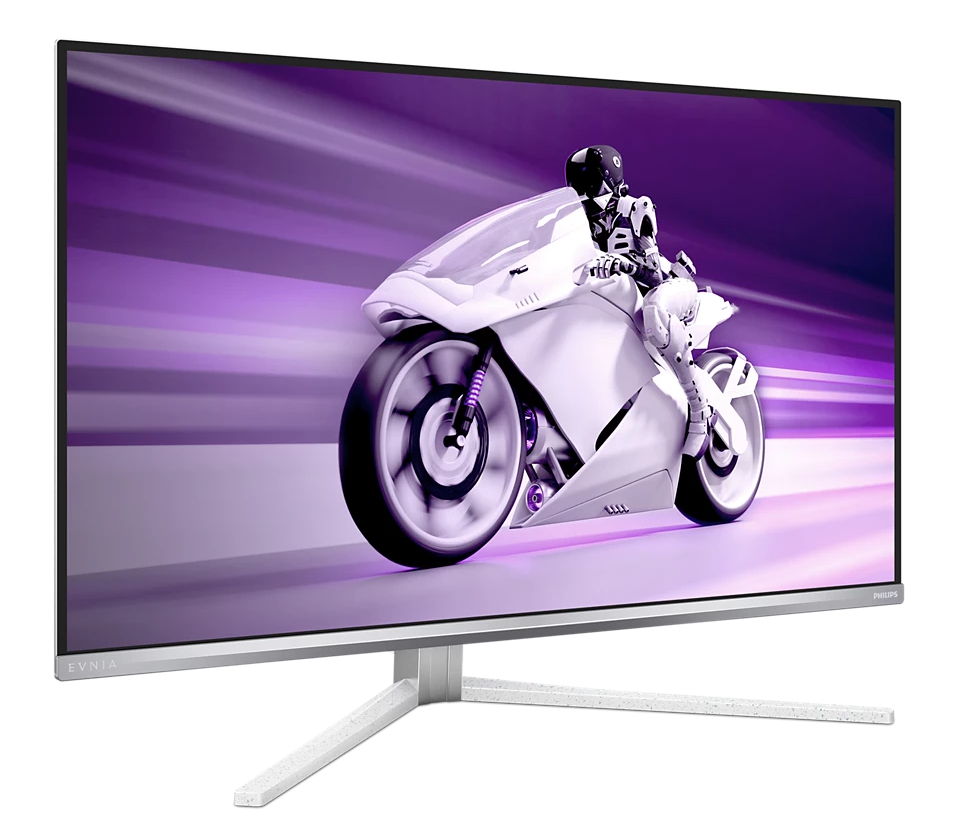
In the gaming world, competition is fierce, especially when it comes to hardware. Philips has made a notable entry into this space with the launch of the Evnia 32M2N8800 – a monitor poised to take on some of the giant names in the gaming display market. Philips expands its Evnia series, not only presenting various models in recent months but now adding the Evnia 32M2N8800, a 31.5-inch powerhouse boasting a native resolution of 3840 x 2160 pixels (4K/UHD).
This display isn’t just about high resolution, as it ramps up the game with a 240 Hz refresh rate accompanied by an impressive 0.03 ms gray-to-gray (GtG) response time, making it an enticing choice for gamers seeking both visual clarity and performance. The Evnia 32M2N8800 incorporates QD-OLED technology, developed by Samsung Display, providing vibrant colors and deep blacks.
While full specifications remain to be confirmed, features such as VESA DisplayHDR True Black 400 and a certification indicative of high motion picture quality hint at its use of a Gen 3 QD-OLED panel. This aligns it with several notable gaming monitors that have hit the market recently, such as the Alienware AW3225QF, ASUS ROG Swift OLED PG32UCDM, and MSI MPG 321URX, among others.
Philips is committing to high-end performance, citing a 1,000 nits peak brightness, though it’s important to note this is attainable across 3% of the panel at one time. For standard dynamic range (SDR) content, the monitor supports up to 250 nits brightness. Additionally, the Evnia 32M2N8800 comes with integrated speakers delivering a total output of 5 W, an ergonomic adjustable stand, and a USB hub to enhance connectivity.
I/O ports are not skimped on, with DisplayPort 1.4 and HDMI 2.1 available for diverse connectivity. Initially, Philips has marked the debut of this monitor in Hong Kong for HKD 8,990, which is around $1,151, and while international release details are not yet confirmed, the company typically rolls out its premium monitors on a global scale eventually.
This monitor certainly aims to pose a challenge to established brands and their offerings, demonstrating Philips’s commitment to carving out a space in the performance gaming segment. With gamers continuously seeking technology that can push their experience further, monitors like the Evnia 32M2N8800 serve as crucial components in the evolution of immersive gaming environments. Whether it will become a staple choice for gamers around the world remains to be seen, but its specs suggest it has the potential to shake up the market significantly.