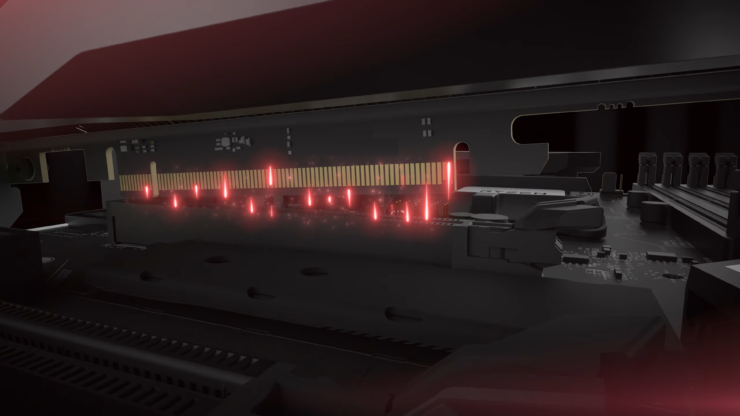
PCIe 8.0 hits a major milestone with a draft specification that points to a massive leap in performance, aimed squarely at advanced computing rather than everyday PCs. The standards body behind PCI Express confirmed that version 0.3 of the PCIe 8.0 spec is now complete and available to members, setting the stage for a new era of high-speed I/O.
What stands out is the raw throughput. PCIe 8.0 targets a signaling rate of 256 GT/s and up to 1.0 TB/s of bidirectional bandwidth over a standard x16 configuration. That’s eight times the bandwidth of PCIe 5.0, and it marks the first time a PCIe generation has reached the 1-terabyte-per-second club. It’s impressive—but it’s also designed for the kinds of workloads where every microsecond and every gigabyte per second matter: AI training and inference, large-scale machine learning, high-speed networking, edge deployments, and even quantum computing research.
If you’re a typical PC user, don’t expect PCIe 8.0 to land on your desktop anytime soon. PCIe 4.0 and 5.0 already provide ample bandwidth for consumer graphics cards and SSDs, and most current GPUs can’t fully utilize PCIe 5.0. Even PCIe 6.0 is expected to take time before it becomes commonplace in consumer systems, with broader mainstream adoption likely after 2030. In the enterprise and data center world, however, PCIe 6.0 is moving ahead, with early ecosystem activity such as new SSD controllers already appearing.
PCIe 8.0 continues the cadence of doubling bandwidth roughly every three years. Following the PCIe 7.0 announcement earlier this year, PCIe 8.0 is on track to be readied by 2028, extending the roadmap and reinforcing a predictable upgrade path for the high-performance computing industry.
Key technology details reflect a blend of cutting-edge signaling and practical compatibility. PCIe 8.0 keeps using PAM4 (Pulse Amplitude Modulation, 4-level) signaling, the same approach adopted for PCIe 6.0 and 7.0, to push higher data rates across lanes. At the same time, the standard aims to preserve the hallmark of PCIe: backward compatibility. That means future platforms should continue to support earlier generations of devices, which is critical for smooth transitions in large-scale deployments.
To make such extreme speeds viable, the group is also evaluating new connector technologies and interconnect solutions. Alongside raw bandwidth targets, the draft focuses on maintaining strict latency goals, meeting reliability requirements, refining forward error correction, optimizing power efficiency, and introducing protocol enhancements that help extract even more effective throughput.
PCIe 8.0 specification feature objectives include:
– Delivering 256.0 GT/s signaling rate and up to 1.0 TB/s bidirectionally via an x16 configuration
– Reviewing new connector technology and interconnect solutions
– Confirming latency and forward error correction targets
– Ensuring reliability goals are met at higher speeds
– Maintaining backward compatibility with previous PCIe generations
– Developing protocol enhancements to improve effective bandwidth
– Continuing to emphasize techniques that reduce power consumption
What it means in practice: data centers and research labs will be able to move larger datasets faster, interconnect accelerators more efficiently, and feed AI and HPC workloads with fewer bottlenecks. For consumers, the takeaway is that the PCIe ecosystem is future-proofing the infrastructure that powers cloud services, AI features, and next-gen applications—benefits you’ll feel indirectly long before PCIe 8.0 shows up in a home PC.
With the first draft complete and a clear roadmap ahead, PCIe 8.0 is poised to become the backbone of next-generation high-bandwidth computing, continuing the standard’s tradition of relentless, predictable progress.