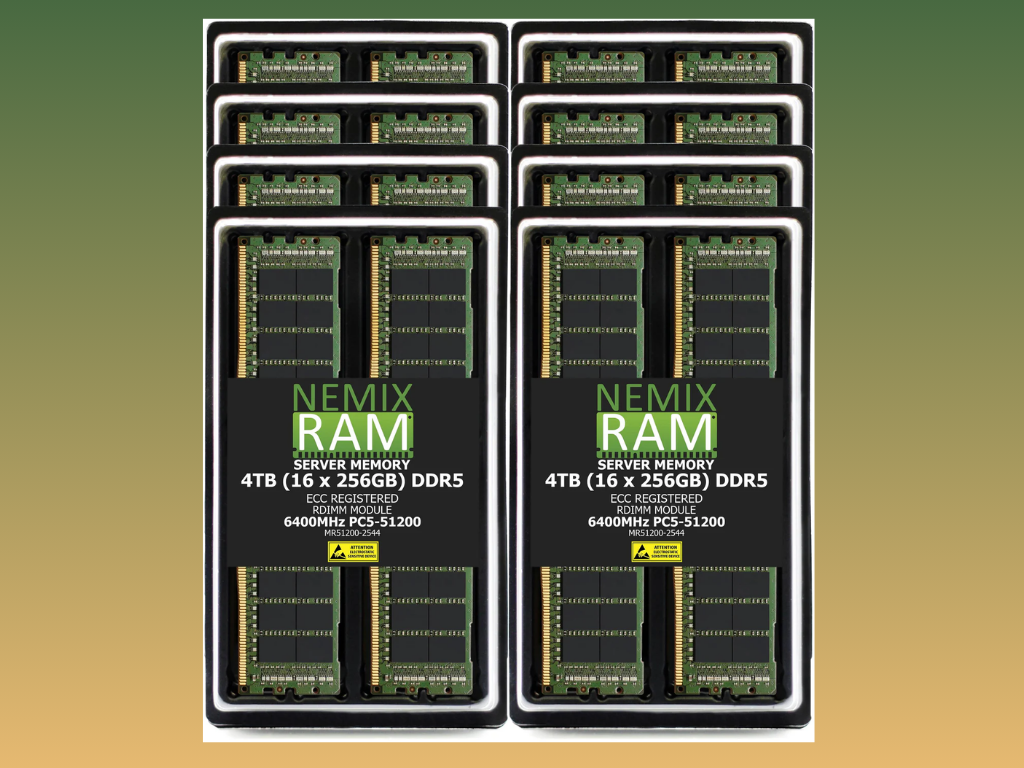
Most PC gamers will never need, or be able to justify, extreme amounts of system memory. But in the world of enterprise computing, AI workloads, and government-grade infrastructure, “too much RAM” isn’t really a thing. That’s exactly the audience a newly listed DDR5 kit from NEMIX is targeting, and the numbers are as jaw-dropping as the price tag.
NEMIX, a U.S.-based company known for memory and storage products aimed at enterprise clients and public-sector organizations, has introduced a massive 4TB DDR5 RAM kit. It’s built from 16 individual 256GB ECC RDIMM modules and carries a listed price as high as $76,999, with some pricing starting closer to roughly $70,800 depending on the seller and configuration.
On paper, the specifications are properly server-class. The kit is rated for 6400 MT/s and comes with a CAS latency of 52. That performance profile makes sense for its intended role: handling enormous datasets and sustained workloads where stability and error correction matter more than chasing low-latency gains.
So why does it cost as much as a high-end car? A big part of it comes down to density and validation. Packing 256GB into a single DDR5 module isn’t comparable to consumer RAM—it requires far denser memory ICs, tighter qualification standards, and the sort of reliability features expected in mission-critical systems. These modules include ECC (error-correcting code) support and are offered in configurations ranging from 1Rx8 to 4Rx4, designed to remain stable under heavy, continuous load.
When you break the pricing down, it lands around $17–$18 per gigabyte. That’s nearly double what many consumer buyers are used to paying, even in a market where RAM and storage pricing has been volatile. Consumer-grade DRAM can still be found under $10/GB in many common capacities, but it’s not built to meet the same requirements as ECC RDIMMs meant for servers and high-reliability workstations.
And despite how tempting “4TB of DDR5” might sound in a bragging-rights kind of way, this isn’t a gaming upgrade. Aside from the latency profile, the practical hardware barriers make it a non-starter for typical PCs. Most consumer motherboards top out at four DIMM slots, and even workstation platforms commonly reach eight. This kit requires 16 modules, which puts it firmly in server and specialized platform territory.
Interestingly, availability also hints at who’s buying. With DRAM supply reportedly tightening and demand surging for data-intensive compute, these types of ultra-capacity kits are increasingly being snapped up by AI data centers, hyperscalers, and enterprise customers that measure value in throughput, uptime, and memory headroom—not in budget-friendly builds.
The bigger takeaway is simple: the market for specialized, ultra-high-capacity DDR5 memory is growing fast, and buyers who truly need it are willing to pay a premium. In 2025’s compute climate, 4TB of RAM isn’t a flex for gamers—it’s a tool for organizations racing to power the next wave of AI and large-scale data workloads, even if the entry fee is nearly $77,000.