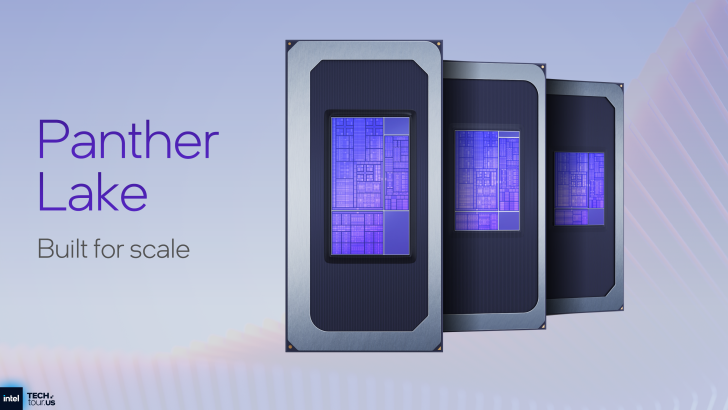
Early leaked benchmarks suggest Intel’s next-gen Panther Lake laptop chips could deliver Arrow Lake-class multi-threaded performance while pushing efficiency forward. If these engineering-sample results hold true in retail hardware, mobile users may see similar compute speeds with better battery life and stronger integrated graphics.
What’s been tested so far
Reports point to two Panther Lake-H engineering samples:
– Core Ultra X7 358H: 4 performance cores and 12 efficiency cores, preliminary boost up to 4.8 GHz
– Core Ultra X5 338H: 4 performance cores and 8 efficiency cores, preliminary boost up to 4.7 GHz
These chips were compared with current Arrow Lake-H counterparts under configured power limits:
– Core Ultra X7 358H scored about 20,000 in Cinebench R23 Multi-Thread at 65W
– Core Ultra 7 255H (6P+10E, up to 5.1 GHz) scored around 21,826 at 65W
– Core Ultra X5 338H scored about 16,000 at 60W
– Core Ultra 5 225H (4P+10E, up to 4.9 GHz) scored around 17,988 at 65W
What the numbers mean
– Despite fewer or slower big cores on the engineering samples, Panther Lake lands close to Arrow Lake in multi-threaded tests.
– Final silicon often gains notable performance via microcode, firmware, and clock refinements. It’s reasonable to expect parity or a slight lead once retail chips ship, especially at the same power targets.
– Intel has indicated Panther Lake aims for up to 30% power savings at equal multi-threaded performance versus Arrow Lake-H. Matching today’s speeds at lower wattage would translate to quieter thermals and better battery life in real-world laptops.
Integrated graphics get a lift
Updated 3DMark Time Spy results for the 12-core Xe3 iGPU show a jump from roughly 6,300 to as high as 6,830 points, an 8.5% uplift attributed to a more optimized pre-release configuration. Against Intel’s previous-gen 8Xe2 iGPU found in Lunar Lake, the Xe3 configuration is cited as up to 55% faster. For everyday gaming and GPU-accelerated creation on thin-and-light systems, that’s a meaningful step forward.
Why laptop buyers should care
– Comparable multi-threaded CPU performance to Arrow Lake-H at similar or lower power could mean longer battery life, cooler operation, and steadier sustained performance in slim designs.
– A stronger Xe3 iGPU narrows the gap with discrete entry-level graphics for casual gaming and content creation, reducing the need for a dGPU in many mainstream notebooks.
Preliminary lineup snapshot
Expect a spread of H- and U-series models, generally featuring up to 4 performance cores, up to 8 efficiency cores, and next-gen Xe3 graphics. Nominal targets appear to be around 45W for H-series and 15–28W for U-series. Early names floating around include Core Ultra X9 388H, Core Ultra X7 368H, Core Ultra X7 358H, Core Ultra X5 338H for H-class, and Core Ultra 7 360U, Core Ultra 5 350U, Core Ultra 5 340U, Core Ultra 3 320U on the U side. Specific clocks and GPU configurations remain subject to change.
Release timing
The first Panther Lake SKU is expected to surface this quarter, with a broader family rollout and full unveiling targeted for January at CES 2026.
Bottom line
– CPU performance: Close to Arrow Lake-H in multi-threaded Cinebench R23, with room to improve on final silicon.
– Efficiency: Positioned to be a major selling point, potentially delivering the same throughput at meaningfully lower power.
– Graphics: Xe3 iGPU gains put integrated performance on a stronger footing for modern workloads.
As with all pre-release, engineering-sample data, treat these figures as indicative rather than definitive. Likelihood assessment: plausible to probable, but not confirmed until retail reviews land.