NXP CEO Says Physical AI Needs to React Like a Spine, Not Just Think Like a Brain
As robots and autonomous machines move beyond controlled factory environments and into hospitals, warehouses, streets, and public spaces, the future of artificial intelligence is becoming increasingly physical. At Computex 2026, NXP Semiconductors CEO Rafael Sotoayo highlighted a key idea that could shape the next generation of robotics: physical AI should not be judged only by how intelligent it appears, but by how quickly and safely it can react to the real world.
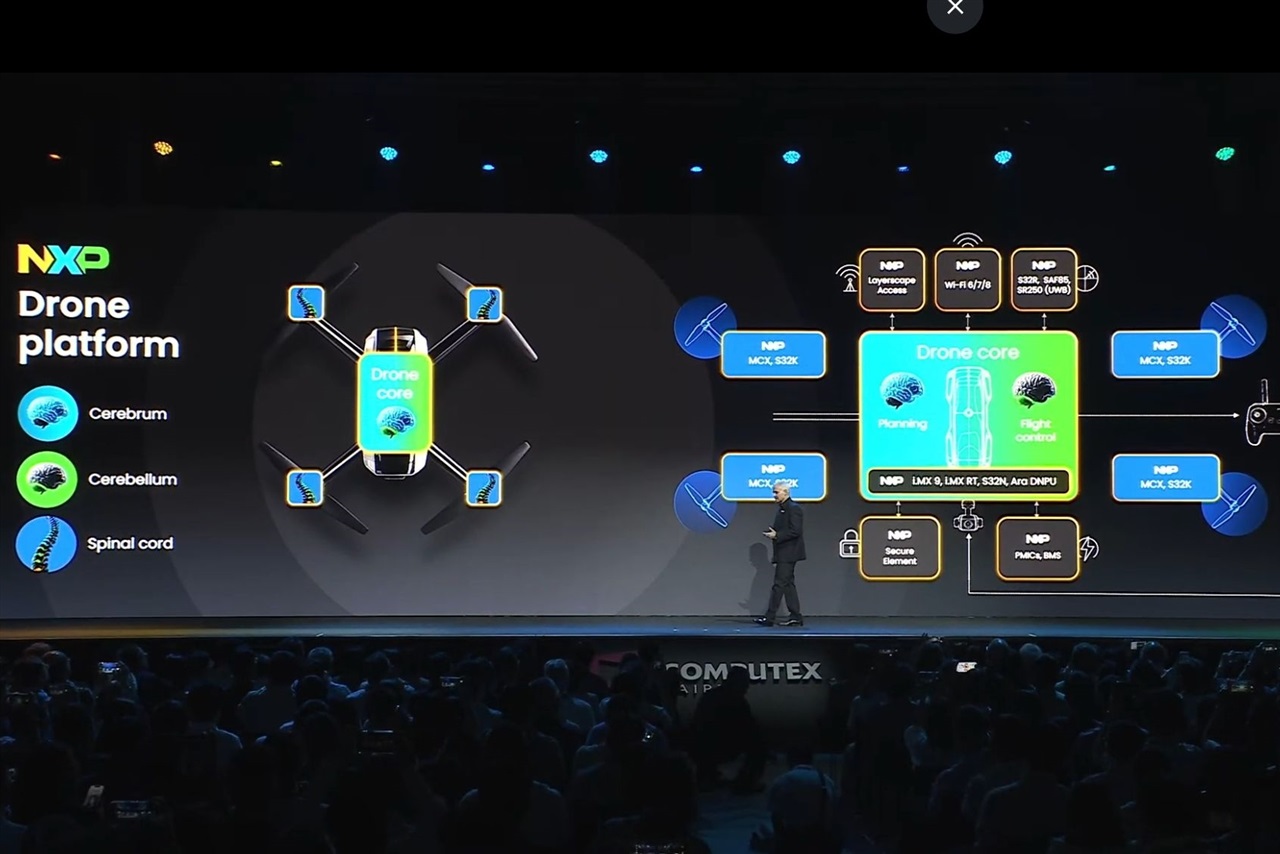
His message centered on a simple but powerful comparison. While many AI systems are built to “think” like a brain, machines that interact with people and unpredictable environments also need to respond more like a spine. In the human body, the spine helps trigger fast reflexes before the brain fully processes what is happening. That kind of instant reaction is essential when a robot is moving near patients, workers, pedestrians, or valuable equipment.
The point is especially important as autonomous systems become more common in everyday life. A warehouse robot must be able to stop immediately if a person steps into its path. A hospital service robot needs to navigate crowded corridors without causing risk. Delivery machines, industrial arms, smart vehicles, and inspection drones all face the same challenge: they must make decisions in real time, often with limited room for error.
For physical AI, speed can be just as important as intelligence. Cloud-based AI may be powerful, but sending data back and forth to remote servers can introduce delays. In many real-world situations, even a fraction of a second matters. This is why edge computing, local processing, sensors, and specialized chips are becoming central to the development of safer and more reliable autonomous machines.
Sotoayo’s keynote suggested that the next stage of AI innovation will depend on building systems that can sense, process, and act instantly. Instead of relying only on massive AI models running in distant data centers, physical AI needs distributed intelligence built directly into devices. That means cameras, radar, lidar, motor controls, microcontrollers, and AI processors must work together smoothly to create fast, coordinated responses.
This “spine-like” approach could become a foundation for safer robotics. Just as human reflexes help prevent injury before conscious thought takes over, machines may need built-in reflex systems that allow them to avoid collisions, adjust movement, detect danger, and respond to changing surroundings without waiting for higher-level commands.
The idea also reflects a broader shift in the tech industry. Artificial intelligence is no longer limited to chatbots, image generators, or software tools. It is increasingly moving into machines that lift, carry, drive, sort, scan, assist, and interact with the physical world. As AI enters these environments, trust becomes a major requirement. People will only accept autonomous systems if they are predictable, responsive, and safe.
For companies building the hardware behind these systems, the opportunity is significant. Physical AI requires powerful but efficient computing platforms, advanced sensors, secure connectivity, and low-latency control systems. Energy efficiency is also crucial, especially for battery-powered robots and mobile devices that must operate for long periods without interruption.
The keynote’s central message was clear: the future of robotics will not be defined by intelligence alone. A robot that can understand complex instructions is useful, but a robot that can react instantly to danger is essential. As autonomous machines enter more human spaces, the winning designs may be those that combine brain-like reasoning with spine-like reflexes.
Physical AI is becoming one of the most important frontiers in technology, and its success will depend on more than smarter algorithms. It will require systems that can sense the world, interpret what matters, and respond in real time. In that future, the most advanced robots may not simply be the ones that think the most, but the ones that react the fastest and safest.