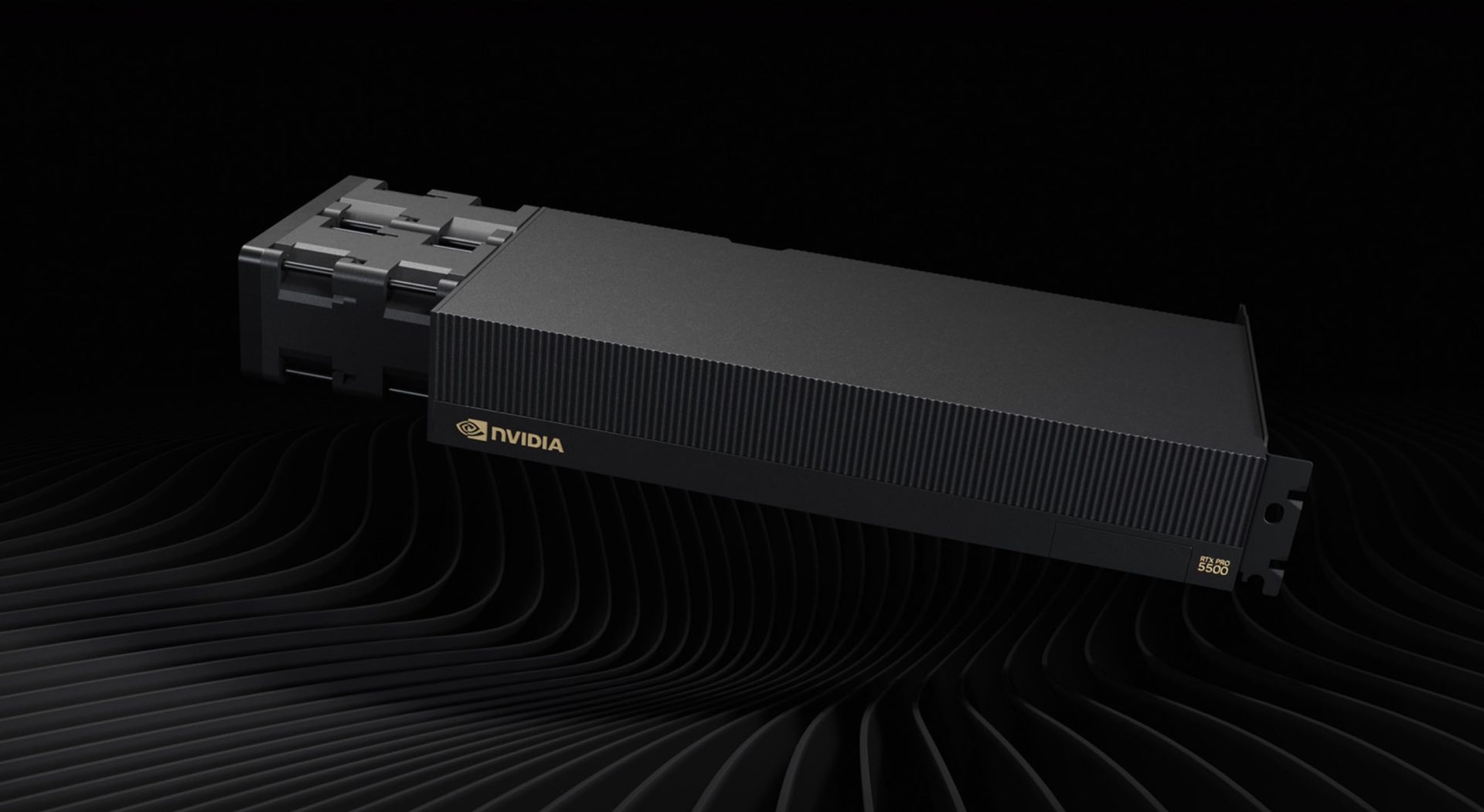
NVIDIA RTX PRO 5500 Blackwell Workstation GPU Arrives With 84GB GDDR7 Memory and 21,760 CUDA Cores
NVIDIA has expanded its RTX PRO Blackwell workstation graphics card family with a powerful new model aimed at professional users who need serious GPU performance for AI, simulation, rendering, and enterprise workstation deployments. The new NVIDIA RTX PRO 5500 Blackwell Workstation Edition sits between the RTX PRO 5000 and RTX PRO 6000, offering a large 84GB pool of GDDR7 memory and a high-end GB202 GPU configuration.
The RTX PRO Blackwell lineup is already one of NVIDIA’s broadest professional GPU families, covering everything from compact workstation cards to flagship enterprise-class solutions. With the RTX PRO 5500, NVIDIA is targeting studios, engineers, AI developers, researchers, and enterprise teams that need workstation-grade power at scale without jumping all the way to the most expensive RTX PRO 6000 tier.
At the heart of the NVIDIA RTX PRO 5500 Blackwell is the GB202 GPU, the same silicon used in NVIDIA’s top-tier RTX PRO 6000 and GeForce RTX 5090 graphics cards. This gives the RTX PRO 5500 a very strong foundation for demanding compute, graphics, and AI workloads.
The card is listed with 21,760 CUDA cores, matching the core count of the GeForce RTX 5090. That makes it a major step up for professionals working with GPU-accelerated tasks such as 3D rendering, AI inference, real-time visualization, virtual production, CAD, digital twins, physical simulation, and advanced content creation.
Power consumption is rated at 600W, placing the RTX PRO 5500 firmly in the high-performance workstation category. This is not a GPU designed for basic desktop use. Instead, it is built for professional environments where performance, memory capacity, reliability, and scalability are the priority.
One of the biggest highlights of the RTX PRO 5500 Blackwell Workstation Edition is its 84GB of ultra-fast GDDR7 memory. That is a significant amount of VRAM for a workstation GPU and gives the card a major advantage in memory-heavy professional workloads.
Compared to the RTX PRO 5000 Blackwell, the RTX PRO 5500 offers 36GB more memory. Compared to the RTX PRO 6000 Blackwell, it has 12GB less. It also delivers more than 2.5 times the memory capacity of the GeForce RTX 5090, making it much better suited for large AI models, complex 3D scenes, massive datasets, and high-resolution simulation work.
The card reportedly uses a 416-bit memory bus, which is an unusual configuration. Based on that bus width, the design would involve 13 32-bit memory interfaces. With a clamshell memory layout, that could allow for 26 DRAM placements. Since standard memory density combinations do not easily land on 84GB, it is possible NVIDIA is using a mix of different GDDR7 memory densities to reach this capacity.
Memory bandwidth is rated at up to 1,398GB/s, with the GDDR7 memory operating at around 27Gbps. That puts the RTX PRO 5500 slightly ahead of the RTX PRO 5000 Blackwell in bandwidth, though still below the 1,792GB/s bandwidth available on the RTX PRO 6000 Blackwell and GeForce RTX 5090.
The RTX PRO 5500 Blackwell also includes three 9th-generation NVENC engines and three 6th-generation NVDEC engines. This makes it a strong choice for professional video workflows, including encoding, decoding, streaming, video production, and media processing at scale. For teams working with high-resolution video, multi-stream editing, AI-enhanced media pipelines, or cloud-based creative workflows, this could be one of the card’s most valuable features.
Display connectivity includes up to four DisplayPort 2.1b outputs, giving professional users support for modern high-resolution and high-refresh-rate display setups. The GPU connects through a PCIe Gen5 x16 interface and uses a single CEM5 16-pin power connector.
Another important feature is support for both air-cooled and liquid-cooled thermal solutions. This is especially useful for enterprise environments and rack-mounted workstation deployments, where cooling requirements can vary depending on density, airflow, and system design. NVIDIA is positioning the RTX PRO 5500 as a card that can be centralized, shared, and scaled across professional teams.
The RTX PRO 5500 also supports Multi-Instance GPU functionality, also known as MIG. This allows the card to be split into two separate GPU instances, each with 42GB of memory. For organizations running multiple workloads, virtual workstations, or shared GPU resources, MIG support can make the RTX PRO 5500 more flexible and efficient.
Pricing has not been officially listed yet, but the RTX PRO 5500 Blackwell is expected to be expensive. For context, the RTX PRO 5000 Blackwell with 48GB of memory has been seen around the $9,200 range, so the RTX PRO 5500 with 84GB of GDDR7 memory and a larger GPU configuration will likely sit well above that.
Within the broader NVIDIA RTX PRO Blackwell lineup, the RTX PRO 5500 fills an important gap. The RTX PRO 6000 remains the flagship with 24,064 cores, 96GB of GDDR7 memory, a 512-bit bus, and 1,792GB/s of bandwidth. The RTX PRO 6000 Max-Q offers similar memory capacity with a lower 300W power target. The RTX PRO 5000 sits below the new RTX PRO 5500 with 14,080 cores, up to 72GB of GDDR7 memory, a 384-bit bus, and 1,344GB/s of bandwidth.
Further down the lineup, NVIDIA offers the RTX PRO 4500 with 10,496 cores and 32GB of GDDR7 memory, the RTX PRO 4000 with 8,960 cores and 24GB of memory, the compact RTX PRO 4000 SFF with the same 24GB memory capacity in a smaller form factor, and the RTX PRO 2000 with 4,352 cores and 16GB of GDDR7 memory.
The arrival of the NVIDIA RTX PRO 5500 Blackwell Workstation Edition gives professionals another high-memory option for advanced AI and workstation workloads. With 21,760 CUDA cores, 84GB of GDDR7 memory, strong media engines, PCIe Gen5 support, MIG functionality, and both air and liquid cooling options, it is designed for organizations that need powerful, scalable GPU performance without necessarily moving to the top RTX PRO 6000 model.
For AI developers, 3D artists, engineers, researchers, and enterprise IT teams, the RTX PRO 5500 could become one of the most attractive Blackwell workstation GPUs in NVIDIA’s professional lineup.


