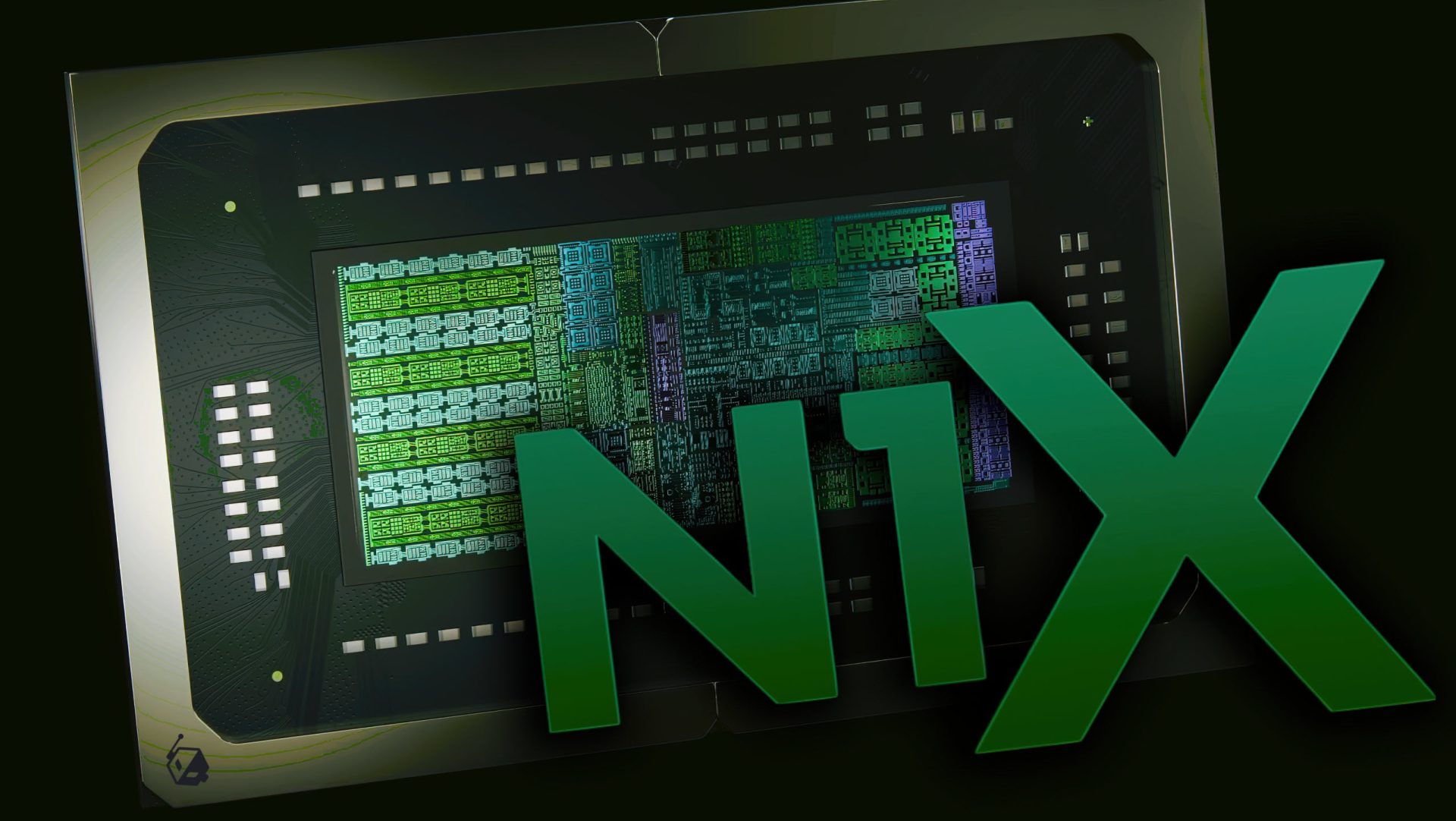
An engineering sample motherboard built around NVIDIA’s upcoming N1 SoC has reportedly surfaced online, offering an early glimpse at the chip expected to drive NVIDIA’s next push into AI PC laptops.
The board appeared on a Chinese resale marketplace, where a seller claims to have an early engineering sample featuring the N1 system-on-chip. NVIDIA’s N1 is widely expected to be a Windows on Arm (WoA) processor aimed at the AI PC category, with support for the full Microsoft Windows experience and Copilot+ features. While the listing doesn’t prove real-world performance or readiness, the hardware layout strongly suggests this is a mobile-focused design intended for thin laptops, with hints it could also fit into high-end tablets thanks to its compact footprint.
From the photos and shared details, the N1 SoC is the largest package on the motherboard, positioned like a centerpiece and surrounded by memory. The board is equipped with eight LPDDR5X memory modules totaling 128GB. The chips are identified as SK hynix LPDDR5X ICs (H58G78CK8B) rated for 8533 MT/s, a speed grade that aligns with premium mobile platforms focused on bandwidth-heavy AI workloads.
Power delivery also looks serious for a slim device. The motherboard is described as using an 8+6+2 phase VRM configuration, suggesting the platform is built to sustain meaningful CPU/NPU/GPU loads rather than short bursts—an important detail for always-on AI features and on-device inference.
Storage expansion appears to be handled through two M.2 slots, both sized for the shorter 2240 form factor. That choice is common in compact laptops and tablets where internal space is limited, but it still allows fast NVMe SSD configurations depending on lane allocation and platform support.
Connectivity on this sample board includes a mix of mainstream ports: a USB port, HDMI, USB Type-C, plus a 3.5mm microphone/headphone combo jack. There’s also an onboard Wi‑Fi component visible, and the PCB routing shows additional traces that could support more I/O on a finalized retail design.
Cooling is another tell that this is meant for a laptop-style chassis. A cutout on the board suggests a blower-style fan setup, typical of compact notebooks that need to move heat efficiently through a heatpipe and heatsink assembly. The N1 SoC itself would sit under a dedicated heatsink, which fits expectations for a high-performance Arm-based Windows machine engineered to run demanding AI-assisted workloads locally.
As for pricing, the listing shows 9,999 RMB (roughly $1,400 USD), though this figure is likely a placeholder rather than a true market value—engineering sample parts sold through resale channels are often priced unpredictably and may be negotiable. More importantly, there’s no guarantee the motherboard is fully functional, stable, or supported with usable firmware and drivers.
The bigger takeaway is timing. The seller claims NVIDIA’s N1 platform is targeting a launch later this year, with broader rumors pointing to a second-half release window. If that holds, official details about NVIDIA’s Windows on Arm strategy for AI PCs could surface soon—potentially around major industry events in the months ahead.