The world of graphics processing units (GPUs) has seen a significant shift from crypto mining to artificial intelligence (AI) development. To cater to this new demand, Nvidia has broadened its range of workstation GPUs for both desktop and mobile platforms. This diversification aims to mitigate the risk of shortages that have affected gaming GPUs in the past, providing more options for professionals.
Among the varied range of workstation graphics cards, Nvidia offers models extending from the RTX 2000 series all the way to the high-end RTX 6000 series. Despite these offerings being labeled with the suffix ADA, identifying the GPU architecture, the market faces some confusion regarding different variants and their names.
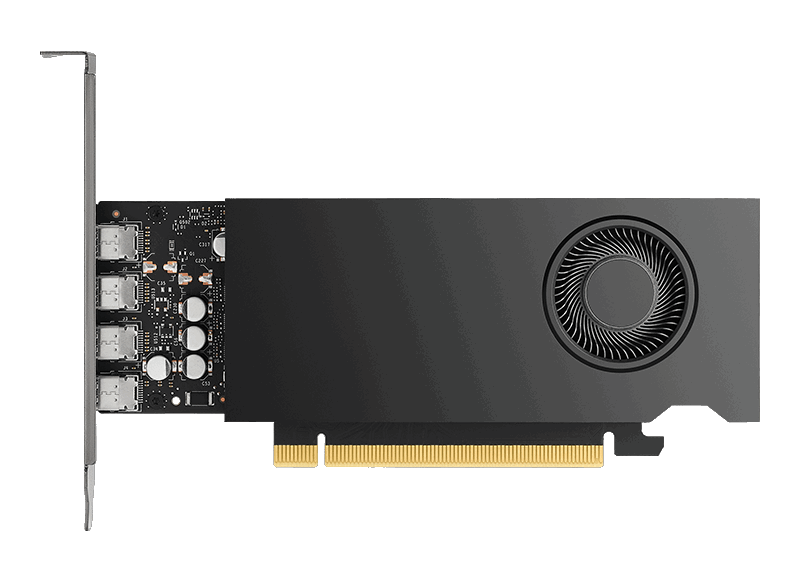
Adding to the lineup is the recently introduced RTX 2000E ADA, which fits neatly into the desktop workstation GPU family. This card maintains the core features of the entry-level RTX 2000 ADA, such as the number of CUDA cores, but it boasts a more compact, single-slot design and a reduced total graphics power (TGP) rating.
The RTX 2000E ADA is designed for efficiency and occupies a single slot due to its 50 W TGP—which is notably lower than the 70 W of its dual-slot predecessor—and it does not require an external power connector. The card is built on the same AD107 chipset, a cut-down version of the robust AD102, and it comes equipped with 2816 CUDA cores, 16 GB of GDDR6 VRAM, and a 128-bit bus width.
Performance-wise, the lower TGP of the RTX 2000E ADA translates to a decrease in raw compute power, offering 8.9 teraflops compared to the 12 teraflops of the non-E variant. However, its Tensor performance, crucial for AI and machine learning tasks, remains consistent at 71 teraflops. Additionally, the RTX 2000E ADA features four mini DisplayPort 1.4a video outputs to accommodate multiple monitor setups.
One of the distinct advantages of the RTX 2000E ADA’s design is its ability to be powered directly from a PCIe 4.0 slot while still providing the necessary 16 GB VRAM for AI applications such as large language models (LLMs) and generative AI. This capability enables users to install more of these cards in a single motherboard, optimizing space and reducing costs for AI training infrastructures.
It’s worth noting that, as of now, this new variant has yet to be listed on Nvidia’s official website. Reports suggest a manufacturer’s suggested retail price (MSRP) of $849, which is $220 more than the RTX 2000 ADA, according to available information for cards produced by PNY.
The RTX 2000E ADA, with its energy-efficient design, ample memory, and competitive pricing, appears to be a strategic addition to Nvidia’s workstation GPU offerings. It meets the growing needs of professionals in the AI space, providing an affordable and scalable solution for sophisticated AI tasks. This introduction is an indication of Nvidia’s continued investment in the AI and machine learning sector, reinforcing its commitment to supporting the computational demands of these rapidly advancing technologies.