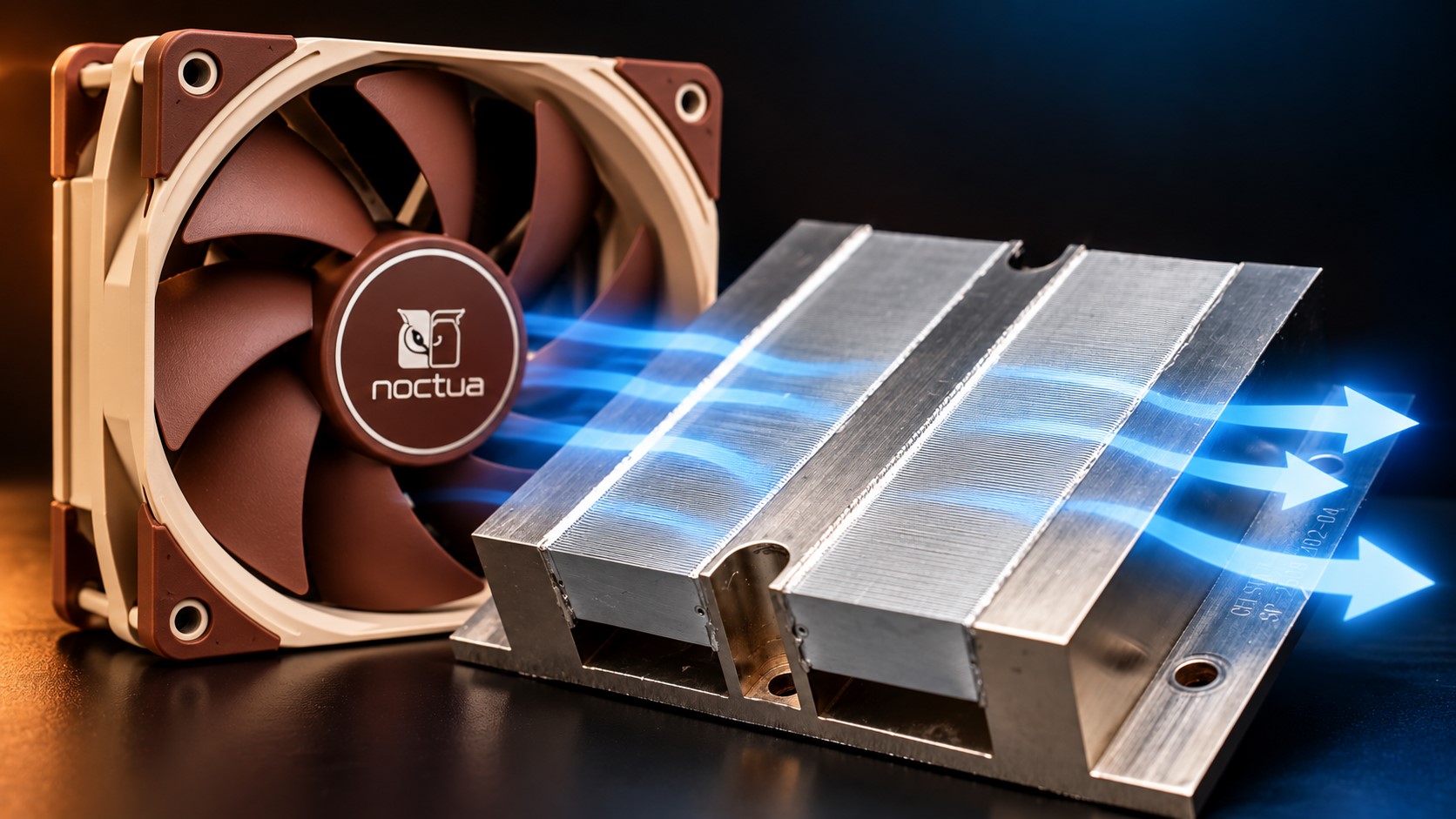
Noctua and Forced Physics Explore Next-Generation Air Cooling for Future High-End PCs
Noctua is taking a serious look at the future of PC cooling through a new long-term research partnership with Forced Physics DCT. The collaboration will focus on adapting Forced Physics’ JouleForce micro-channel array cooling technology for desktop PCs and workstations, potentially opening the door to air coolers capable of handling heat loads far beyond what conventional heatsinks can manage today.
The partnership is especially interesting for PC enthusiasts, workstation users, and anyone following the future of CPU cooling. As processors, graphics cards, AI hardware, and high-performance desktop components continue to demand more power, cooling technology has to evolve. Traditional air coolers remain popular because they are reliable, simple, and maintenance-free compared to liquid cooling, but they also face physical limits. Noctua appears to be investigating whether those limits can be pushed much further.
JouleForce is designed as an advanced thermal management platform for high-density computing environments, including AI accelerators and data center hardware. Forced Physics describes it as a different approach to cooling because it does not depend on complicated liquid cooling loops, yet it can outperform standard heatsink designs under the right conditions.
According to Forced Physics, JouleForce technology can manage more than 2000 W of thermal energy in suitable operating scenarios. That number is far beyond the heat output of current desktop CPUs, but it shows why the technology has attracted attention. If a version of this cooling method can be adapted for consumer and workstation PCs, it could lead to a new generation of extremely powerful air coolers for demanding systems.
The main difference between JouleForce and a traditional heatsink comes down to how air interacts with hot surfaces. Standard heatsinks use large fin stacks to increase surface area, while fans push air through the fins to move heat away. However, airflow over those surfaces can be limited by a thermal boundary layer, which slows down heat transfer and reduces overall efficiency.
JouleForce takes a different route by using extremely small micro-channels. Air is forced through these tiny channels, allowing it to interact more directly and effectively with heated surfaces. This can dramatically improve heat transfer compared to conventional fin-based cooler designs.
However, bringing this technology to normal desktop PCs is not simple. The biggest challenge is airflow resistance. Because the channels are so small, they require much higher static pressure than ordinary PC fans can provide. In existing JouleForce-style setups, cooling may rely on equipment such as industrial blowers, high-speed centrifugal fans, or even vacuum pumps.
That creates a major problem for desktop users: noise. PC builders expect cooling solutions that are powerful, reliable, compact, and quiet. Industrial airflow systems may work in specialized environments, but they are not suitable for a gaming PC, home workstation, or enthusiast desktop sitting near a user.
This is where Noctua’s experience becomes important. The company is widely known for its work in quiet PC cooling, high-pressure fan design, and long-lasting air cooler engineering. By combining Noctua’s expertise in low-noise airflow with Forced Physics’ micro-channel cooling platform, the two companies will investigate whether this technology can be reshaped for real-world desktop and workstation use.
Forced Physics founder and CEO Scott Davis noted that desktop and workstation systems present airflow challenges that are very different from data center deployments. He pointed to Noctua’s experience in quiet, high-pressure air movement as a key reason for the partnership.
If the research is successful, future CPU coolers could offer a major leap in performance without relying on traditional liquid cooling. This could be especially valuable as high-end desktop CPUs continue to increase core counts, boost frequencies, and power limits. Workstations used for rendering, simulation, engineering, AI workloads, and content creation could also benefit from stronger and more dependable air cooling.
Still, this does not mean a Noctua JouleForce-based CPU cooler is ready for release. The partnership is currently focused on research, and adapting a technology designed for high-density computing into a consumer-friendly cooler will take time. The companies must solve difficult issues related to fan pressure, noise levels, size, reliability, cost, and compatibility with existing PC cases.
For now, the announcement signals an exciting direction for the future of air cooling. While liquid coolers have become increasingly common in high-performance PCs, many users still prefer air cooling for its simplicity and durability. If Noctua and Forced Physics can bring micro-channel cooling into a practical desktop form, air coolers could become far more capable than today’s designs.
The project is still in its early stages, but it could become an important step toward next-generation PC cooling. With modern processors pushing thermal limits higher than ever, the industry needs new ideas, and this partnership may be one of the most promising developments for future high-performance desktop cooling.


