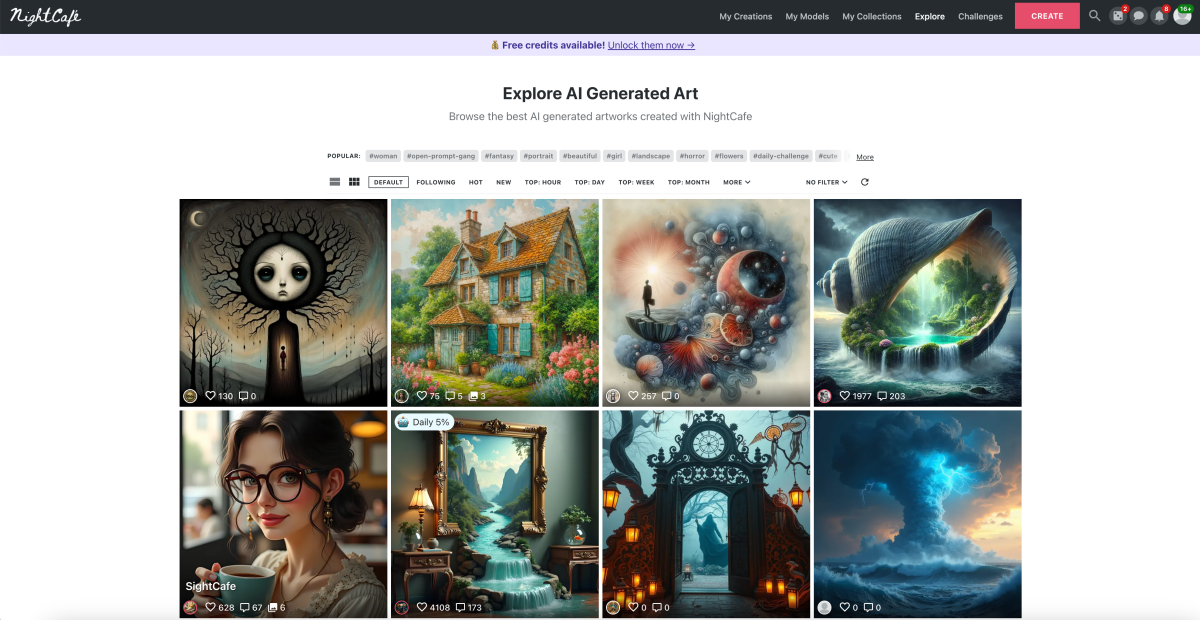
Elle Russell, co-founder of the Cairns, Australia-based company NightCafe, prefers to maintain a low profile despite the significant accomplishments of her platform, which focuses on AI-driven art creation tools.
According to Elle, NightCafe, which she helped her partner Angus Russell launch five years ago, often operates under the radar compared to competitors like Midjourney. Nonetheless, NightCafe’s impact is substantial, with over 25 million users creating nearly a billion images with its tools. The company, entirely bootstrapped and profitable most months, has managed to keep a significant presence in the generative art market.
Angus launched NightCafe in 2019 as a side project stemming from his need to decorate his new home with personalized art. Named after Vincent Van Gogh’s “The Night Café,” the site originally aimed to sell AI-generated artwork prints but found more success as a free art creation tool. After noticing unusually high hosting costs due to extensive image generation, Angus instituted a credit system. This change quickly led to financial sustainability as users requested to purchase more credits. Elle then came on board to manage the business, leveraging her background in business, communications, and accounting.
NightCafe took off further in mid-2021 following the announcement of OpenAI’s image-generating AI model DALL-E. Although OpenAI did not release the model, others reverse-engineered similar versions, allowing NightCafe to integrate them. Angus invested in scaling these models with considerable resources, which soon paid off as NightCafe’s popularity surged, achieving impressive revenue milestones.
Today, NightCafe offers an array of AI art models, running some on its servers and integrating others through APIs from various AI vendors. This includes models from OpenAI, Google, and Black Forest Labs. The platform’s appeal is further enhanced by its user-friendly interface and community-focused features such as chatrooms, art collaborations, and AI art competitions.
A notable feature of NightCafe is its fine-tuning capability, allowing users to train models to recreate specific styles or objects under certain restrictions to prevent misuse. It is a free-to-use platform with premium options, including image-generation credits and subscription services offering advanced features and higher processing limits.
Financially, NightCafe has flourished, reportedly generating $4 million in annual revenue with substantial profits. The site attracts around a million visitors monthly, with 20,000 subscribers. Unlike some AI art platforms, NightCafe moderates its content to avoid legal issues related to copyright infringement, ensuring compliance with relevant laws and regulations. Users retain copyright for their AI-generated artworks where applicable.
Elle highlights that despite the competitive nature of the AI art generation market, NightCafe distinguishes itself by fostering an engaged community, catering particularly to an older demographic compared to other platforms. This approach helps position NightCafe as a unique and supportive environment for AI-generated art enthusiasts.NightCafe operates under the premise that it is the users, not the platform itself, who are responsible for ensuring that their use of generated images complies with intellectual property laws. Despite this stance, a glance through the site reveals a multitude of images depicting Pokémon, Donald Duck, celebrities, and well-known brands like Coca-Cola and LEGO, all seemingly without the approval of their respective copyright holders.
Elle, a representative from NightCafe, notes that users can report content that bypasses automated filters, with a dedicated team of human moderators working around the clock to manage flagged content.
When it comes to political content and deepfakes, NightCafe has a more lenient approach compared to some other platforms that have banned the generation of images featuring political figures. Elle mentions that generating images of public figures like Donald Trump and Kamala Harris is permissible, though NightCafe discourages political debates. While political images can circulate outside the platform, they are subject to review before being posted to NightCafe’s public feeds.
The guidelines on what content is allowed are somewhat flexible. Political baiting, glorification of divisive figures, or offensive imagery is generally prohibited. However, a search might still reveal content that seems to violate these rules. Elle indicates that moderators have the discretion to interpret the platform’s guidelines and that repeated offenses could lead to warnings or bans.
NightCafe’s moderation team is relatively small, consisting of five paid moderators and twenty volunteers who receive premium NightCafe features as compensation. This team is responsible for sifting through over 700 images generated daily. The paid moderators are hired through an Indonesian outsourcing firm and are overseen by a NightCafe staff member.
Regarding NSFW content, NightCafe allows certain explicit but not pornographic material. This includes suggestive poses, graphic depictions of violence, and images depicting drug use. The platform justifies this by citing the need for “artistic freedom” and has established community standards to delineate what is acceptable.
Despite the occasional explicit content, the majority of NSFW images on NightCafe tend to feature women—a common trend on similar platforms.
As of now, NightCafe is focusing on expanding its model offerings, including video-generating models like Stable Video Diffusion, but it remains cautious due to the potential impacts of impending legal regulations. Elle asserts that NightCafe doesn’t require external investment and is confident in the platform’s unique position in the market, emphasizing the importance of accessibility to advanced technology for creativity.
Elle predicts that as image-generation models improve and become widely available, the competition will shift from the technology itself to the range of models a platform can aggregate. NightCafe aims to provide a diverse and advanced assortment of these models, positioning itself as a leading community and social hub in the AI art space.