Apex Neural Rendering Emerges as a DLSS Rival With Frame Generation for Older GPUs
Nvidia DLSS may soon face fresh competition from a new AI rendering technology called Apex Neural Rendering, or ANR. Developed by Apex Compute, this new suite of graphics tools is designed to improve gaming performance through AI-powered frame generation, upscaling, and ray reconstruction.
What makes ANR especially interesting is its broad hardware support. While many modern frame generation technologies are limited to newer graphics cards, ANR Frame Generation is being built to work across GPUs from Nvidia, AMD, and Intel, including several older models.
According to Apex Compute, ANR Frame Generation supports Nvidia GeForce GTX 16-series and RTX 20-series graphics cards or newer, AMD Radeon RX 5000-series GPUs or newer, and Intel Arc A-series and B-series graphics cards. The Steam Deck is also supported, making ANR potentially appealing to handheld PC gamers as well.
On the software side, the current beta works with Windows 10, Windows 11, Linux, and SteamOS through Proton. That gives ANR a wide potential audience, especially among PC gamers who want better frame rates without upgrading to the latest high-end GPU.
Apex Neural Rendering is made up of three major technologies: frame generation, super-resolution upscaling, and ray reconstruction. For now, only ANR Frame Generation is available in beta. The other two features are expected to arrive later.
The early performance claims are attention-grabbing. Apex Compute says that on a GeForce RTX 5090 running at 4K resolution, ANR can generate a frame in 1.01 milliseconds in 2x mode. By comparison, Nvidia DLSS Frame Generation is listed at 1.26 milliseconds in the same scenario. In 4x mode, ANR reportedly takes 0.61 milliseconds, while DLSS takes 0.82 milliseconds.
Memory usage is another area where ANR claims an advantage. Apex Compute says ANR uses 214 MB of GPU memory, compared with 562 MB for DLSS Frame Generation. If these numbers hold up in real-world testing, ANR could become a strong option for gamers who are sensitive to latency and VRAM usage.
Latency is one of the biggest concerns with frame generation. While generating extra frames can make gameplay look smoother, it does not always make the game feel more responsive. In some cases, added processing can increase input delay. Apex Compute appears to be targeting this issue directly by focusing on faster frame generation times and lower memory overhead.
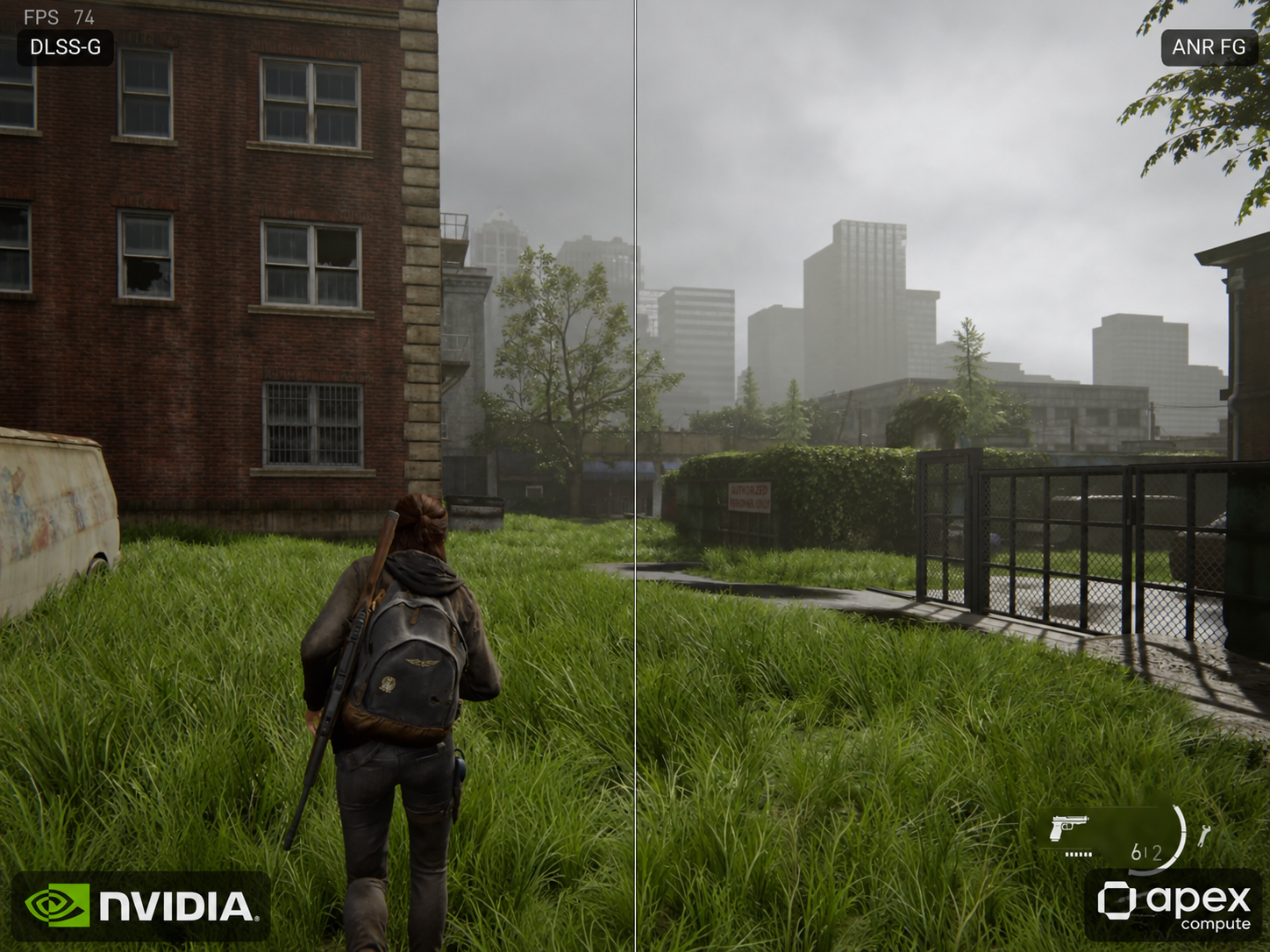
The company also claims that ANR can deliver better image quality than competing solutions. It has shown several side-by-side comparisons, including scenes from The Last of Us Part II, to demonstrate its visual output. However, these are still company-provided examples, so independent testing will be important before drawing firm conclusions.
For now, ANR should be viewed as a promising but unproven DLSS alternative. Faster frame generation is exciting, especially for older GPUs and devices like the Steam Deck, but performance in actual games will matter more than controlled benchmark figures. Smooth visuals, image stability, input latency, compatibility, and ease of use will all determine whether ANR becomes a serious competitor.
The current ANR Frame Generation beta is available publicly and relies on OptiScaler. Installation is not as simple as enabling a setting inside a game menu. Users need to modify individual game directories, which means setup may vary from one title to another. Game compatibility is also likely to differ during the beta stage.
Still, Apex Neural Rendering could become one of the most interesting AI graphics technologies to watch. If it can deliver high-quality frame generation on older Nvidia, AMD, and Intel GPUs, it may give more PC gamers access to smoother gameplay without requiring a costly hardware upgrade.


