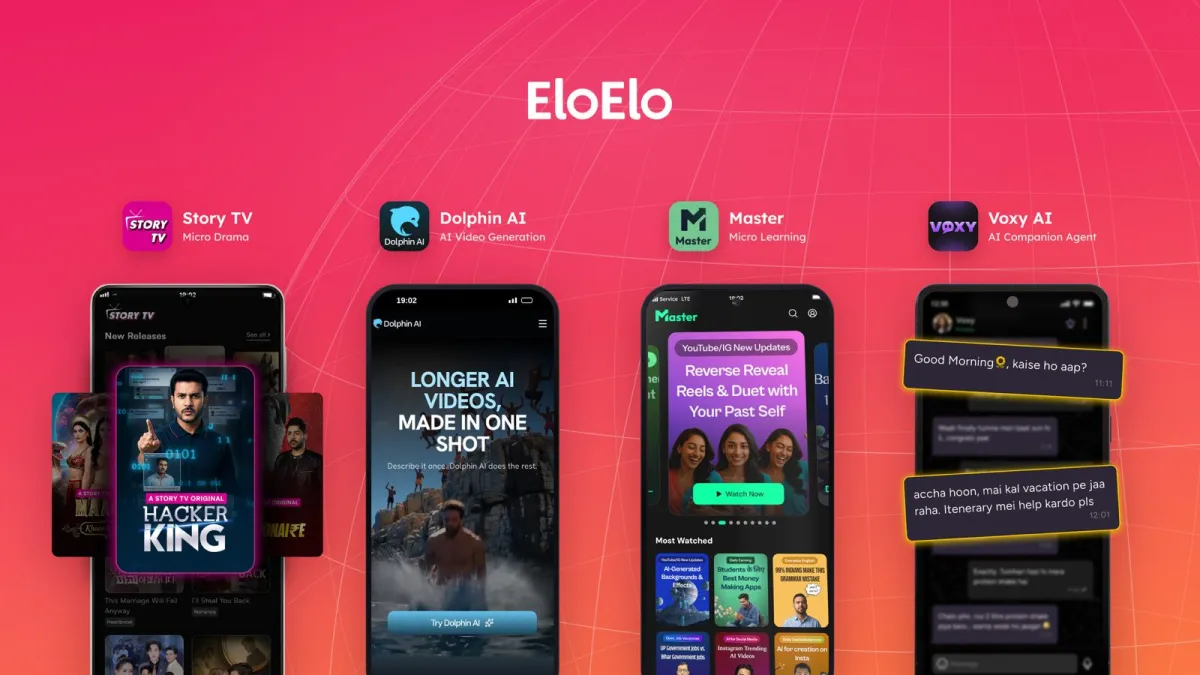
EloElo’s Story TV Raises $80 Million as India’s Microdrama Market Booms
India’s microdrama craze is quickly becoming one of the biggest shifts in digital entertainment. More than 118 million people in the country now watch short, serialized dramas every month, turning bite-sized mobile storytelling into a fast-growing media category.
One of the strongest players in this space is EloElo’s Story TV, a microdrama platform that has reportedly crossed 33 million active users. Building on that momentum, EloElo has raised $80 million in a Series C funding round led by Hornbill Capital and NBCUniversal. The latest investment brings the company’s total funding to $130 million and values it at around $500 million.
Microdramas are designed for mobile-first audiences. Episodes are short, vertical, and built to be watched during quick breaks throughout the day. This format has already gained popularity in markets such as China, the United States, and India, where smartphone usage and affordable mobile data have reshaped how people consume entertainment.
India, with more than a billion internet users and a massive appetite for video content, is emerging as one of the most promising markets for this format. Industry analysts expect the microdrama sector in India to generate $3 billion to $4 billion in annual revenue by 2030. Dedicated apps such as Story TV, Kuku TV, and Quick TV were also among the country’s most downloaded video streaming apps last year, highlighting rising demand for short-form serialized entertainment.
Founded in 2020 by former Flipkart executive Saurabh Pandey, EloElo’s Story TV has grown rapidly over the last few years. The platform now offers more than 5,000 titles across six languages, giving it a broad reach across India’s diverse regional audience.
A key reason for the platform’s growth is its highly engaging content format. Users reportedly spend an average of 95 minutes per day on the app, often across several viewing sessions. That behavior reflects a major change in entertainment habits, especially among mobile-first viewers who prefer quick, episodic storytelling over traditional scheduled television.
Pandey believes the next wave of internet users will not grow up relying mainly on television. Instead, they will consume entertainment primarily on smartphones. According to him, content for this audience has to be designed differently. It must fit into small time slots during the day rather than expecting viewers to sit down at a fixed time for a long episode or movie.
While large-screen viewing with family and friends will continue to have its place, mobile entertainment is expected to dominate everyday consumption. Microdramas sit directly at the center of that trend.
However, Story TV and other microdrama platforms face intense competition from free video platforms such as YouTube, Instagram, and TikTok-style apps, where creators already publish short-form content at scale. Some of those platforms are also experimenting with serialized storytelling.
EloElo is betting that professionally produced, high-quality stories will help Story TV stand apart from free alternatives. The company has formed partnerships with established production houses, including Balaji Telefilms, to create original content for its platform.
Story TV uses a subscription-led model, offering monthly, quarterly, and annual plans that unlock premium content. It also provides some free, ad-supported videos. While advertising can help bring in casual viewers, subscriptions are generally seen as a stronger revenue source for platforms that invest heavily in original storytelling.
Monetization remains one of the biggest challenges for India’s microdrama industry. Many viewers are willing to watch free content, but fewer convert into paying users. Research suggests that more than 40 million users in India have paid for microdrama content at least once, but only around 15 million to 17 million pay monthly. Another survey found that 72% of microdrama viewers have never paid to watch this type of content.
To grow sustainably, platforms will need to strike the right balance between free discovery, affordable subscriptions, and exclusive content strong enough to justify payment.
Artificial intelligence is also becoming a major focus for microdrama companies. As demand rises, platforms need to produce more content quickly while keeping production costs under control. Some companies are using AI to speed up workflows, while others are exploring AI-generated video clips.
EloElo is taking a workflow-focused approach through its Dolphin AI platform. Originally developed as an internal tool to improve video creation, Dolphin AI is now being prepared for broader use. The tool can support editing, templates, image generation, audio production, and video creation.
The company also sees potential for Dolphin AI beyond entertainment. It could eventually be used for marketing campaigns, advertising, and creator-led content production.
Even so, Pandey believes AI cannot replace human creativity. In his view, AI is like a powerful race car engine, but it still needs a skilled driver. For storytelling, that driver is the creative director or showrunner. AI can help with speed, structure, and execution, but the strongest stories still require human emotion, judgment, and imagination.
Beyond Story TV, EloElo is also building other vertical video and AI-driven products. The company operates Master, a vertical learning app competing in the mobile education and skill-building category, as well as Voxy AI, an AI companion app. Across its apps, EloElo says it has more than 40 million monthly users, with Story TV accounting for the majority.
The company currently has around 240 employees and plans to expand its AI and machine learning research team. A significant portion of the new funding will also go toward producing more original microdrama titles.
The Series C round included participation from MIT Investment Co. and existing investors such as Play Ventures, Kalaari Capital, Waterbridge Ventures, and Griffin Gaming Partners.
EloElo’s latest funding signals growing investor confidence in India’s microdrama market. As mobile video consumption continues to rise, platforms that can combine addictive storytelling, regional language content, smart monetization, and AI-powered production may be well positioned to shape the future of entertainment in India.