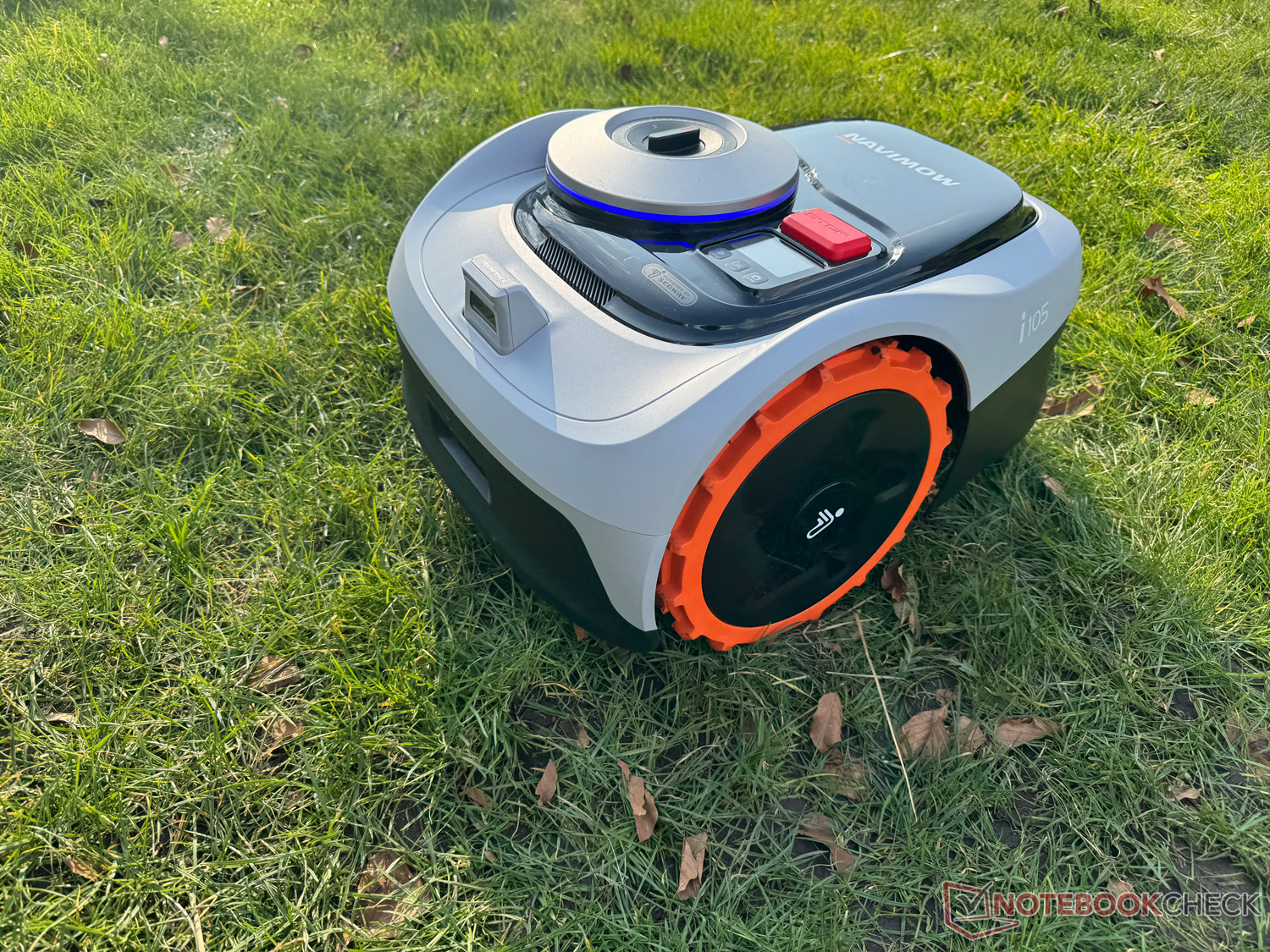
As the gardening season of 2024 kicks off, a new player has entered the field of robotic lawn mowing: Segway’s Navimow brand, which introduced its latest models, the Navimow i105E and i108E. These models cater to smaller gardens with surfaces of 500 to 800 square meters. Focused on practicality and affordability, these mowers are equipped with innovative technology to streamline lawn care.
Let’s delve into the Navimow i105E. When it arrives, you’ll find the robotic mower, a charging station, power unit, and ground screws to secure everything in place. An essential component is the GNSS antenna with a rod and ground spike to aid navigation. Along with the necessary cables and a selection of accessories, including replacement blades and instructions, you’re set to start.
At the heart of the Navimow i105E is the EFLS 2.0 navigation system. Utilizing AI-enhanced GNSS positioning assisted by GPS satellites, the system allows for wire-free orientation in your garden. Complementing this is the VisionFence camera, providing a 140-degree field of vision for object detection and avoidance through AI technology.
A notable feature of the i105E is its manual cutting height adjustment, ranging from 20 to 60 cm. Despite lacking the automatic adjustment seen in higher-end models, this does not detract from its functionality. Additionally, an LED ring under the cutting plate offers quick status updates at a glance, such as charging state and GPS reception.
Setting up the Navimow i105E is refreshingly simple. The charging station requires minimal wiring, just for power supply and the RTK antenna. With extension cables at your disposal, placement flexibility is enhanced. Connect the mower to the Navimow app—available for Android and iOS—and you’re guided through the setup, which includes creating a virtual map of the lawn’s boundary without the hassle of laying a boundary wire.
The mower can be piloted with virtual joysticks via the app. Should you misstep while setting boundaries, an eraser function allows you to backtrack and correct the route. AI-assist mapping is an additional feature that enables the mower to autonomously understand lawn boundaries, particularly where there is a clear transition from grass to other surfaces.
Once the virtual map is established in the app, you have the start for the mower’s first session. The app’s interface provides you with control over mowing schedules, settings for sound and lighting, firmware updates, and access to customer support.
Distinct from its predecessors, the new model mows systematically rather than randomly. This approach is both time and energy efficient, ensuring complete lawn coverage with minimal deviation from the virtual boundaries, as noted in practice.
For larger gardens, the optional Navimow Access+ accessory, at a cost of 99.99 euros, offers 4G mobile connectivity and geofencing-based anti-theft protection should Wi-Fi coverage not suffice.
In practice, the precision with which the Navimow i105E handles virtual boundaries is impressive. However, gardens with flat transitions may leave edges uncut, and larger gaps are noticed around raised borders due to the central mower deck positioning.
Conclusively, the Navimow i105E speaks to those seeking a modern solution to lawn care without the intricacies of boundary wires. Its combination of GPS-based navigation and AI-assisted obstacle detection promises efficiency and ease of use, making it a noteworthy option for anyone in the market for an intelligent robotic lawn mower. As testing continues, insights into the device’s full capabilities across varied terrains and larger areas will give a fuller picture of its potential.When it comes to maintaining your lawn with the convenience of technology, robotic lawnmowers have carved out a niche for themselves, promising to keep your grass trimmed without the need for manual intervention. However, the effectiveness of robotic lawnmowers, particularly when dealing with lawn edges, has been a subject of discussion and evaluation. In this detailed guide, we’ll explore the challenges and solutions related to robotic mowing, taking into consideration recent advancements and models on the market.
One of the common drawbacks to many robotic mowers is their inability to mow close to the edges of lawns, especially when the edges are not at ground level. This issue may necessitate the use of wide lawn edging stones or regular manual trimming to maintain a neat appearance. Some newer mower models address this problem by featuring an offset mowing blade that better tackles edge mowing, but it remains a challenge across the industry. It’s also not as straightforward as robotic vacuum cleaners, which are increasingly designed with features like retractable mops or extending side brushes to effectively clean edges.
Beyond edge mowing, one of the most sought-after features in robotic mowers is advanced navigation and obstacle detection. Premium models, such as the Navimow i105E and i108E, boast superior obstacle detection capabilities, which not only include natural formations like molehills but also common garden objects like gnomes, trampolines, and garden tools.
During practical tests, these robotic mowers demonstrated the ability to identify and avoid many obstacles, though there were minor hiccups, such as not always recognizing softer objects. More realistic-looking hazards, like certain garden ornaments, were consistently detected. The effectiveness of these obstacle-detection systems, once fine-tuned, helps to prevent accidents and ensure a thorough mowing job.
The setup of these robotic mowers is comparatively simple, eliminating the need for perimeter cables which are a staple for many other models. Instead, they employ systematic navigation to cover the lawn. They’re equipped with sophisticated companion apps that provide real-time updates on the mower’s location and mowing status. These models can be further upgraded with 4G connectivity and theft protection, heightening their appeal.
Despite the advancements, there are still some concerns. Models like the Navimow i105E might struggle with properly mowing edges that aren’t level with the lawn. This indicates that while robotic mower technology has come a long way, there’s still room for growth.
Overall, the Navimow i105E, along with its sibling the i108E, is positioned as an attractive option for those who prefer to avoid laying perimeter wires – a particular convenience for owners of smaller gardens. With recommended retail prices at €999 for the i105E, which covers up to 500 square meters, and €1,299 for the i108E for up to 800 square meters, Segway offers competitive and capable solutions.
If you’re considering investing in a robotic lawnmower, keep in mind the limitations regarding edge mowing. You may need to prepare your garden accordingly or be ready for occasional manual touch-ups. Also, stay informed about the latest models and features that may offer improvements in this area. When selecting a model, weigh factors like the ease of setup, navigation capabilities, obstacle detection, and the value-added features like app connectivity and security options to find a mower that suits your needs and budget.
By staying abreast of these developments and choosing wisely, you can integrate this beneficial technology into your gardening routine and enjoy more leisure time while your robotic mower tends to your lawn.


