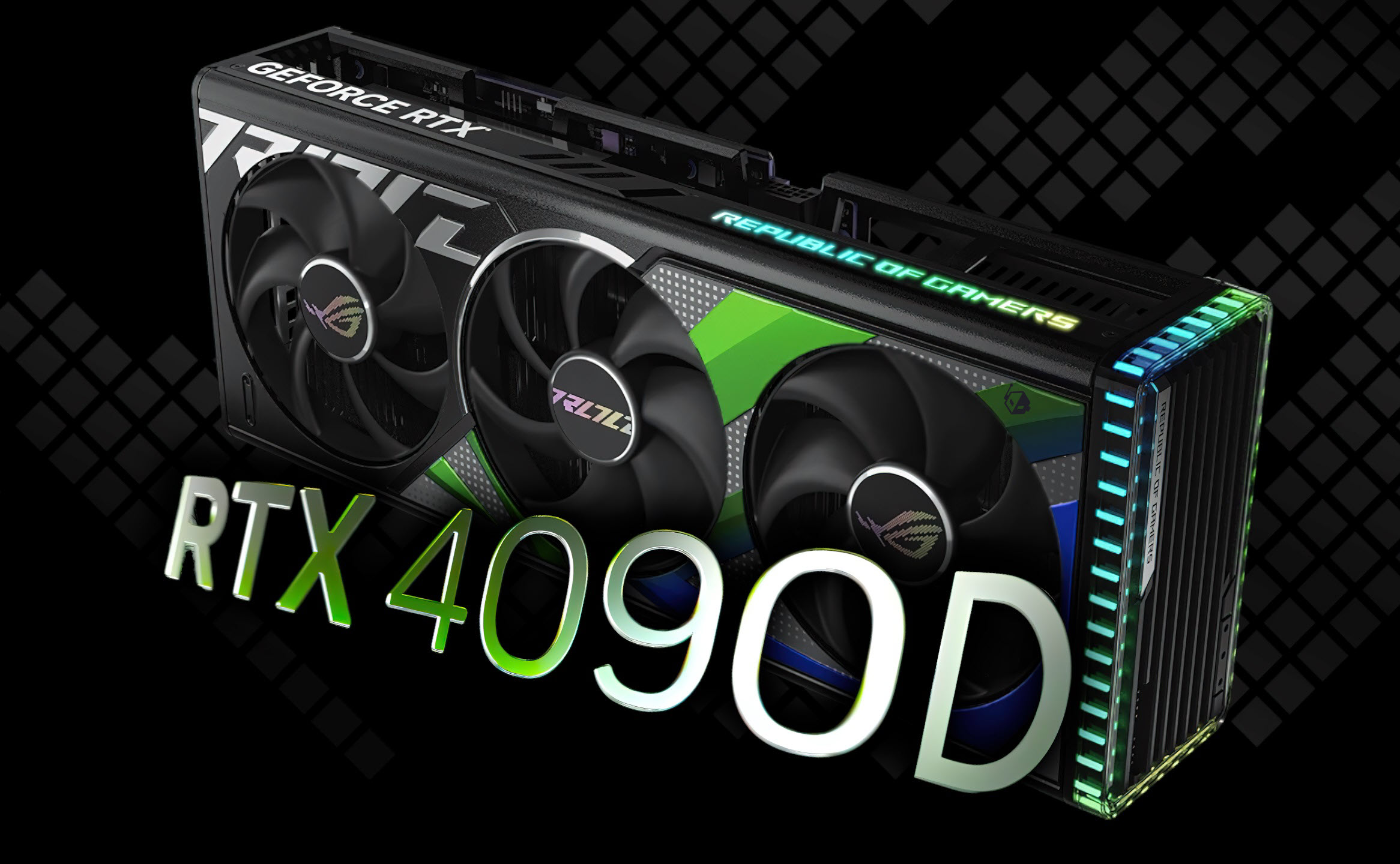
NVIDIA’s GeForce RTX 4090D graphics card, tailored for the Chinese market, has proven that restrictions aren’t a permanent setback when it comes to performance. Initially, there was a limitation imposed on factory overclocking for these GPUs, aligning with strict US export regulations, which meant that all associated brands were instructed to stick to the stock specifications provided by NVIDIA.
However, despite these handicaps, including lower clock speeds and power limits, the RTX 4090D managed to reach up to 95% of the performance of its full-fledged counterpart, the RTX 4090 Founders Edition—a testament to its robust engineering. Though retailing at a similar price point to the Founders Edition, the value proposition seemed questionable at first glance, given the lower performance ceiling.
Intriguingly, enthusiasts and experts alike have found that manual overclocking is still on the table for this GPU. For instance, the ASUS GeForce RTX 4090D ROG STRIX model was put under the microscope and demonstrated impressive results. Tests have revealed that the Total Graphics Power (TGP) of this variant can be unleashed from the factory-set 425W to an astonishing 600W—a 141% increase—using the ASUS GPU Tweak III application.
By default, the TGP boost alone provided a minor performance enhancement. However, once the GPU clock was manually tuned to an additional 200 MHz and the memory clock pushed up by 187 MHz, the capabilities of the card notably increased. Specifically, when operating with an unrestrained TGP, the card notched a 9.3% improvement in the 3DMark Speedway benchmark, surpassing the RTX 4090 FE in performance.
Additionally, another benchmark, the 3DMark Port Royal, reflected an 8.7% performance gain over the original settings. At its peak, the overclocked RTX 4090D touched 3045 MHz with a TGP of 558.4W, hinting at the fact that there’s more to these GPUs than their factory settings suggest.
While it’s still unclear how many other models can replicate the same level of TGP and overclocking flexibility, this information is undoubtedly a beacon of hope for gamers in China aiming for top-tier performance akin to the RTX 4090 FE. However, it’s worth noting that such performance gains do come with a cost, notably for the ASUS ROG STRIX OC variant, which comes with a hefty price tag of approximately 16,999 RMB or around $2350 US—$250 more than the MSRP in the United States.
For tech enthusiasts interested in pushing their NVIDIA GeForce RTX 4090D to match or exceed the capabilities of the RTX 4090 Founders Edition, here are some actionable steps:
1. **Understand the Baseline Performance**: Start by assessing the performance of your RTX 4090D at default settings. This gives you a baseline to compare your overclocking results against.
2. **Use Compatible Tools**: For adjustments, use a reliable overclocking software compatible with your GPU model, like the ASUS GPU Tweak III for ASUS models.
3. **Increase TGP**: If your model supports it, consider unlocking and increasing the Total Graphics Power to allow for higher performance.
4. **Adjust Clock Speeds**: Incrementally adjust the GPU and memory clock speeds while closely monitoring stability and temperature.
5. **Benchmark and Test**: Use benchmarking tools to measure performance gains and ensure system stability after each adjustment.
6. **Monitor Temperatures**: Keep a close eye on your GPU temperatures to prevent overheating, which could lead to hardware damage.
7. **Understand the Risks**: Overclocking can lead to increased wear and tear on components and may void warranties. Proceed with caution and understand the potential risks.
Remember, every GPU is different and results will vary. Overclocking requires patience, a careful hand, and in-depth knowledge of your system’s capabilities and cooling capacity. While the power and potential of the NVIDIA GeForce RTX 4090D are clear, unlocking it requires a bit of know-how and the willingness to push the boundaries of the card’s default limitations.