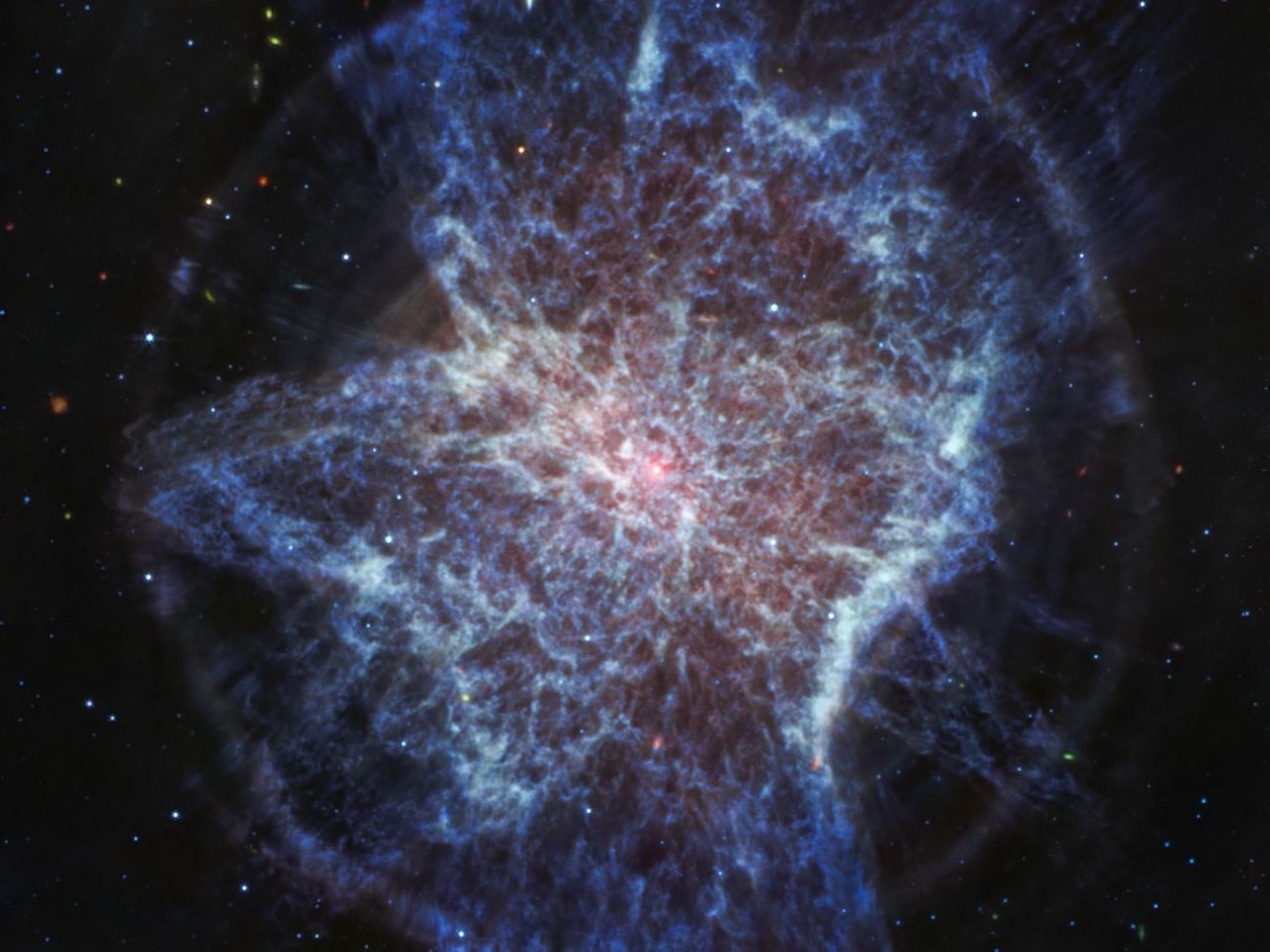
NASA’s James Webb Space Telescope has captured a captivating cosmic scene in the distant reaches of the universe. A striking pattern of concentric rings emerges from the central region of a dying star, as revealed by Webb’s Mid-Infrared Instrument (MIRI). This phenomenon hints at the presence of a secondary star, potentially influencing the patterns as gas or dust was ejected evenly in all directions, perhaps over thousands of years.
In the center of this celestial display is a small pinkish-white dot, believed to be the star orchestrating this cosmic dance. As this star cools and dims over time, it will gradually disperse into the interstellar medium, enriching it with heavier elements. These elements could eventually contribute to the birth of new stars and planets.
By providing such a detailed view of NGC 6072, Webb is revolutionizing our understanding of how complex planetary nebulae play a crucial role in enriching star-forming regions. The telescope’s recent achievements also include correcting misconceptions about Uranus, highlighting its pivotal role in advancing astronomical science.
Located about 3,000 light-years away, NGC 6072 is observable through a powerful telescope. For those eager to witness this marvel firsthand, a telescope like the Celestron NexStar 8 SE, with its 8-inch aperture, is recommended under optimal dark-sky conditions with minimal light pollution. This newfound glimpse into the universe beckons both amateur and seasoned astronomers to explore the wonders above.