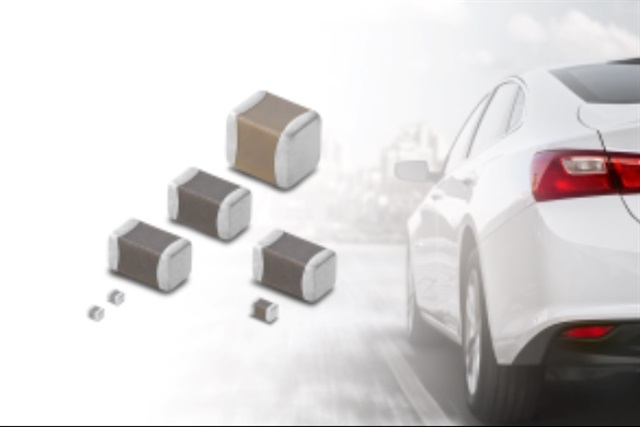
Murata Manufacturing, one of Japan’s best-known passive component makers, has started mass production of seven new multilayer ceramic capacitors (MLCCs) designed specifically for automotive use. The company says these parts deliver the world’s largest capacitance in their class, a development aimed squarely at the fast-growing needs of modern vehicles built around electrification, advanced driver-assistance systems, and the road to autonomous driving.
As cars add more sensors, cameras, radar modules, high-performance processors, and high-speed communication systems, the demand for dependable power stabilization increases sharply. MLCCs play a crucial role here by smoothing voltage fluctuations, reducing electrical noise, and helping sensitive electronics run reliably. In advanced automotive electronics, that stability can translate into better system performance and higher overall safety.
Murata’s move into mass production matters because it signals readiness for large-scale adoption by automakers and suppliers. Automotive-grade components must meet strict reliability standards, operate consistently under harsh temperature swings, and withstand vibration over long service lifetimes. By introducing multiple MLCC types at once, Murata is addressing a wider set of design requirements—giving engineers more options to balance capacitance, size, placement, and durability in crowded electronic control units and power-related modules.
These new MLCCs are positioned for the kinds of applications where capacity and reliability are especially important: computing platforms used for autonomous driving, power circuits that support electrified drivetrains, and the many control systems that now define the driving experience. As vehicles continue shifting toward software-defined architectures and higher power demands, components that can provide higher capacitance in compact footprints become increasingly valuable for both performance and packaging efficiency.
With mass production now underway, Murata is clearly betting that the next generation of vehicles will require not just more capacitors, but better ones—engineered for the tougher electrical environments of advanced automotive systems and capable of supporting the steady rise of autonomous and electrified technologies.