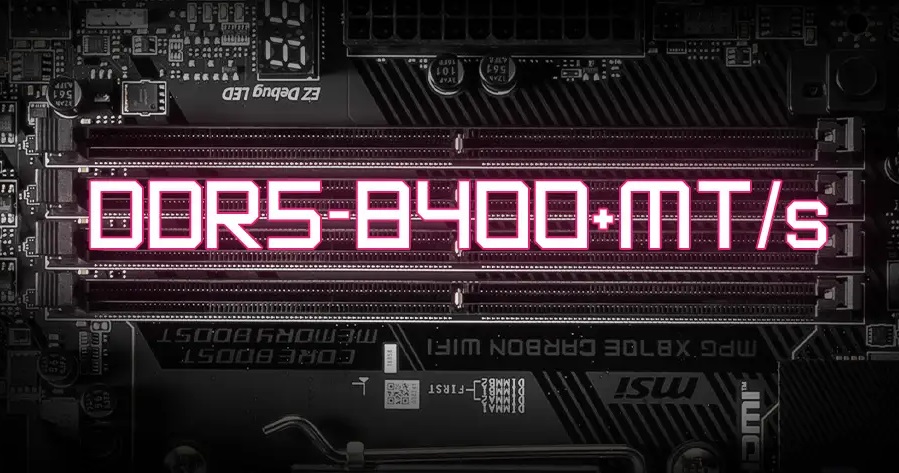
MSI is set to launch its X870E motherboards with innovative CUDIMM memory support, specifically for the AMD Ryzen 9000 and 8000 CPUs. However, at least initially, this groundbreaking feature will come with some limitations.
CUDIMM, short for Clocked Unbuffered Dual In-Line Memory Module, has gained traction among manufacturers due to its ability to significantly enhance memory transfer capabilities. This new memory standard leverages a Clock Driver (CKD) to regenerate clock signals, improving stability and allowing RAM modules to achieve higher frequencies. This dynamic approach helps in managing voltages and clock speeds more effectively. Notably, companies like Biwin, V-Color, and Asgard have already introduced CUDIMM solutions that push speeds up to an impressive 9,600 MT/s.
There’s been widespread curiosity among tech enthusiasts about whether AMD’s upcoming Ryzen 9000 series CPUs would support CUDIMM. MSI’s representative and renowned in-house overclocker, TOPPC, recently confirmed that their new X870E platform will feature CUDIMM compatibility. However, this will be limited to the Ryzen 9000 and 8000 series, with the Ryzen 7000 series missing out due to compatibility concerns.
In a recent YouTube update, TOPPC revealed that MSI plans to tweak the onboard memory slots to support CUDIMM, alongside the new CAMM 2 standards. Initially, though, the motherboards might not achieve the highest speeds like 10,000 MT/s. Early adopters may need to adjust their expectations as these motherboards could boot up with lower frequencies initially, stabilizing at higher speeds as the technology becomes more widespread.
Interestingly, Intel’s upcoming Arrow Lake-S processors are also expected to support CUDIMM, thanks to the onboard “GEAR 2” configuration, which enables the memory to function at double the processor’s memory clock speeds. This creates a competitive landscape where both AMD’s Zen 5 CPUs and Intel’s offerings will utilize CUDIMM, bringing them to a level playing field in terms of memory performance.
While MSI has denoted their X870 platform’s CUDIMM compatibility, it’s still unclear whether this will be an exclusive feature to MSI or if other manufacturers will follow its lead. This bold step could mark the beginning of a broader industry shift towards faster, more efficient memory solutions. Keep an eye on MSI and other tech giants as they continue to push the boundaries of what’s possible in computing technology.


