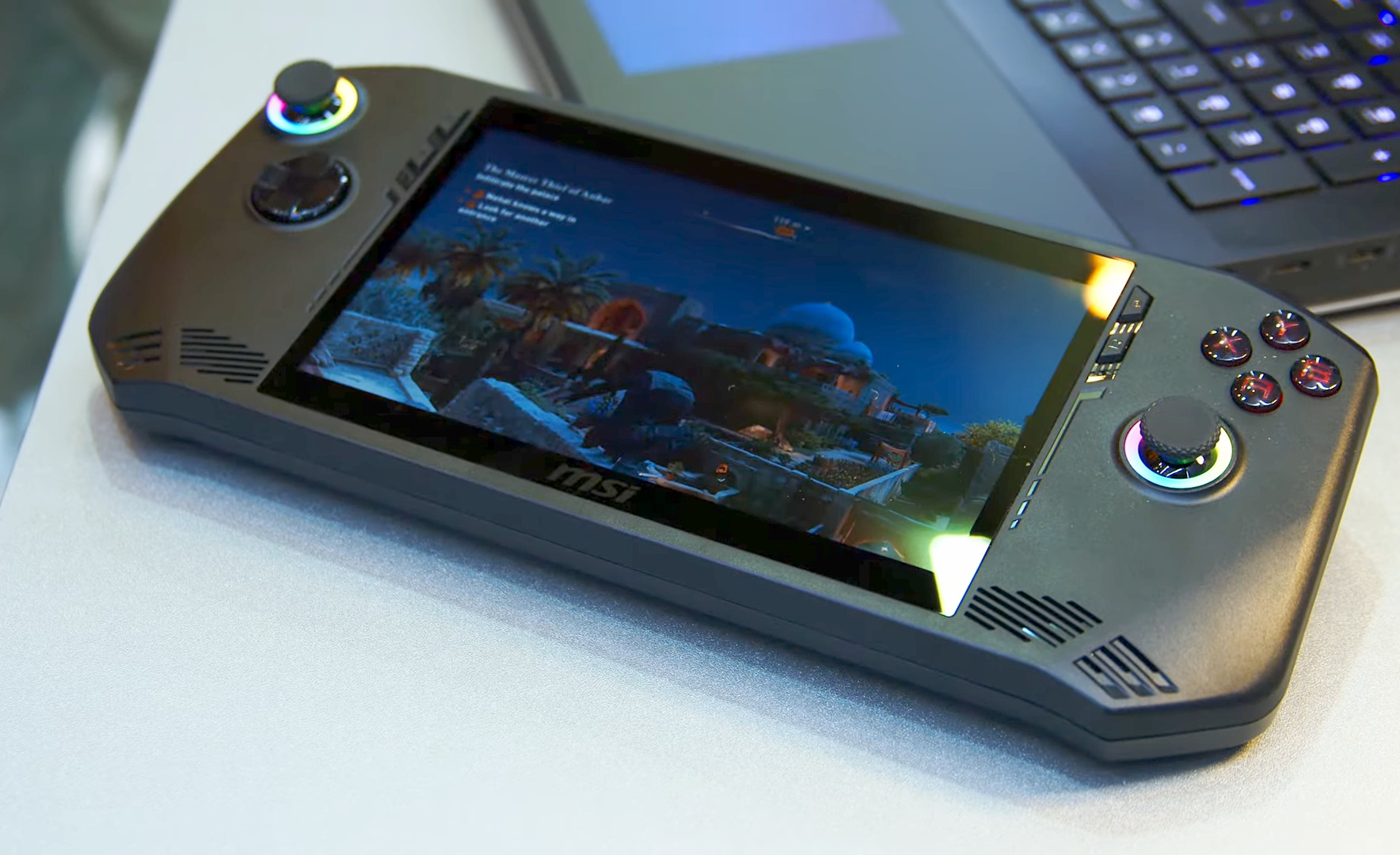
The landscape of gaming handhelds, which has been under AMD’s influence with CPUs such as the Ryzen 7 7840U and Ryzen Z1 Extreme, is on the cusp of change with Intel’s entry via its new Meteor Lake series. One key player heralding this shift is the MSI Claw A1M.
Unlike handhelds like the Asus ROG Ally and the Lenovo Legion Go, which shine brightest when equipped with AMD’s top-tier Ryzen Z1 Extreme CPU, Intel’s Core Ultra CPU series offers greater versatility. The MSI Claw A1M benefits from a mid-range CPU that is capable of harnessing the eight-core prowess of Intel’s Arc iGPU.
The strategy of choosing mid-tier processors for mid-range gaming systems has held strong because flagship CPUs often provide minimal performance gains for a premium cost. Fortunately for the MSI Claw A1M, selecting a mid-range CPU gives it an efficiency advantage, possibly translating into enhanced battery life, without sacrificing much in the way of performance when compared to the Core Ultra 7 CPU.
When evaluating the Intel Core Ultra 5 135H against the Core Ultra 7 155H, the distinction is not stark. The Core Ultra 5 135H has two fewer performance cores than the Core Ultra 7 but maintains the same number of Efficient-cores and Low Power Efficient-cores, thus only slightly differing in terms of raw power.
Both CPUs share the same power specifications, sustaining up to 65 W with a limit of 155 W. Additionally, although the Core Ultra 5 135H has a 200 MHz lower turbo frequency than the Core Ultra 7, it enjoys a 300 MHz higher base frequency, bringing it to a baseline of 1.7 GHz. This means the Core Ultra 5 135H is just as competent, if not more so, in applications that aren’t heavily reliant on multi-threading, which typically includes most gaming scenarios.
Given their shared iGPU and power envelope, along with the Core Ultra 5 135H’s fewer CPU cores, this processor is a prime choice for graphics-intensive tasks, like gaming. In the compact space of a handheld device, achieving very high frame rates without CPU bottlenecks is more realistic. Moreover, the lower core count could allow each core to run at higher clock speeds with reduced power demands.
This could also allow for more power to be funneled to the iGPU, potentially enhancing graphical performance due to the additional energy budget. While users could theoretically manage power allocation on CPUs like the Core Ultra 7 155H through software, configuring silicon for this purpose is likely more effective.
Importantly, the 8-Core Arc iGPU on the Core Ultra 5 135H significantly outperforms the custom GPU on other handhelds such as the Steam Deck, providing superior graphics capability in the MSI Claw.
The critical aspect for both Intel and MSI will be the management of power consumption of their CPU and iGPU combinations. If users are provided with the flexibility to modify settings such as TDP in real-time, the MSI Claw A1M powered by the Intel Core Ultra 5 135H has the potential to deliver outstanding value, marrying battery longevity with robust gaming performance.