Micro Center reportedly asks RTX 5090 buyers to sign a no-export declaration
Buying an NVIDIA GeForce RTX 5090 is no longer just a matter of finding stock and paying at checkout. As demand for the flagship graphics card continues to outpace supply, some retailers are reportedly adding extra steps before completing a sale.
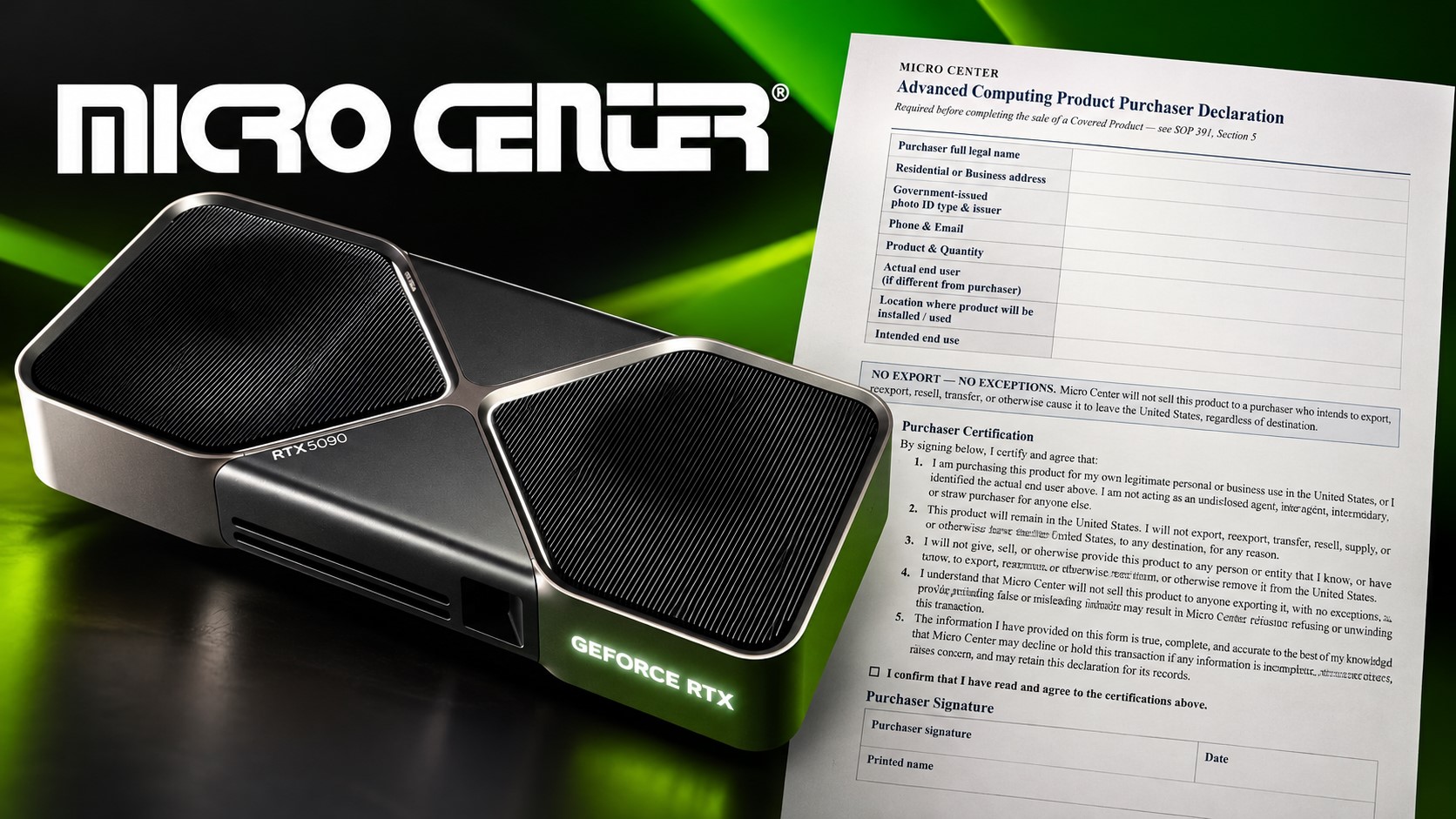
Micro Center has allegedly started asking certain RTX 5090 customers to complete a Purchaser Declaration form. The move appears aimed at limiting exports, resales, and transfers of the high-end GPU outside the United States, especially as global demand and inflated pricing continue to fuel a heated resale market.
The GeForce RTX 5090 launched with a starting price of $1,999, but real-world pricing has climbed dramatically in many regions. In some markets, the card is reportedly selling for more than $5,000, making it one of the most expensive consumer gaming GPUs available. Despite the extreme pricing, demand remains intense, with enthusiasts, professionals, resellers, and AI-focused buyers all competing for limited inventory.
According to a customer report shared online, a buyer purchasing a PowerSpec Ai90 prebuilt PC equipped with an RTX 5090 was asked by Micro Center to provide a driver’s license and fill out a declaration form before the transaction could be completed.
The form reportedly includes a strict “NO EXPORT” policy. It states that Micro Center will not sell the graphics card to anyone intending to export, reexport, resell, or transfer it outside the United States. Buyers must also confirm that the GPU will be used only for personal or business purposes within the U.S.
The declaration further states that if a customer provides false or misleading information, Micro Center may refuse the sale or reverse the transaction.
This policy appears to be part of a broader effort to prevent restricted hardware from reaching regions where sales of the RTX 5090 may be banned or limited. China is one of the key markets often discussed in connection with high-end GPU restrictions, particularly because powerful graphics processors can be repurposed for artificial intelligence workloads.
However, whether declaration forms can meaningfully stop gray-market activity remains uncertain. High-demand GPUs have historically found their way into restricted markets through resellers, bulk buyers, and unofficial distribution channels. In some cases, high-end gaming cards are reportedly dismantled, with their GPU and memory chips removed and installed onto custom circuit boards designed for AI use.
For regular PC gamers and workstation users, the added paperwork may feel unusual, but it reflects how valuable and difficult to obtain the RTX 5090 has become. What was once a premium gaming product is now caught between gaming demand, AI demand, export controls, and a global shortage-driven resale market.
The RTX 5090 remains one of the most sought-after graphics cards in the world, but buyers may now face more than just high prices and limited availability. At least at some retail locations, purchasing NVIDIA’s flagship GPU could also require identity verification and a signed promise that the card will stay in the United States.