Maxsun brings Intel Panther Lake and Wildcat Lake chips to desktop motherboards with new MoTD designs
Maxsun is pushing mobile silicon into a new desktop direction with its latest MoTD motherboards, bringing Intel Panther Lake and Wildcat Lake processors into standard PC configurations. The company has introduced new “Mobile on Desktop” designs that allow Intel’s latest mobile-focused chips to be used in systems that look and function more like traditional desktops, compact workstations, or storage-focused builds.
The highlight is that Maxsun appears to be among the first PC hardware makers to showcase Intel Panther Lake and Wildcat Lake MoTD motherboards, with configurations reaching up to the Intel Core Ultra X9 388H. These platforms are designed to take mobile SoCs that are typically found in laptops and mini PCs and place them on desktop-style motherboards with expanded storage, networking, and PCIe options.
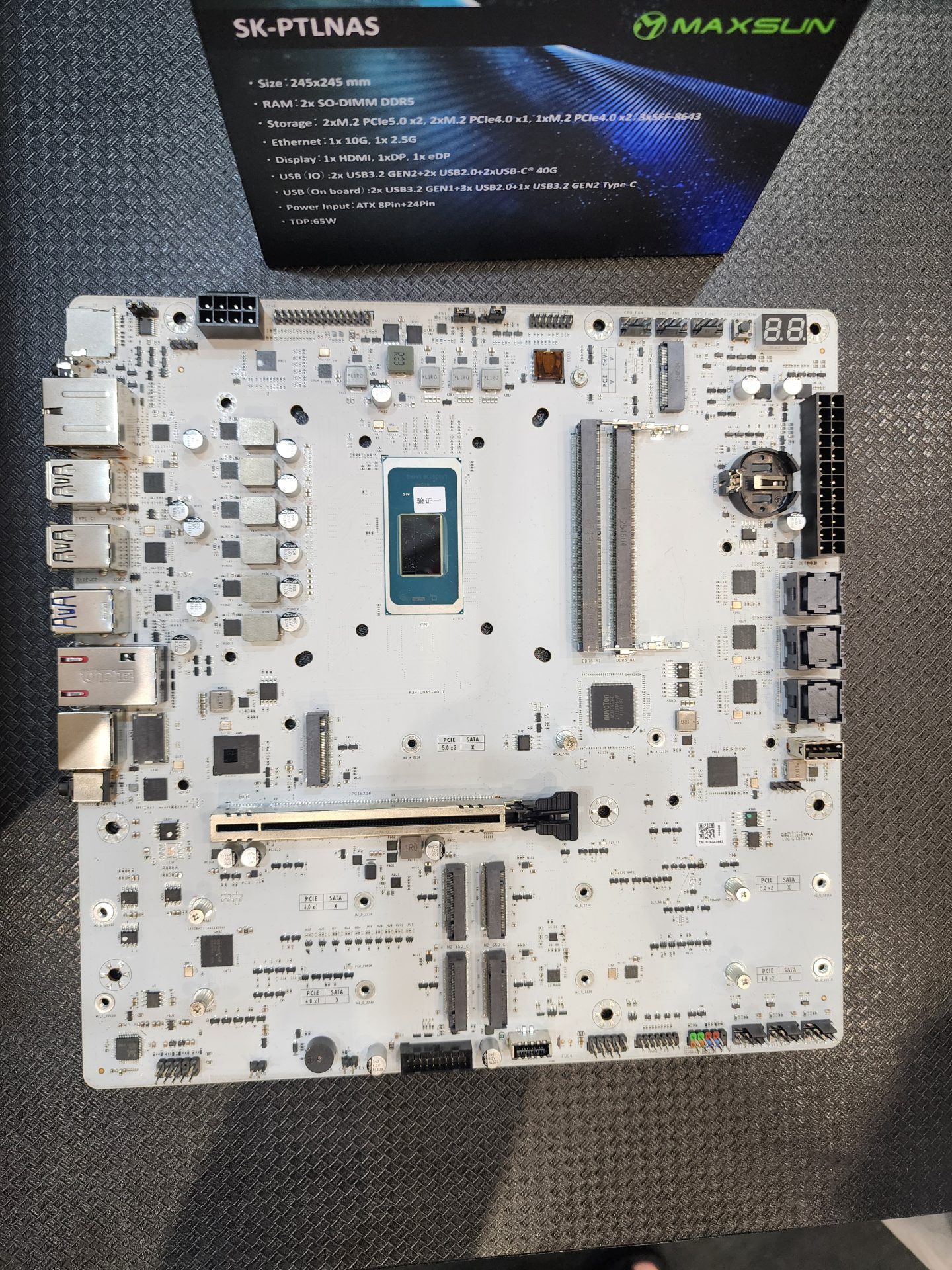
At Computex, Maxsun displayed two new MoTD motherboard designs. The more powerful model is the SK-PTLNAS, a Panther Lake-based board aimed primarily at NAS and storage-heavy systems. Despite its NAS-oriented positioning, the board uses a standard ATX layout, meaning it can also fit into a conventional desktop case. That makes it an interesting option for users who want the efficiency of a mobile processor but still need the flexibility of a full-sized motherboard.
The SK-PTLNAS is built around Intel Core Ultra Series 3 Panther Lake SoCs. Maxsun indicated that the platform can scale up to the flagship Core Ultra X9 388H, giving the board room for high-performance configurations. The model shown on the exhibition floor used a Core Ultra 7 356H, featuring 8 cores, 8 threads, and integrated Xe3 graphics with 4 GPU cores.
For power, the Panther Lake MoTD board maintains a 65W TDP and uses a single 8-pin power connector. This should make it easier to integrate into desktop-style systems while keeping power requirements relatively manageable compared with many full desktop CPU platforms.
The motherboard itself is designed with a 6+4 phase VRM layout and includes two SO-DIMM slots supporting DDR5 memory capacities of up to 128GB. This is a strong fit for NAS, home server, and compact workstation users who need high memory capacity without moving to a much larger or more power-hungry setup.
Storage is one of the biggest strengths of the SK-PTLNAS. The board includes a full-length PCIe Gen5 x16 slot, along with five M.2 SSD slots. These include two Gen5 x2 slots, two Gen4 x1 slots, and one Gen4 x2 slot. There is also another slot positioned at the top of the board that can support Wi-Fi modules. For users building a storage server, media system, or high-speed local backup machine, the inclusion of three Mini SAS ports adds even more expansion potential.
Maxsun has also given the board a distinctive visual design with a white PCB, making it stand out from the typical dark-colored server and desktop motherboards. Practical onboard features include debug LEDs and buttons for clearing CMOS, which can be helpful for builders, system integrators, and enthusiasts who regularly test hardware configurations.
Connectivity is another strong point. An ASMedia controller enables two USB-C 40Gbps ports, joined by two USB 3.2 Gen2 ports and two USB 2.0 ports on the rear I/O. Internal USB headers include two USB 3.2 Gen1 ports, three USB 2.0 ports, and one USB 3.2 Gen2 Type-C connection. Networking is handled by both 10GbE and 2.5GbE LAN, making the board especially appealing for NAS builds, high-speed file transfers, and home lab environments.
Alongside the Panther Lake design, Maxsun also revealed a second MoTD motherboard using Intel Core Series 3 Wildcat Lake SoCs. This board is a more entry-level design and comes in a compact mATX form factor. It is aimed at lower-power systems where efficiency, size, and simplicity matter more than extreme expansion.
The Wildcat Lake MoTD motherboard includes a single SO-DIMM DDR5 memory slot, expected to support up to 32GB of RAM. Power delivery is handled by a 4+2 phase VRM design, which is suitable for the lower power requirements of this platform. The board supports a maximum TDP of 28W, making it a good candidate for compact desktops, office PCs, embedded systems, digital signage, and lightweight home server use.
Storage options on the Wildcat Lake board are more modest than the Panther Lake model, with one PCIe Gen4 x4 M.2 slot and one SATA III port. Rear USB connectivity includes two USB 3.2 Gen1 ports and two USB 2.0 ports, while onboard headers provide one USB 3.2 Gen2 Type-C port and three USB 2.0 ports. The board is powered through a 12V DC jack, further reinforcing its focus on small, efficient, low-power systems.
These new Maxsun MoTD motherboards show how mobile processors are becoming increasingly relevant outside laptops. By combining mobile Intel SoCs with desktop-style expansion, Maxsun is creating platforms that could appeal to users who want quieter operation, lower power consumption, and strong integrated performance without giving up storage flexibility or desktop compatibility.
In addition to the new MoTD motherboards, Maxsun also showed two new Intel Arc Pro B65 graphics card options. One model uses a Turbo-style blower cooler, while the other is a fully passive fanless version. Both cards use a single-slot design and include one 16-pin 12V-2×6 power connector to support a 200W TDP.
The combination of Panther Lake, Wildcat Lake, high-speed networking, PCIe expansion, and compact GPU options suggests that Maxsun is targeting a wide range of builders, from NAS enthusiasts and small workstation users to businesses looking for efficient desktop systems. With these new MoTD designs, mobile-on-desktop hardware could become a more practical alternative for users who want laptop-class efficiency in a more expandable PC format.