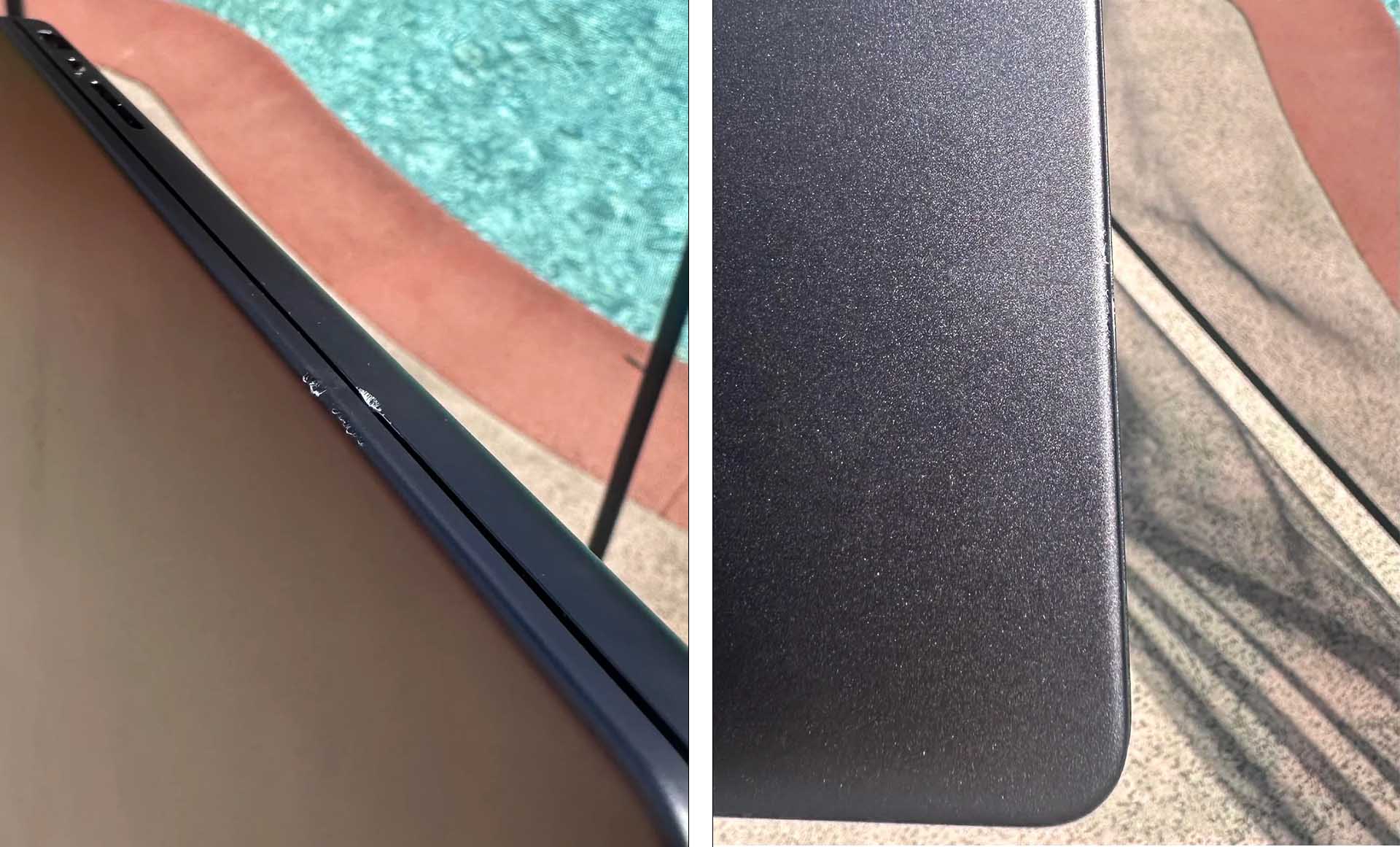
Dropping a laptop down a staircase is usually the kind of accident that ends with shattered screens, dented corners, and a sudden shopping trip for a replacement. But one recent MacBook Pro mishap is reminding people why aluminum unibody laptops have such a strong reputation for durability.
A MacBook Pro owner shared that they accidentally sent their nearly new laptop flying out of an unzipped backpack. The machine reportedly launched about 13 feet forward, struck the edge of a stair step, and then tumbled the rest of a roughly 25-step staircase. The laptop was inside a soft sleeve intended mainly to prevent scuffs in a backpack, but the sleeve actually tore at the point of impact—setting expectations that the computer itself would be “completely obliterated.”
Instead, the MacBook Pro appeared to escape with surprisingly minor cosmetic damage. Photos show scuffs and small missing bits on the casing, but nothing like the deep dents, cracked glass, or warped panels many laptops would suffer from a fall of that height and violence. The owner noted the biggest functional change was that the display now sits slightly misaligned—shifted about a millimeter to the left relative to the base—yet the screen itself wasn’t visibly damaged. Even so, they plan to use their coverage deductible for repair because the marks and slight crookedness are bothersome.
Stories like this are often used to highlight the advantage of a solid aluminum chassis. A rigid unibody design can help distribute impact forces better than many plastic or mixed-material builds, reducing the chance of catastrophic external failure. It’s the same idea behind why so many people associate premium notebooks with sturdier everyday resilience.
That said, a laptop can look fine on the outside and still have issues internally. While modern MacBook Pros have relatively few moving parts beyond the fans, a hard impact can still cause problems that don’t show up immediately. There’s also the question of the cooling system: heatpipes, typically made with copper, can potentially bend or deform because the metal is malleable. If a heatpipe is damaged, cooling performance could degrade over time, which might lead to throttling, higher temperatures, or instability under heavy workloads. Other internal concerns after a violent drop can include loosened connectors, stress on the logic board, or subtle changes to the hinge and display assembly that worsen with use.
For anyone who experiences a similar accident, it’s smart to watch for warning signs over the following days: new rattling noises, fan behavior changes, unexpected slowdowns, overheating, display oddities, or charging/port issues. Even if the damage looks purely cosmetic, a thorough inspection during a repair visit can confirm whether everything inside is still operating as it should.
In this case, the takeaway is simple: the MacBook Pro’s build quality likely saved it from a far worse outcome. A fall down an entire stairwell with forward momentum is about as punishing as real-world accidents get—and the fact that this one ended with mostly scratches is exactly the kind of durability moment that keeps the MacBook Pro’s reputation for toughness alive.