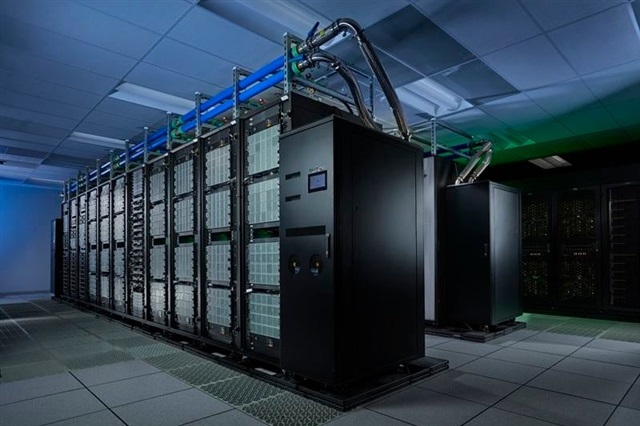
Cornelis Networks has announced that the Lynx supercomputing cluster is now in service at the U.S. Department of Energy’s Lawrence Livermore National Laboratory, strengthening the lab’s advanced computing capabilities and marking an important step forward for high-performance networking technology.
The deployment is a major milestone for Cornelis Networks and its CN5000 Omni-Path networking platform, which is designed to support the demanding workloads found in modern supercomputing environments. By powering high-speed communication across the Lynx cluster, the platform helps researchers move massive amounts of data quickly and efficiently, a key requirement for large-scale scientific simulations, national security research, artificial intelligence workloads, and complex modeling tasks.
Lawrence Livermore National Laboratory is one of the nation’s leading centers for advanced scientific computing, and the addition of Lynx expands the computing resources available to the National Nuclear Security Administration. These systems play a critical role in supporting mission-driven research, including stockpile stewardship, predictive modeling, materials science, energy research, and other computationally intensive projects.
For supercomputing systems, raw processing power is only part of the equation. The network connecting thousands of processors must deliver low latency, high bandwidth, and reliable performance under heavy workloads. Cornelis Networks’ CN5000 Omni-Path technology is built to address these challenges, enabling faster communication between compute nodes and helping researchers complete simulations and data analysis more efficiently.
The launch of Lynx also highlights the growing importance of scalable interconnect solutions as laboratories and research institutions prepare for increasingly complex workloads. As artificial intelligence, machine learning, and high-resolution simulations become more central to scientific discovery, supercomputing clusters require networking systems that can keep pace with rapid data movement and parallel processing demands.
Cornelis Networks’ involvement in the Lynx deployment reinforces its position in the high-performance computing market. With the CN5000 Omni-Path platform now supporting a major national laboratory system, the company gains an important reference point for its technology in mission-critical environments.
The successful deployment of the Lynx supercomputing cluster at Lawrence Livermore National Laboratory represents more than a hardware upgrade. It is a step toward faster scientific discovery, stronger national research infrastructure, and more capable computing systems for some of the most demanding workloads in the world.